
Towards Robust Communication in ITS: A Comprehensive Study of Blockchain for V2I
15th International Conference on Ubiquitous and Future Networks (ICUFN 2024), Budapest, Hungary, Jul 2, 2024
DOI: 10.1109/ICUFN61752.2024.10624948
Summary in three lines
- The study considers how to maintain an infrastructure-based blockchain as connected vehicles move.
- The proposed framework balances membership management across cooperating nodes.
- An integrated traffic, network, and blockchain simulation measures latency and membership changes with one roadside unit.
Figures from the paper
Abstract
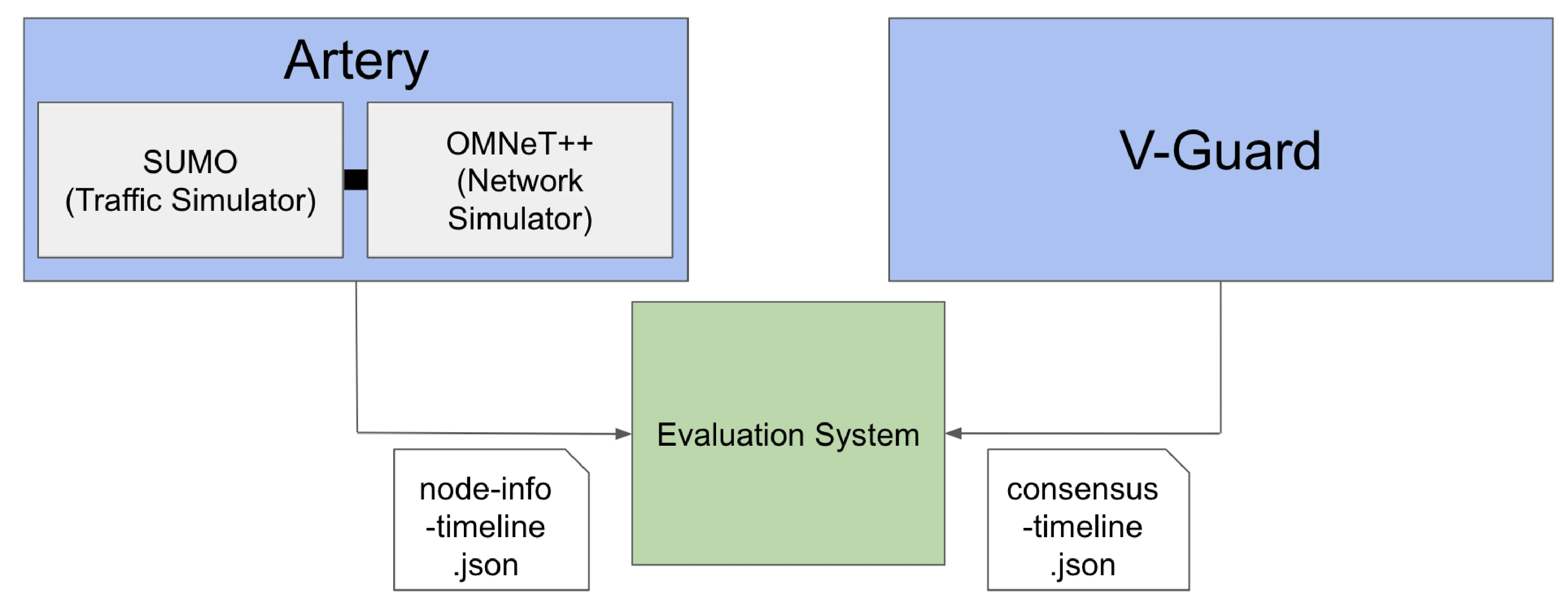
V2X in connected autonomous vehicles (CAV) plays an important role in information sharing through communication. The integration of V2X and blockchain has the potential to create functionalities such as seamless V2X information sharing, similar to Bitcoin, and post-accident investigation utilities that leverage data immutability. However, the integration of blockchain into V2X communication requires addressing CAV mobility. In this study, we propose a framework that takes into account the high mobility of CAVs. Furthermore, we propose a method that not only addresses this challenge but also achieves load balancing by facilitating cooperation among nodes responsible for member management. In this paper, we integrate the ITS simulator, the communication simulator, and the blockchain simulator to build an infrastructure that can be evaluated end-to-end. Using the integrated simulator, we perform an evaluation based on metrics such as latency and member change rate in a mobile environment with a single roadside unit (RSU). In the future, we plan to implement the proposed methodology and perform evaluations in environments with multiple RSUs.
How to cite
A. Yoshimura, J. Nakazato, M. Tsukada, and H. Esaki, “Towards Robust Communication in ITS: A Comprehensive Study of Blockchain for V2I,” in 15th International Conference on Ubiquitous and Future Networks (ICUFN 2024), Budapest, Hungary, 2024, doi: 10.1109/ICUFN61752.2024.10624948.
BibTeX
@inproceedings{Yoshimura2024,
  title         = {Towards Robust Communication in ITS: A Comprehensive Study of Blockchain for V2I},
  author        = {Atsuki Yoshimura and Jin Nakazato and Manabu Tsukada and Hiroshi Esaki},
  doi           = {10.1109/ICUFN61752.2024.10624948},
  year          = {2024},
  date          = {2024-07-02},
  urldate       = {2024-07-02},
  booktitle     = {15th International Conference on Ubiquitous and Future Networks (ICUFN 2024)},
  address       = {Budapest, Hungary},
  abstract      = {V2X in connected autonomous vehicles (CAV) plays an important role in information sharing through communication. The integration of V2X and blockchain has the potential to create functionalities such as seamless V2X information sharing, similar to Bitcoin, and post-accident investigation utilities that leverage data immutability. However, the integration of blockchain into V2X communication requires addressing CAV mobility. In this study, we propose a framework that takes into account the high mobility of CAVs. Furthermore, we propose a method that not only addresses this challenge but also achieves load balancing by facilitating cooperation among nodes responsible for member management. In this paper, we integrate the ITS simulator, the communication simulator, and the blockchain simulator to build an infrastructure that can be evaluated end-to-end. Using the integrated simulator, we perform an evaluation based on metrics such as latency and member change rate in a mobile environment with a single roadside unit (RSU). In the future, we plan to implement the proposed methodology and perform evaluations in environments with multiple RSUs.},
  keywords      = {ITS},
  pubstate      = {published},
  tppubtype     = {inproceedings}
}