
Towards Robust & Secure Blockchain-based Communications in ITS
IEEE Transactions on Vehicular Technology, pp. 1–15, Oct 8, 2025
Summary in three lines
- The paper studies reliable blockchain-based data exchange for moving vehicles and roadside units.
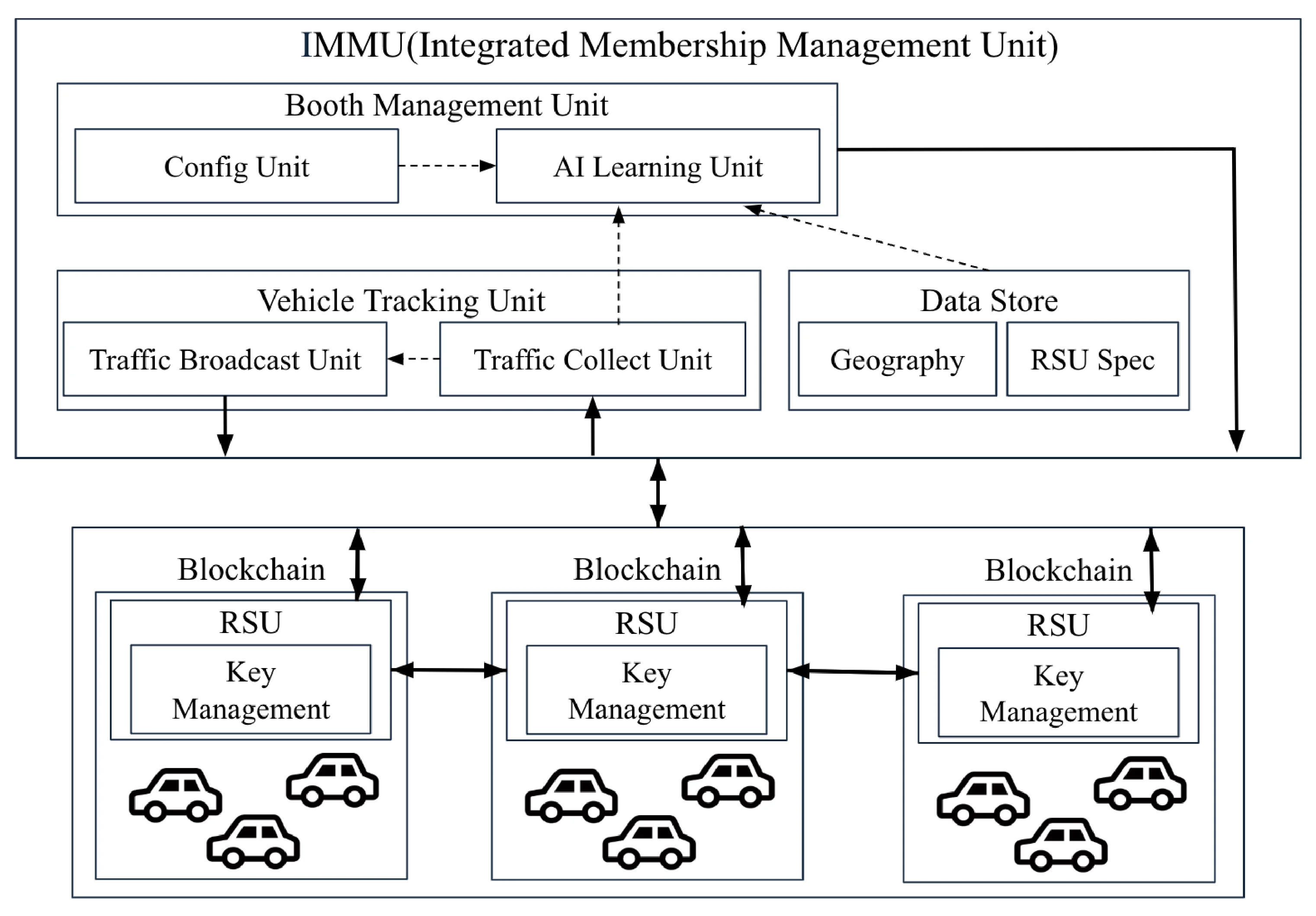
- Its membership management unit coordinates roadside nodes and uses reinforcement learning to balance the load.
- Evaluation measures how that coordination affects consensus performance under vehicle mobility and congestion.
Figures from the paper
Abstract
In Intelligent Transportation Systems (ITS), the limited perception range of individual connected autonomous vehicles (CAVs) necessitates the collaborative utilization of information detected by nearby vehicles and roadside units (RSUs) to achieve accurate environmental perception and awareness, which relies on reliable data transmission among involved entities. Blockchain technology has been widely recognized for its effectiveness in ensuring secure and trustworthy data exchange, with its importance rapidly increasing across various industries. However, traditional blockchain approaches have not fully addressed the dynamic mobility scenarios of CAV environments or the efficient coordination among multiple RSUs. To address these challenges, this paper proposes an Integrated Membership Management Unit (IMMU) system utilizing blockchain technology to facilitate secure vehicle-to-infrastructure (V2I) communication among multiple CAVs and RSUs, which enables RSUs to cooperate effectively and uses reinforcement learning to achieve optimal load balancing. The performance and effectiveness of our proposed approach have been thoroughly evaluated through an end-to-end simulation.
How to cite
A. Yoshimura, Y. Chen, J. Nakazato, T. Taleb, M. Tsukada, and H. Esaki, “Towards Robust & Secure Blockchain-based Communications in ITS,” IEEE Transactions on Vehicular Technology, pp. 1–15, 2025, doi: 10.1109/TVT.2025.3619191.
BibTeX
@article{Yoshimura2025,
  title         = {Towards Robust & Secure Blockchain-based Communications in ITS},
  author        = {Atsuki Yoshimura and Yan Chen and Jin Nakazato and Tarik Taleb and Manabu Tsukada and Hiroshi Esaki},
  doi           = {10.1109/TVT.2025.3619191},
  isbn          = {1939-9359},
  year          = {2025},
  date          = {2025-10-08},
  urldate       = {2025-10-08},
  journal       = {IEEE Transactions on Vehicular Technology},
  pages         = {1--15},
  abstract      = {In Intelligent Transportation Systems (ITS), the limited perception range of individual connected autonomous vehicles (CAVs) necessitates the collaborative utilization of information detected by nearby vehicles and roadside units (RSUs) to achieve accurate environmental perception and awareness, which relies on reliable data transmission among involved entities. Blockchain technology has been widely recognized for its effectiveness in ensuring secure and trustworthy data exchange, with its importance rapidly increasing across various industries. However, traditional blockchain approaches have not fully addressed the dynamic mobility scenarios of CAV environments or the efficient coordination among multiple RSUs. To address these challenges, this paper proposes an Integrated Membership Management Unit (IMMU) system utilizing blockchain technology to facilitate secure vehicle-to-infrastructure (V2I) communication among multiple CAVs and RSUs, which enables RSUs to cooperate effectively and uses reinforcement learning to achieve optimal load balancing. The performance and effectiveness of our proposed approach have been thoroughly evaluated through an end-to-end simulation.},
  keywords      = {ITS},
  pubstate      = {published},
  tppubtype     = {article}
}