
Trajectory Planning and Task Scheduling for UAVs in Dynamic Environments Using Feature-Driven Multi-Agent Reinforcement Learning
IEEE Transactions on Mobile Computing, Oct 31, 2026
Summary in three lines
- The method jointly plans UAV delivery routes and allocates edge-computing tasks to serve ground devices.
- Alternative graph and point-cloud encoders give the multi-agent controller features of its current environment.
- On unseen simulated maps, both variants cut completion time, collisions and edge-computing latency versus MASAC.
Figures from the paper
Abstract
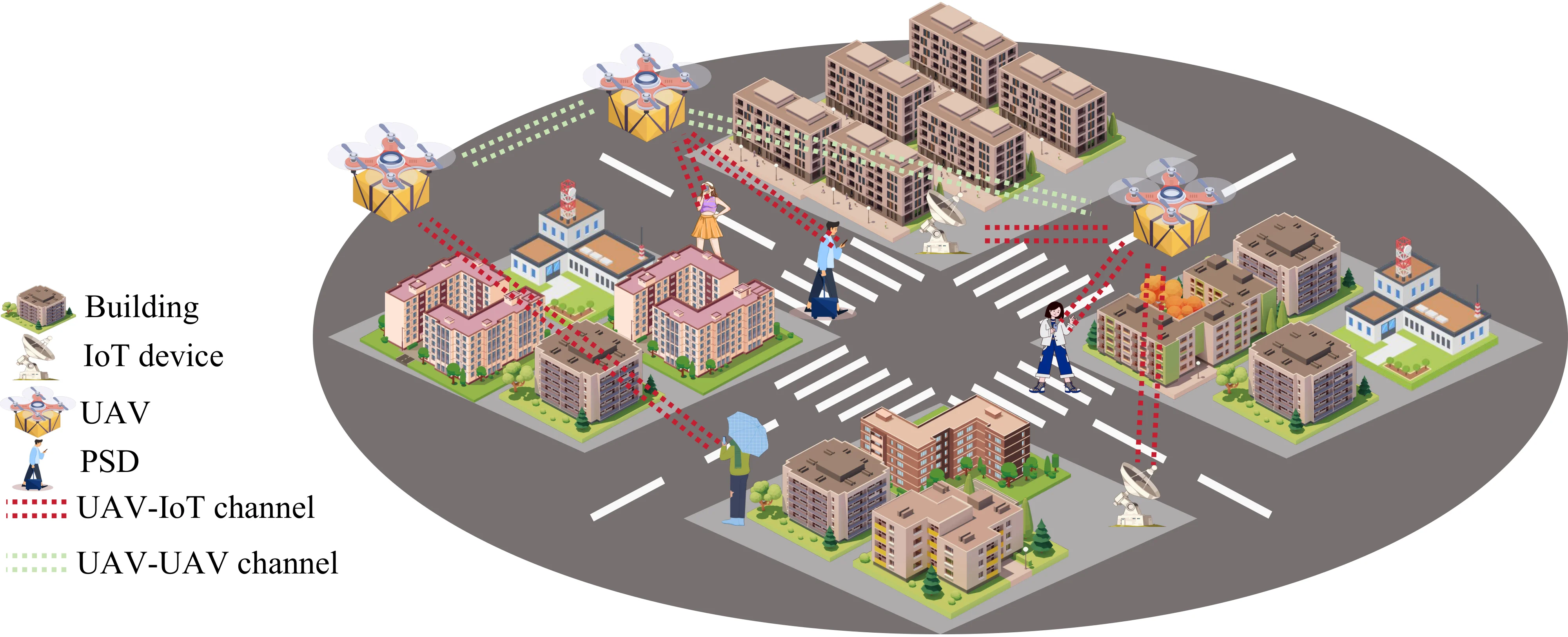
Unmanned Aerial Vehicles (UAVs) can simultaneously perform material delivery over the air and provide MEC service to ground Internet of Things (IoT) devices. However, most existing research considers trajectory planning and task scheduling problems separately in homogeneous environments. In addition, the computational complexity and dynamically changing environmental factors, including building distributions, pedestrian trajectories, IoT device positions, and UAV start points and destinations, add to the complexity of the problems. To jointly optimize UAV trajectory planning and task scheduling with generalization ability, two novel Multi-Agent Reinforcement Learning (MARL) algorithms are proposed: Graph Neural Network-based Feature-Driven (GNNFD)-MARL and Point Cloud Network-based Feature-Driven (PCNFD)-MARL. GNNFD-MARL establishes a connectivity graph between UAVs, ground users, IoT devices, and base stations to guide model training. Meanwhile, PCNFD-MARL utilizes point cloud features derived from the varying distribution of users and IoT devices in different areas and times to assist joint decisions. Both approaches extract environmental features to generate self-adaptive policies suitable for diverse scenarios. Furthermore, the MARL frameworks based on actor-critic architecture are enhanced by improving both actor and critic networks. Experimental results demonstrate that both algorithms exhibit similar convergence properties and task performance, outperforming existing MARL methods. Furthermore, they exhibit distinct time efficiencies under different settings.
How to cite
Q. Zhou, W. Mao, Y. Liang, Y. Liu, M. Tsukada, J. Crowcroft, J. C. S. Lui, and Y. Ji, “Trajectory Planning and Task Scheduling for UAVs in Dynamic Environments Using Feature-Driven Multi-Agent Reinforcement Learning,” IEEE Transactions on Mobile Computing, 2026, doi: 10.1109/TMC.2026.3750340.
BibTeX
@article{Zhou2026e,
  title         = {Trajectory Planning and Task Scheduling for UAVs in Dynamic Environments Using Feature-Driven Multi-Agent Reinforcement Learning},
  author        = {Quanxi Zhou and Wencan Mao and Yilei Liang and Yixuan Liu and Manabu Tsukada and Jon Crowcroft and John C. S. Lui and Yusheng Ji},
  doi           = {10.1109/TMC.2026.3750340},
  year          = {2026},
  date          = {2026-10-31},
  urldate       = {2026-10-31},
  journal       = {IEEE Transactions on Mobile Computing},
  abstract      = {Unmanned Aerial Vehicles (UAVs) can simultaneously perform material delivery over the air and provide MEC service to ground Internet of Things (IoT) devices. However, most existing research considers trajectory planning and task scheduling problems separately in homogeneous environments. In addition, the computational complexity and dynamically changing environmental factors, including building distributions, pedestrian trajectories, IoT device positions, and UAV start points and destinations, add to the complexity of the problems. To jointly optimize UAV trajectory planning and task scheduling with generalization ability, two novel Multi-Agent Reinforcement Learning (MARL) algorithms are proposed: Graph Neural Network-based Feature-Driven (GNNFD)-MARL and Point Cloud Network-based Feature-Driven (PCNFD)-MARL. GNNFD-MARL establishes a connectivity graph between UAVs, ground users, IoT devices, and base stations to guide model training. Meanwhile, PCNFD-MARL utilizes point cloud features derived from the varying distribution of users and IoT devices in different areas and times to assist joint decisions. Both approaches extract environmental features to generate self-adaptive policies suitable for diverse scenarios. Furthermore, the MARL frameworks based on actor-critic architecture are enhanced by improving both actor and critic networks. Experimental results demonstrate that both algorithms exhibit similar convergence properties and task performance, outperforming existing MARL methods. Furthermore, they exhibit distinct time efficiencies under different settings.},
  keywords      = {Other},
  pubstate      = {published},
  tppubtype     = {article}
}