
A Distributed Content Subscription Mechanism with Revision Discovery to Decouple Content Sharing Platform and Creator ID
International Conference on Artificial Intelligence in Information and Communication (ICAIIC 2025), Fukuoka, Japan, Feb 18, 2025
DOI: 10.1109/ICAIIC64266.2025.10920697
Summary in three lines
- The paper proposes a decentralized way to subscribe to creator updates across hosting platforms.
- Revision numbers and republication timestamps extend Kademlia lookup, while public keys verify content authenticity.
- A 200-node simulation tests continuing availability and revision discovery when creators are offline.
Figures from the paper
Abstract
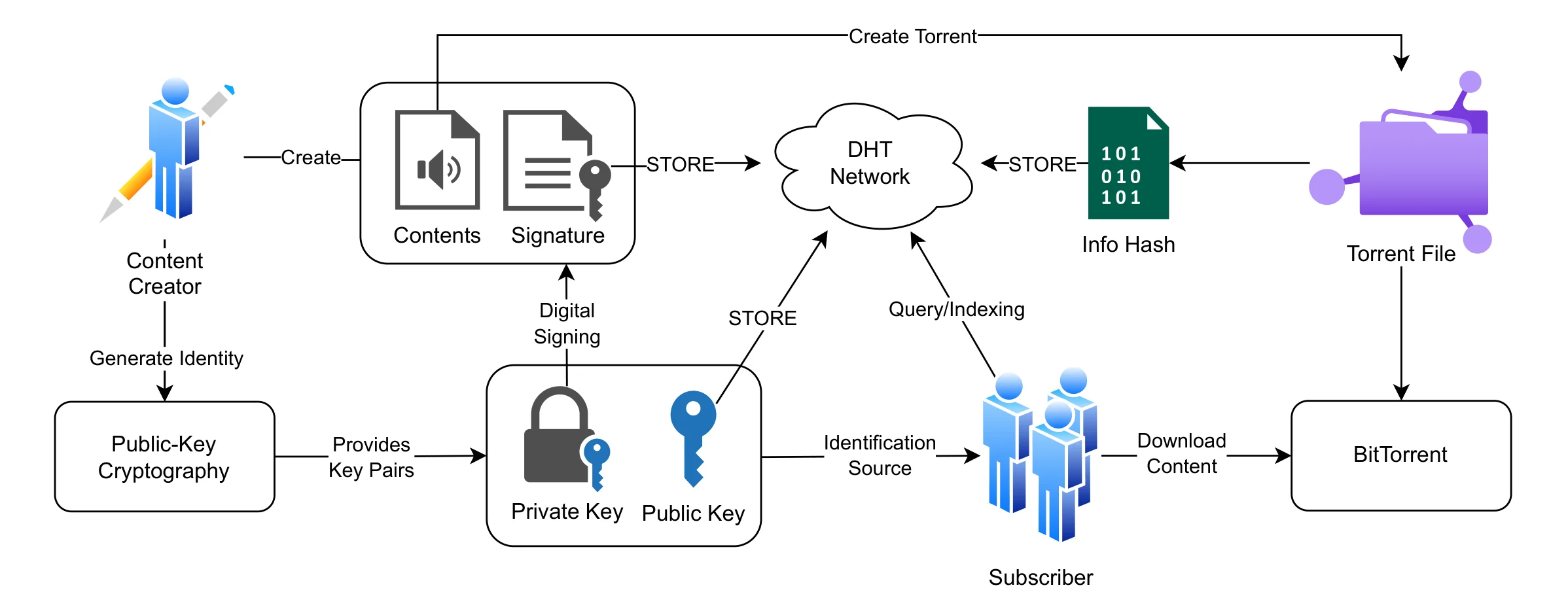
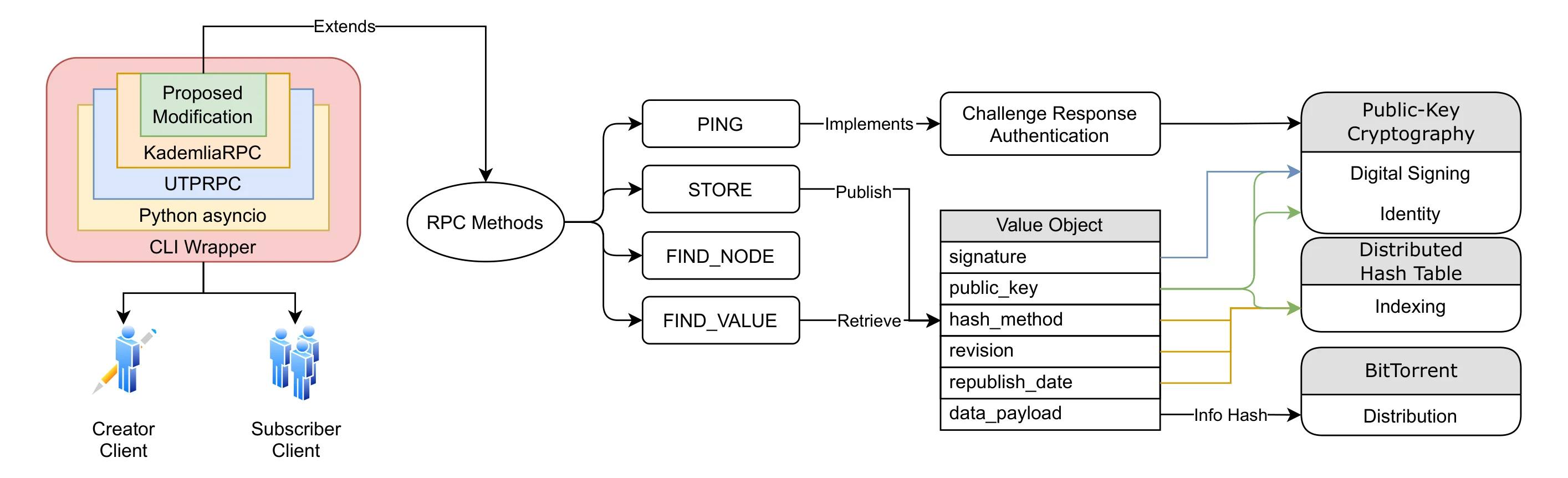
Only the chairs can edit This paper proposes a distributed content subscription mechanism that enables content creators to share updates with their audience while maintaining platform independence and anonymity. The mechanism extends the Kademlia distributed hash table (DHT) protocol by incorporating revision numbers and republication timestamps into the DHT key computation, allowing subscribers to discover content updates through heuristic revision queries. It leverages public key cryptography for creator identification and content authenticity, while integrating with established peer-to-peer protocols like BitTorrent for efficient content distribution. Preliminary testing with 200 simulated nodes demonstrates the mechanism's ability to maintain content availability and update discovery even when content creators are offline. This approach particularly benefits creators operating under strict content controls or surveillance, offering them greater creative freedom and distribution autonomy compared to existing centralized and decentralized solutions.
Related research and software
How to cite
Z. Zhu, Y. Tao, M. Tsukada, and H. Esaki, “A Distributed Content Subscription Mechanism with Revision Discovery to Decouple Content Sharing Platform and Creator ID,” in International Conference on Artificial Intelligence in Information and Communication (ICAIIC 2025), Fukuoka, Japan, 2025, doi: 10.1109/ICAIIC64266.2025.10920697.
BibTeX
@inproceedings{Zhu2025,
  title         = {A Distributed Content Subscription Mechanism with Revision Discovery to Decouple Content Sharing Platform and Creator ID},
  author        = {Zhihai Zhu and Ye Tao and Manabu Tsukada and Hiroshi Esaki},
  doi           = {10.1109/ICAIIC64266.2025.10920697},
  year          = {2025},
  date          = {2025-02-18},
  urldate       = {2025-02-18},
  booktitle     = {International Conference on Artificial Intelligence in Information and Communication (ICAIIC 2025)},
  address       = {Fukuoka, Japan},
  abstract      = {Only the chairs can edit This paper proposes a distributed content subscription mechanism that enables content creators to share updates with their audience while maintaining platform independence and anonymity. The mechanism extends the Kademlia distributed hash table (DHT) protocol by incorporating revision numbers and republication timestamps into the DHT key computation, allowing subscribers to discover content updates through heuristic revision queries. It leverages public key cryptography for creator identification and content authenticity, while integrating with established peer-to-peer protocols like BitTorrent for efficient content distribution. Preliminary testing with 200 simulated nodes demonstrates the mechanism's ability to maintain content availability and update discovery even when content creators are offline. This approach particularly benefits creators operating under strict content controls or surveillance, offering them greater creative freedom and distribution autonomy compared to existing centralized and decentralized solutions.},
  keywords      = {Other},
  pubstate      = {published},
  tppubtype     = {inproceedings}
}