
A Distributed Content Subscription Mechanism with Revision Discovery to Decouple Content Sharing Platform and Creator ID
Master Thesis, Graduate School of Information Science and Technology, The University of Tokyo (Esaki Lab), Mar 31, 2025
Summary in three lines
- The thesis proposes distributed content subscriptions that link updates to a creator independently of a hosting platform.
- It extends Kademlia with revision numbers and republication timestamps, verifies authenticity with public-key cryptography and uses peer-to-peer delivery.
- Analysis and simulations study update discovery and availability as nodes enter or leave the network.
Figures from the paper
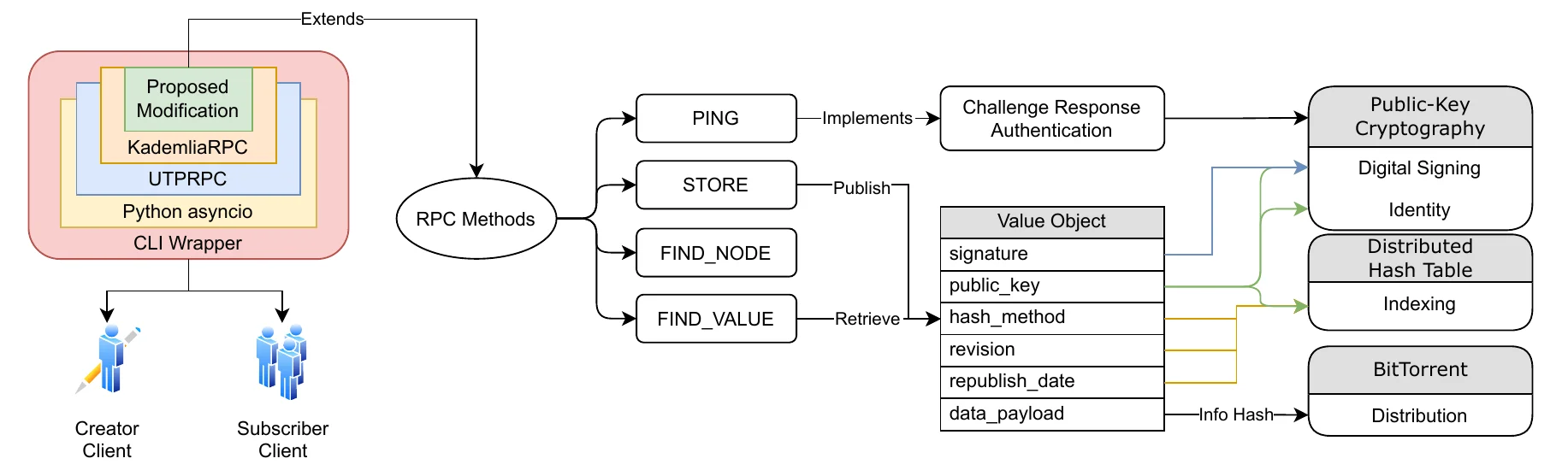
Abstract
This thesis introduces an innovative distributed content subscription mechanism designed to address the challenges of platform independence, anonymity, and censorship resistance for content creators and their audiences. By enhancing the Kademlia Distributed Hash Table (DHT) protocol with revision numbers and republication timestamps, this mechanism enables subscribers to discover content updates through heuristic revision queries while maintaining resilience in dynamic network environments. The proposed mechanism leverages public key cryptography to ensure content authenticity and creator identification, thus establishing a secure and trust-enhanced environment for content sharing. Integration with peer-to-peer protocols, such as BitTorrent, further ensures scalable and efficient content distribution. This system is particularly valuable for creators operating under strict surveillance or content control, offering them the freedom to publish and share without reliance on centralized platforms. Through a combination of theoretical analysis and experimental validation, the mechanism’s effectiveness has been demonstrated. Simulations involving a network of 1000 nodes reveal the system’s ability to maintain content availability and facilitate update discovery, even in the absence of the original content creator. These results highlight the potential of the system to provide a robust alternative to existing centralized and decentralized solutions. The research contributes to the field of distributed systems by addressing the pressing need for decentralized content sharing mechanisms that prioritize user autonomy, privacy, and resilience. By incorporating advancements in cryptographic verification, DHT protocol extensions, and peer-to-peer integration, the proposed solution offers a comprehensive framework for secure, scalable, and censorship-resistant communication. Future work for this study encompasses several promising directions, including the implementation of a Peer Exchange (PEX)-like mechanism to enhance update dissemination efficiency by leveraging the shared interests of peers already engaged in downloading and seeding content. Further evaluation of the mechanism under real-world networking conditions, such as geographically distributed Kubernetes deployments, could assess its robustness in scenarios involving packet loss, NAT traversal, and other complexities. Optimizing system configurations, such as Linux kernel parameters, could also enable efficient resource utilization for large-scale deployments. Additionally, comprehensive threat analyses, including resilience against DDoS attacks, and empirical testing of mitigation strategies, are vital for strengthening security.
How to cite
Z. Zhu, “A Distributed Content Subscription Mechanism with Revision Discovery to Decouple Content Sharing Platform and Creator ID,” in Master Thesis, Graduate School of Information Science and Technology, The University of Tokyo (Esaki Lab), 2025.
BibTeX
@mastersthesis{Zhu2025b,
  title         = {A Distributed Content Subscription Mechanism with Revision Discovery to Decouple Content Sharing Platform and Creator ID},
  author        = {Zhihai Zhu},
  year          = {2025},
  date          = {2025-03-31},
  school        = {Master Thesis, Graduate School of Information Science and Technology, The University of Tokyo (Esaki Lab)},
  abstract      = {This thesis introduces an innovative distributed content subscription mechanism designed to address the challenges of platform independence, anonymity, and censorship resistance for content creators and their audiences. By enhancing the Kademlia Distributed Hash Table (DHT) protocol with revision numbers and republication timestamps, this mechanism enables subscribers to discover content updates through heuristic revision queries while maintaining resilience in dynamic network environments. The proposed mechanism leverages public key cryptography to ensure content authenticity and creator identification, thus establishing a secure and trust-enhanced environment for content sharing. Integration with peer-to-peer protocols, such as BitTorrent, further ensures scalable and efficient content distribution. This system is particularly valuable for creators operating under strict surveillance or content control, offering them the freedom to publish and share without reliance on centralized platforms. Through a combination of theoretical analysis and experimental validation, the mechanism’s effectiveness has been demonstrated. Simulations involving a network of 1000 nodes reveal the system’s ability to maintain content availability and facilitate update discovery, even in the absence of the original content creator. These results highlight the potential of the system to provide a robust alternative to existing centralized and decentralized solutions. The research contributes to the field of distributed systems by addressing the pressing need for decentralized content sharing mechanisms that prioritize user autonomy, privacy, and resilience. By incorporating advancements in cryptographic verification, DHT protocol extensions, and peer-to-peer integration, the proposed solution offers a comprehensive framework for secure, scalable, and censorship-resistant communication. Future work for this study encompasses several promising directions, including the implementation of a Peer Exchange (PEX)-like mechanism to enhance update dissemination efficiency by leveraging the shared interests of peers already engaged in downloading and seeding content. Further evaluation of the mechanism under real-world networking conditions, such as geographically distributed Kubernetes deployments, could assess its robustness in scenarios involving packet loss, NAT traversal, and other complexities. Optimizing system configurations, such as Linux kernel parameters, could also enable efficient resource utilization for large-scale deployments. Additionally, comprehensive threat analyses, including resilience against DDoS attacks, and empirical testing of mitigation strategies, are vital for strengthening security.},
  keywords      = {Thesis},
  pubstate      = {published},
  tppubtype     = {mastersthesis}
}