
Enhancing Reliability in Infrastructure-based Collective Perception: A Dual-Channel Hybrid Delivery Approach with Real-Time Monitoring
IEEE Open Journal of Vehicular Technology, vol. 5, pp. 1124–1138, 2024年8月30日
DOI: 10.1109/OJVT.2024.3443877
3行要約
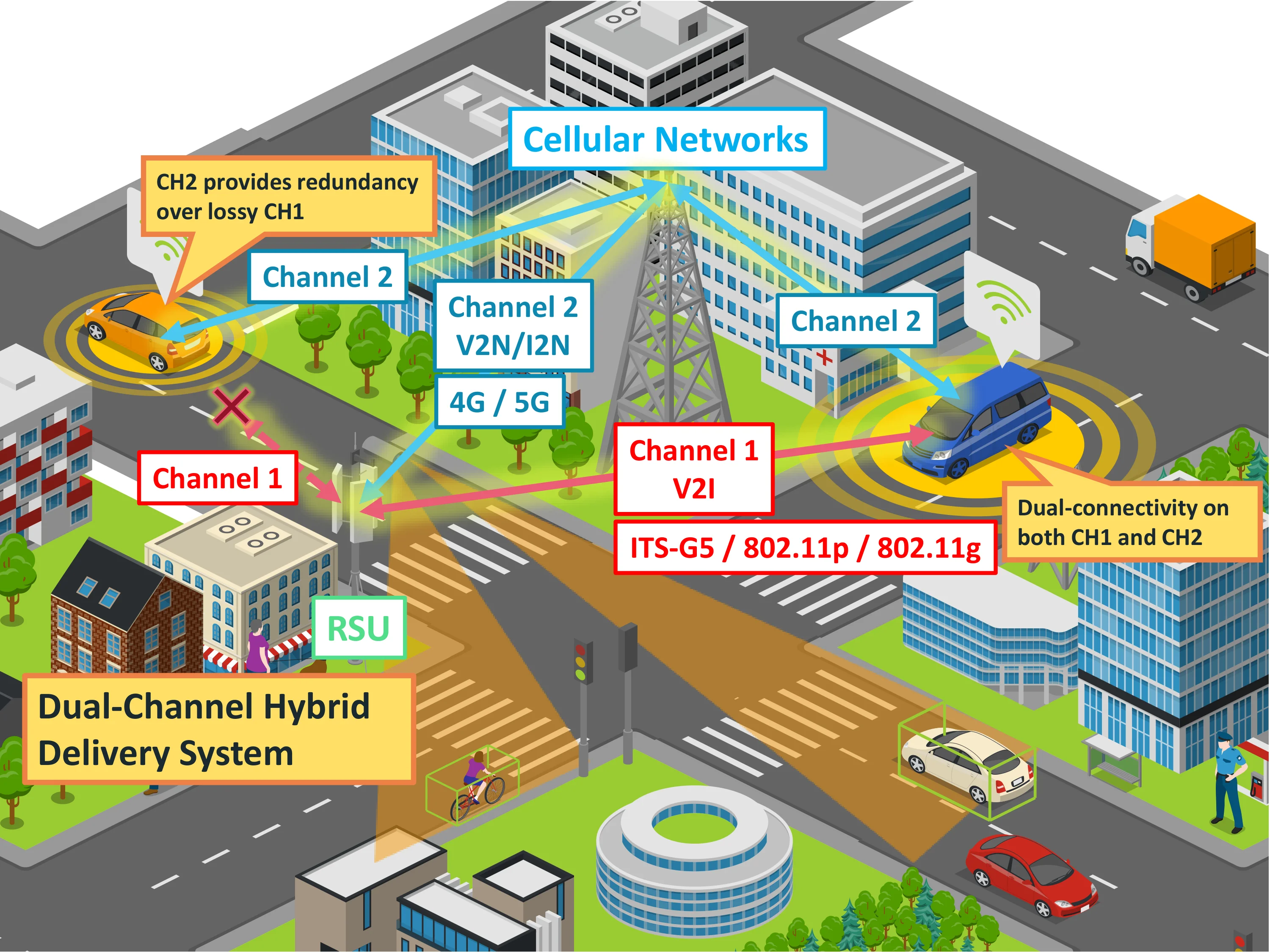
- VTC2023-Spring 版 AutowareV2X を拡張ジャーナル化。Dual-Channel Hybrid Delivery を「ReferenceTime 差分による freshness 判定」として体系化。
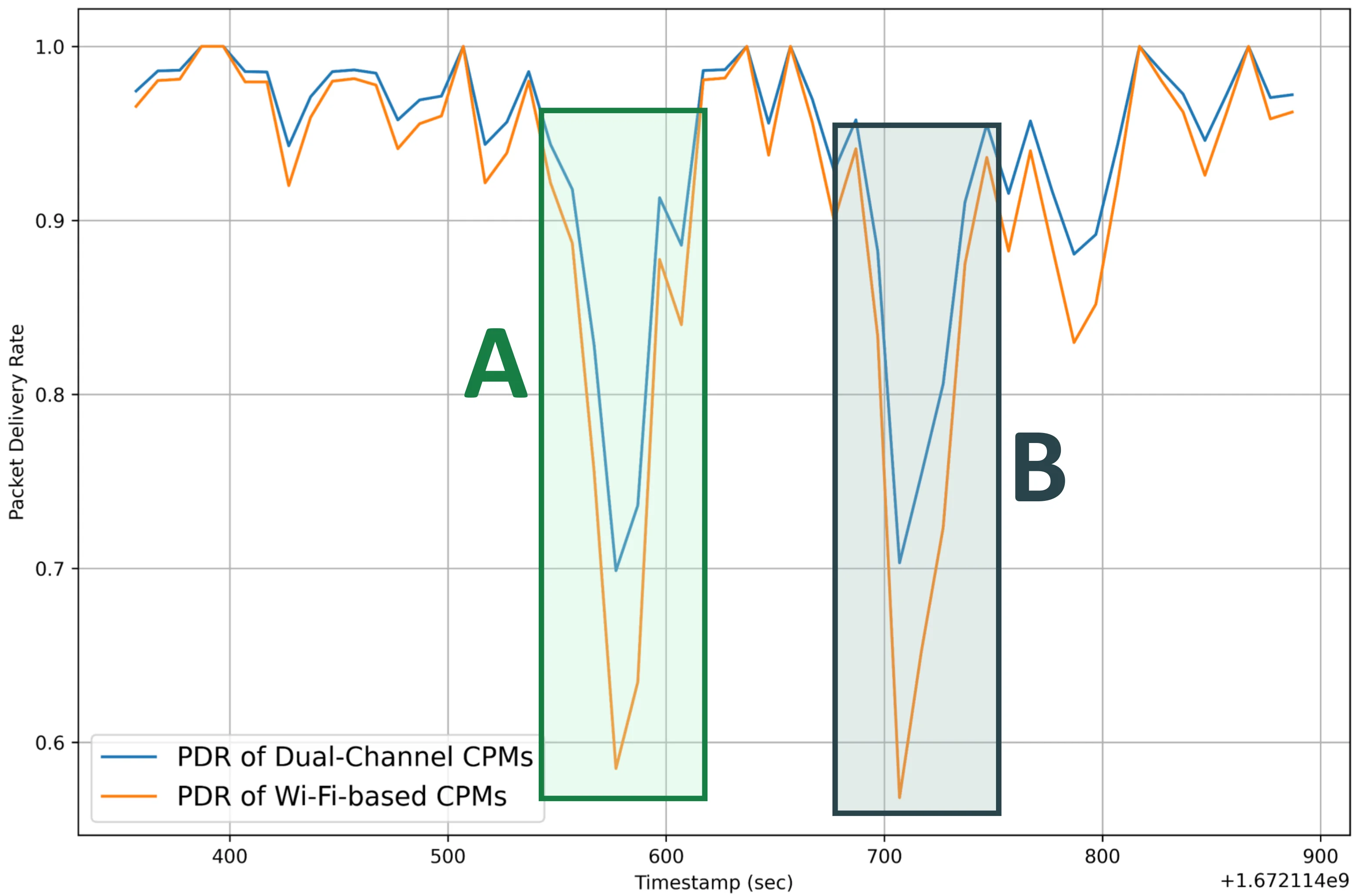
- インフラ側 RSU からの CPM 配信について、リアルタイム PDR モニタリングで Wi-Fi/LTE 切替の挙動を可視化。Wi-Fi の RSSI/PDR ヒートマップと LTE Acceptance Rate (LAR) ヒートマップで「片チャネル劣化時の LTE 補完」を定量実証。
- 結果: Dual-Channel は Wi-Fi 単体比で PDR を大幅改善しつつ E2E latency 約 30 ms を維持。
論文の図
アブストラクト(原文)
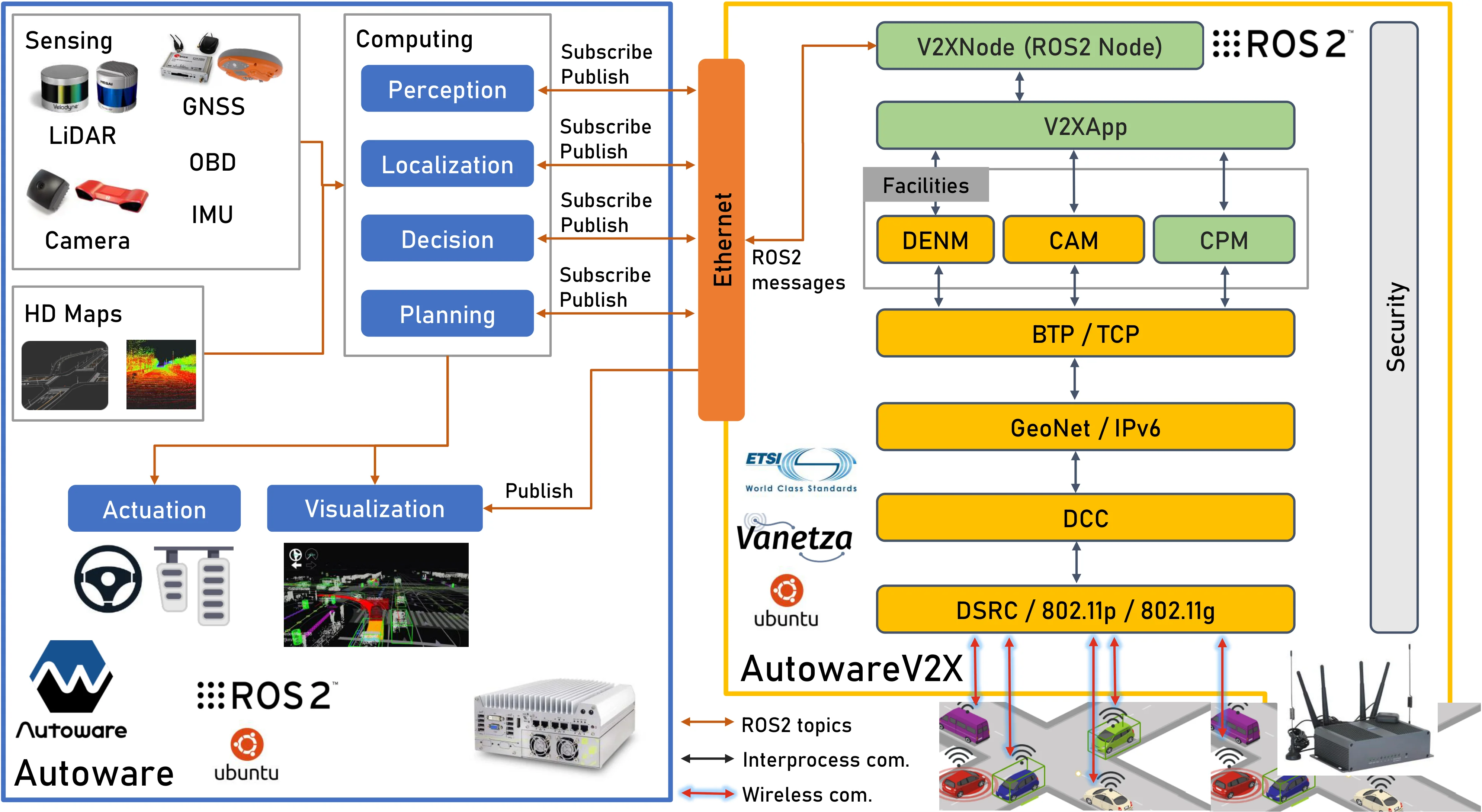
Standalone autonomous vehicles primarily rely on their onboard sensors and may have blind spots or limited situational awareness in complex or dynamic traffic scenarios, leading to difficulties in making safe decisions. Collective perception enables connected autonomous vehicles (CAVs) to overcome the limitations of standalone autonomous vehicles by sharing sensory information with nearby road users. However, unfavorable conditions of the wireless communication medium it uses can lead to limited reliability and reduced quality of service. In this paper, we propose methods for increasing the reliability of collective perception through real-time packet delivery rate monitoring and a dual-channel hybrid delivery approach. We have implemented AutowareV2X, a vehicle-to-everything (V2X) communication module integrated into the autonomous driving (AD) software Autoware. AutowareV2X provides connectivity to the AD stack, enabling end-to-end (E2E) experimentation and evaluation of CAVs. The Collective Perception Service (CPS) was also implemented, allowing the transmission of Collective Perception Messages (CPMs). Our proposed methods using AutowareV2X were evaluated using actual hardware and vehicles in reallife field tests. Results have indicated that the E2E network latency of the perception information sent is around 30 ms, and the AD software can use shared object data to conduct collision avoidance maneuvers. The dual-channel delivery of CPMs enabled the CAV to dynamically select the best CPM from CPMs received from different links, depending on the freshness of their information. This enabled the reliable transmission of CPMs even when there was significant packet loss on one of the transmitting channels.
動画
コード
関連する研究・ソフトウェア
引用方法
Y. Asabe, E. Javanmardi, J. Nakazato, M. Tsukada, and H. Esaki, “Enhancing Reliability in Infrastructure-based Collective Perception: A Dual-Channel Hybrid Delivery Approach with Real-Time Monitoring,” IEEE Open Journal of Vehicular Technology, vol. 5, pp. 1124–1138, 2024, doi: 10.1109/OJVT.2024.3443877.
BibTeX
@article{Asabe2024,
  title         = {Enhancing Reliability in Infrastructure-based Collective Perception: A Dual-Channel Hybrid Delivery Approach with Real-Time Monitoring},
  author        = {Yu Asabe and Ehsan Javanmardi and Jin Nakazato and Manabu Tsukada and Hiroshi Esaki},
  doi           = {10.1109/OJVT.2024.3443877},
  issn          = {2644-1330},
  year          = {2024},
  date          = {2024-08-30},
  urldate       = {2024-08-30},
  journal       = {IEEE Open Journal of Vehicular Technology},
  volume        = {5},
  pages         = {1124--1138},
  abstract      = {Standalone autonomous vehicles primarily rely on their onboard sensors and may have blind spots or limited situational awareness in complex or dynamic traffic scenarios, leading to difficulties in making safe decisions. Collective perception enables connected autonomous vehicles (CAVs) to overcome the limitations of standalone autonomous vehicles by sharing sensory information with nearby road users. However, unfavorable conditions of the wireless communication medium it uses can lead to limited reliability and reduced quality of service. In this paper, we propose methods for increasing the reliability of collective perception through real-time packet delivery rate monitoring and a dual-channel hybrid delivery approach. We have implemented AutowareV2X, a vehicle-to-everything (V2X) communication module integrated into the autonomous driving (AD) software Autoware. AutowareV2X provides connectivity to the AD stack, enabling end-to-end (E2E) experimentation and evaluation of CAVs. The Collective Perception Service (CPS) was also implemented, allowing the transmission of Collective Perception Messages (CPMs). Our proposed methods using AutowareV2X were evaluated using actual hardware and vehicles in reallife field tests. Results have indicated that the E2E network latency of the perception information sent is around 30 ms, and the AD software can use shared object data to conduct collision avoidance maneuvers. The dual-channel delivery of CPMs enabled the CAV to dynamically select the best CPM from CPMs received from different links, depending on the freshness of their information. This enabled the reliable transmission of CPMs even when there was significant packet loss on one of the transmitting channels.},
  keywords      = {ITS},
  pubstate      = {published},
  tppubtype     = {article}
}