
SHFL: K-Anonymity-based Secure Hierarchical Federated Learning Framework for Smart Healthcare Systems
Future Internet, vol. 14, no. 11, 2022年11月18日
Web サイトDOI: 10.3390/fi14110338
3行要約
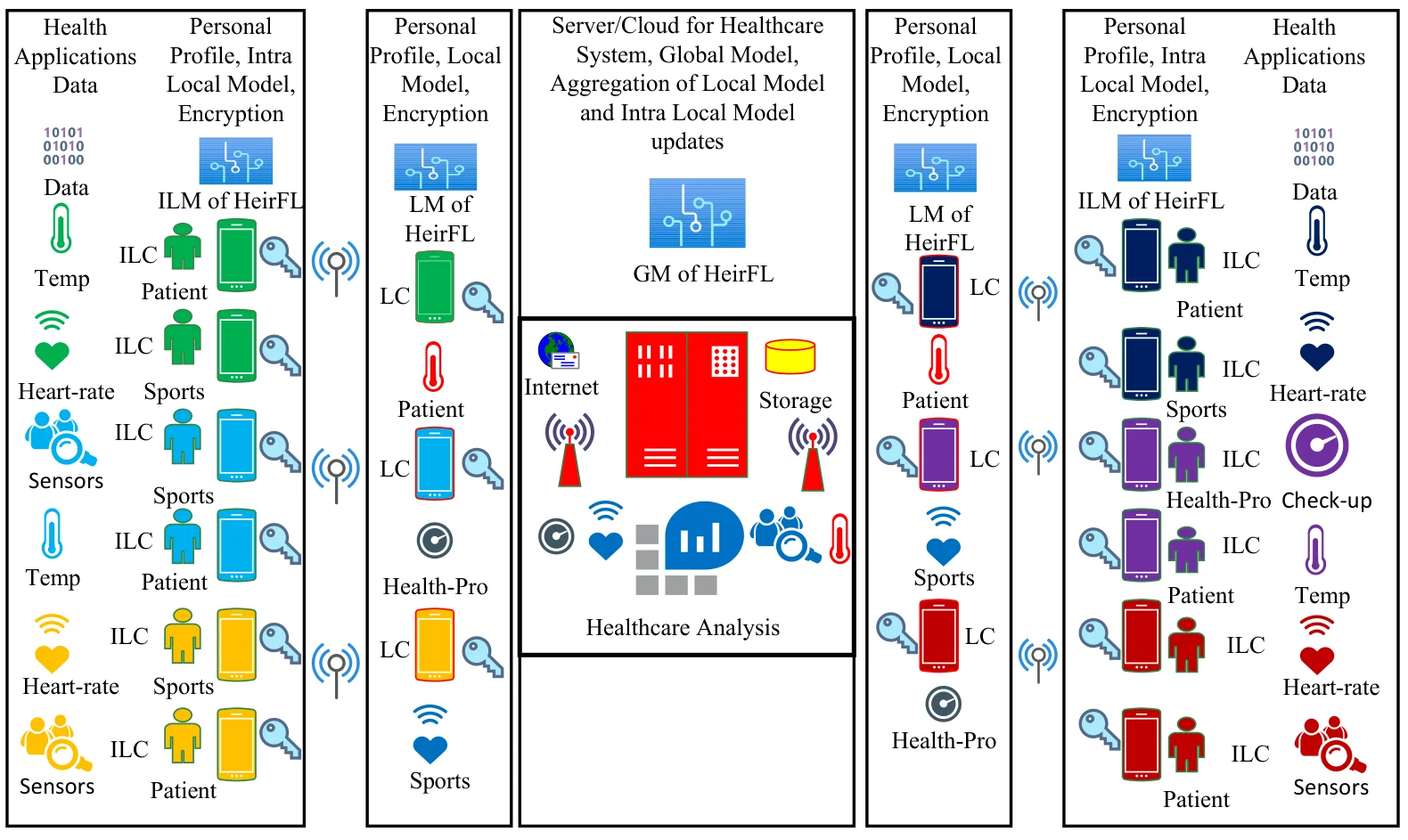
- ヘルスケア向け連合学習のため、参加端末を階層化するSHFLを提案する。
- 位置に基づいて端末をグループ化し、k-匿名性を用いて端末の位置情報を保護する。
- 複数のモデルとデータセットを用い、階層構成を変えて評価した。
論文の図
アブストラクト(原文)
Dynamic and smart infrastructures of the Internet of Things (IoT) allow the development of smart healthcare systems. These smart healthcare systems are equipped with mobile health and embedded healthcare sensors to provide a broad range of healthcare applications. These IoT applications provide the key availability of clients’ health information. However, the boost in the number of mobile devices and social networks intends to share the locations without the clients’ concern. In this regard, Federated Learning (FL) is an emerging paradigm of decentralized machine learning that guarantees to train a shared global model without compromising client data privacy. To this end, in this paper, we propose a K-Anonymity-based Secure Hierarchical Federated Learning (SHFL) framework for smart healthcare systems. In the proposed hierarchical FL approach, a centralized server communicates with multiple directly and indirectly connected devices hierarchically. In particular, the proposed SHFL formulates the location-based services (LBS)-hierarchical clusters to execute distributed FL. Besides, the proposed SHFL utilizes the K-Anonymity method to hide the location of the clusters’ devices. In the end, we evaluate the performance of the proposed SHFL by configuring the different hierarchical networks with multiple model architectures and datasets. The experiments validate that the proposed SHFL provides a suitable generalization to enable network scalability of accurate healthcare systems without compromising data and location privacy.
引用方法
M. Asad, M. Aslam, S. F. Jilani, S. Shaukat, and M. Tsukada, “SHFL: K-Anonymity-based Secure Hierarchical Federated Learning Framework for Smart Healthcare Systems,” Future Internet, vol. 14, no. 11, 2022, doi: 10.3390/fi14110338.
BibTeX
@article{Asad2022,
  title         = {SHFL: K-Anonymity-based Secure Hierarchical Federated Learning  Framework for Smart Healthcare Systems},
  author        = {Muhammad Asad and Muhammad Aslam and Syeda Fizzah Jilani and Saima Shaukat and Manabu Tsukada},
  url           = {https://www.mdpi.com/1999-5903/14/11/338},
  doi           = {10.3390/fi14110338},
  isbn          = {1999-5903},
  year          = {2022},
  date          = {2022-11-18},
  urldate       = {2022-11-18},
  journal       = {Future Internet},
  volume        = {14},
  number        = {11},
  abstract      = {Dynamic and smart infrastructures of the Internet of Things (IoT) allow the development of smart healthcare systems. These smart healthcare systems are equipped with mobile health and embedded healthcare sensors to provide a broad range of healthcare applications. These IoT applications provide the key availability of clients’ health information. However, the boost in the number of mobile devices and social networks intends to share the locations without the clients’ concern. In this regard, Federated Learning (FL) is an emerging paradigm of decentralized machine learning that guarantees to train a shared global model without compromising client data privacy. To this end, in this paper, we propose a K-Anonymity-based Secure Hierarchical Federated Learning (SHFL) framework for smart healthcare systems. In the proposed hierarchical FL approach, a centralized server communicates with multiple directly and indirectly connected devices hierarchically. In particular, the proposed SHFL formulates the location-based services (LBS)-hierarchical clusters to execute distributed FL. Besides, the proposed SHFL utilizes the K-Anonymity method to hide the location of the clusters’ devices. In the end, we evaluate the performance of the proposed SHFL by configuring the different hierarchical networks with multiple model architectures and datasets. The experiments validate that the proposed SHFL provides a suitable generalization to enable network scalability of accurate healthcare systems without compromising data and location privacy.},
  keywords      = {Other},
  pubstate      = {published},
  tppubtype     = {article}
}