
SHFL: K-Anonymity-based Secure Hierarchical Federated Learning Framework for Smart Healthcare Systems
Future Internet, vol. 14, no. 11, Nov 18, 2022
WebsiteDOI: 10.3390/fi14110338
Summary in three lines
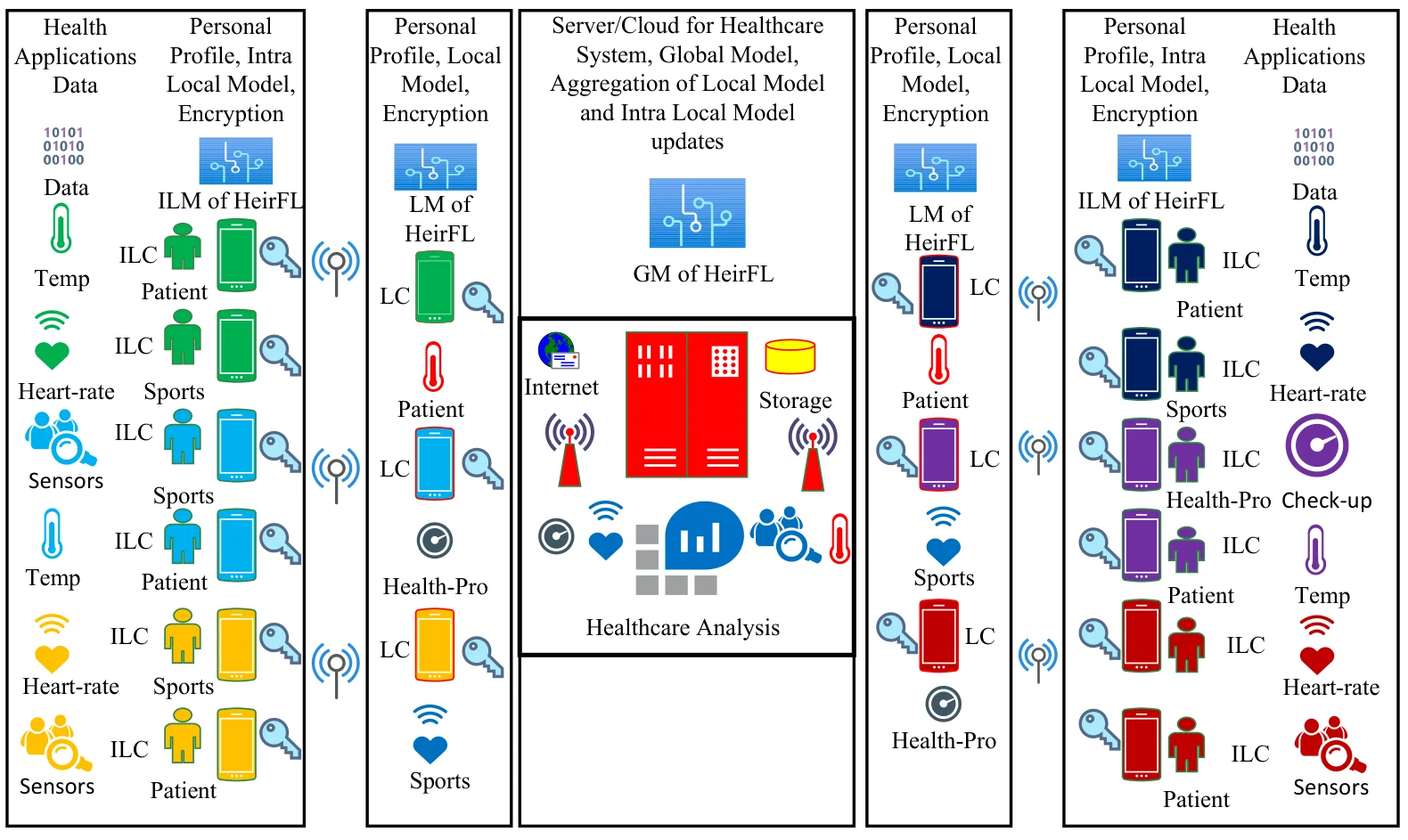
- SHFL organizes federated learning devices in a hierarchy for smart healthcare.
- It forms location-based clusters and uses k-anonymity to protect device location information.
- The authors compare network hierarchies with multiple learning models and datasets.
Figures from the paper
Abstract
Dynamic and smart infrastructures of the Internet of Things (IoT) allow the development of smart healthcare systems. These smart healthcare systems are equipped with mobile health and embedded healthcare sensors to provide a broad range of healthcare applications. These IoT applications provide the key availability of clients’ health information. However, the boost in the number of mobile devices and social networks intends to share the locations without the clients’ concern. In this regard, Federated Learning (FL) is an emerging paradigm of decentralized machine learning that guarantees to train a shared global model without compromising client data privacy. To this end, in this paper, we propose a K-Anonymity-based Secure Hierarchical Federated Learning (SHFL) framework for smart healthcare systems. In the proposed hierarchical FL approach, a centralized server communicates with multiple directly and indirectly connected devices hierarchically. In particular, the proposed SHFL formulates the location-based services (LBS)-hierarchical clusters to execute distributed FL. Besides, the proposed SHFL utilizes the K-Anonymity method to hide the location of the clusters’ devices. In the end, we evaluate the performance of the proposed SHFL by configuring the different hierarchical networks with multiple model architectures and datasets. The experiments validate that the proposed SHFL provides a suitable generalization to enable network scalability of accurate healthcare systems without compromising data and location privacy.
How to cite
M. Asad, M. Aslam, S. F. Jilani, S. Shaukat, and M. Tsukada, “SHFL: K-Anonymity-based Secure Hierarchical Federated Learning Framework for Smart Healthcare Systems,” Future Internet, vol. 14, no. 11, 2022, doi: 10.3390/fi14110338.
BibTeX
@article{Asad2022,
  title         = {SHFL: K-Anonymity-based Secure Hierarchical Federated Learning  Framework for Smart Healthcare Systems},
  author        = {Muhammad Asad and Muhammad Aslam and Syeda Fizzah Jilani and Saima Shaukat and Manabu Tsukada},
  url           = {https://www.mdpi.com/1999-5903/14/11/338},
  doi           = {10.3390/fi14110338},
  isbn          = {1999-5903},
  year          = {2022},
  date          = {2022-11-18},
  urldate       = {2022-11-18},
  journal       = {Future Internet},
  volume        = {14},
  number        = {11},
  abstract      = {Dynamic and smart infrastructures of the Internet of Things (IoT) allow the development of smart healthcare systems. These smart healthcare systems are equipped with mobile health and embedded healthcare sensors to provide a broad range of healthcare applications. These IoT applications provide the key availability of clients’ health information. However, the boost in the number of mobile devices and social networks intends to share the locations without the clients’ concern. In this regard, Federated Learning (FL) is an emerging paradigm of decentralized machine learning that guarantees to train a shared global model without compromising client data privacy. To this end, in this paper, we propose a K-Anonymity-based Secure Hierarchical Federated Learning (SHFL) framework for smart healthcare systems. In the proposed hierarchical FL approach, a centralized server communicates with multiple directly and indirectly connected devices hierarchically. In particular, the proposed SHFL formulates the location-based services (LBS)-hierarchical clusters to execute distributed FL. Besides, the proposed SHFL utilizes the K-Anonymity method to hide the location of the clusters’ devices. In the end, we evaluate the performance of the proposed SHFL by configuring the different hierarchical networks with multiple model architectures and datasets. The experiments validate that the proposed SHFL provides a suitable generalization to enable network scalability of accurate healthcare systems without compromising data and location privacy.},
  keywords      = {Other},
  pubstate      = {published},
  tppubtype     = {article}
}