
Spatial ID Authoring in Mixed Reality: A Unified Platform Integrating Anchoring and Visualization
IEEE International Conference on Artificial Intelligence and Virtual Reality (AIxVR 2026), Work in Progress (WiP), Osaka, Japan, 2026年1月26日
DOI: 10.1109/AIxVR67263.2026.00045
3行要約
- 複合現実上のコンテンツを物理環境に固定する共通参照として空間IDを使う。
- 空間インデックスでセルを注釈やライブデータに結び付け、アプリや端末をまたいで利用できる。
- 試作機ではヘッドセットを実空間に位置合わせし、検出された物体と入力したラベルを現地に重ねて表示した。
論文の図
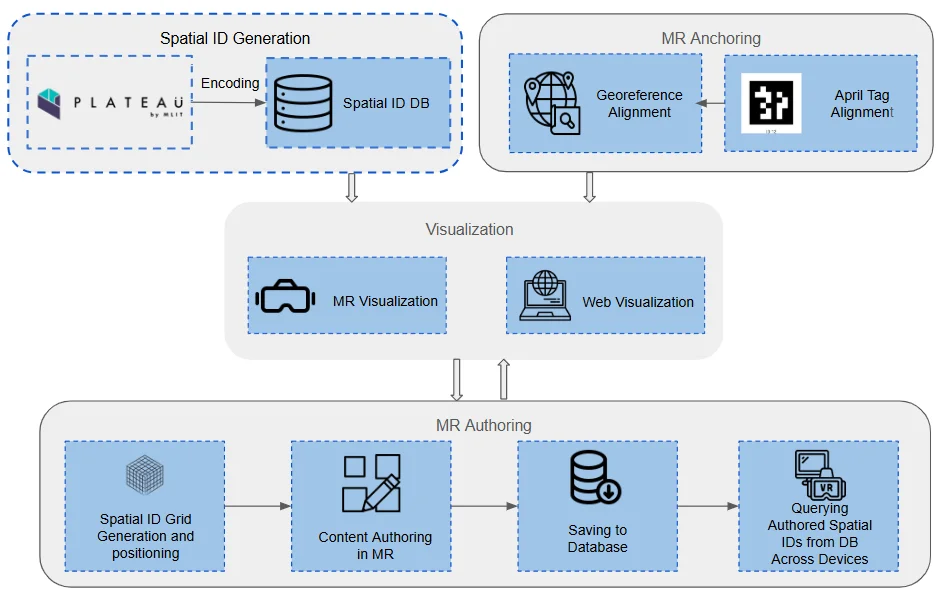
アブストラクト(原文)
We present a Mixed Reality (MR) authoring platform that leverages Spatial IDs as a standardized reference to align digital content with the physical environment. The platform enables users to tag and annotate space through Spatial IDs, with annotations managed through a decoupled architecture where a queryable Spatial ID index links spatial entities to external databases containing attributes and application-specific content. To support this, we integrate two enabling components. First, anchoring: Spatial IDs provide a hierarchical four-dimensional indexing system that ensures consistent alignment across datasets and localization methods. Second, visualization: anchored Spatial IDs allow both real-world data streams and authored datasets to be rendered in MR. As a proof of concept, we integrate cloud-based object detection from an external depth camera, streaming recognized objects into MR and visualizing them at their true physical locations. Together, these components demonstrate how Spatial IDs enable accurate visualization and persistent authoring, offering a unified pipeline for next-generation spatial computing.
関連する研究・ソフトウェア
引用方法
S. B. Djelloul, Y. Chen, A. Orsholits, and M. Tsukada, “Spatial ID Authoring in Mixed Reality: A Unified Platform Integrating Anchoring and Visualization,” in IEEE International Conference on Artificial Intelligence and Virtual Reality (AIxVR 2026), Work in Progress (WiP), Osaka, Japan, 2026, doi: 10.1109/AIxVR67263.2026.00045.
BibTeX
@inproceedings{Djelloul2026,
  title         = {Spatial ID Authoring in Mixed Reality: A Unified Platform Integrating Anchoring and Visualization},
  author        = {Sami Brahim Djelloul and Yanru Chen and Alex Orsholits and Manabu Tsukada},
  doi           = {10.1109/AIxVR67263.2026.00045},
  year          = {2026},
  date          = {2026-01-26},
  urldate       = {2026-01-26},
  booktitle     = {IEEE International Conference on Artificial Intelligence and Virtual Reality (AIxVR 2026), Work in Progress (WiP)},
  address       = {Osaka, Japan},
  abstract      = {We present a Mixed Reality (MR) authoring platform that leverages Spatial IDs as a standardized reference to align digital content with the physical environment. The platform enables users to tag and annotate space through Spatial IDs, with annotations managed through a decoupled architecture where a queryable Spatial ID index links spatial entities to external databases containing attributes and application-specific content. To support this, we integrate two enabling components. First, anchoring: Spatial IDs provide a hierarchical four-dimensional indexing system that ensures consistent alignment across datasets and localization methods. Second, visualization: anchored Spatial IDs allow both real-world data streams and authored datasets to be rendered in MR. As a proof of concept, we integrate cloud-based object detection from an external depth camera, streaming recognized objects into MR and visualizing them at their true physical locations. Together, these components demonstrate how Spatial IDs enable accurate visualization and persistent authoring, offering a unified pipeline for next-generation spatial computing.},
  keywords      = {SDM},
  pubstate      = {published},
  tppubtype     = {inproceedings}
}