
SwitchAuthn: Trusted Hardware-Based Layer-2 Authentication to Prevent MAC Spoofing in Ethernet Networks
40th International Conference on Advanced Information Networking and Applications (AINA 2026), Victoria University of Wellington, New Zealand, 2026年4月8日
DOI: 10.1007/978-3-032-23311-0_5
3行要約
- SwitchAuthnはハードウェアに裏付けられた認証で、イーサネットスイッチの端末確認を強化する。
- TPMによるチャレンジ・レスポンスを使い、端末が保持する資格情報をネットワークへの接続と結び付ける。
- 試作機で、MACなりすましへの耐性、認証遅延、処理負荷を評価した。
論文の図
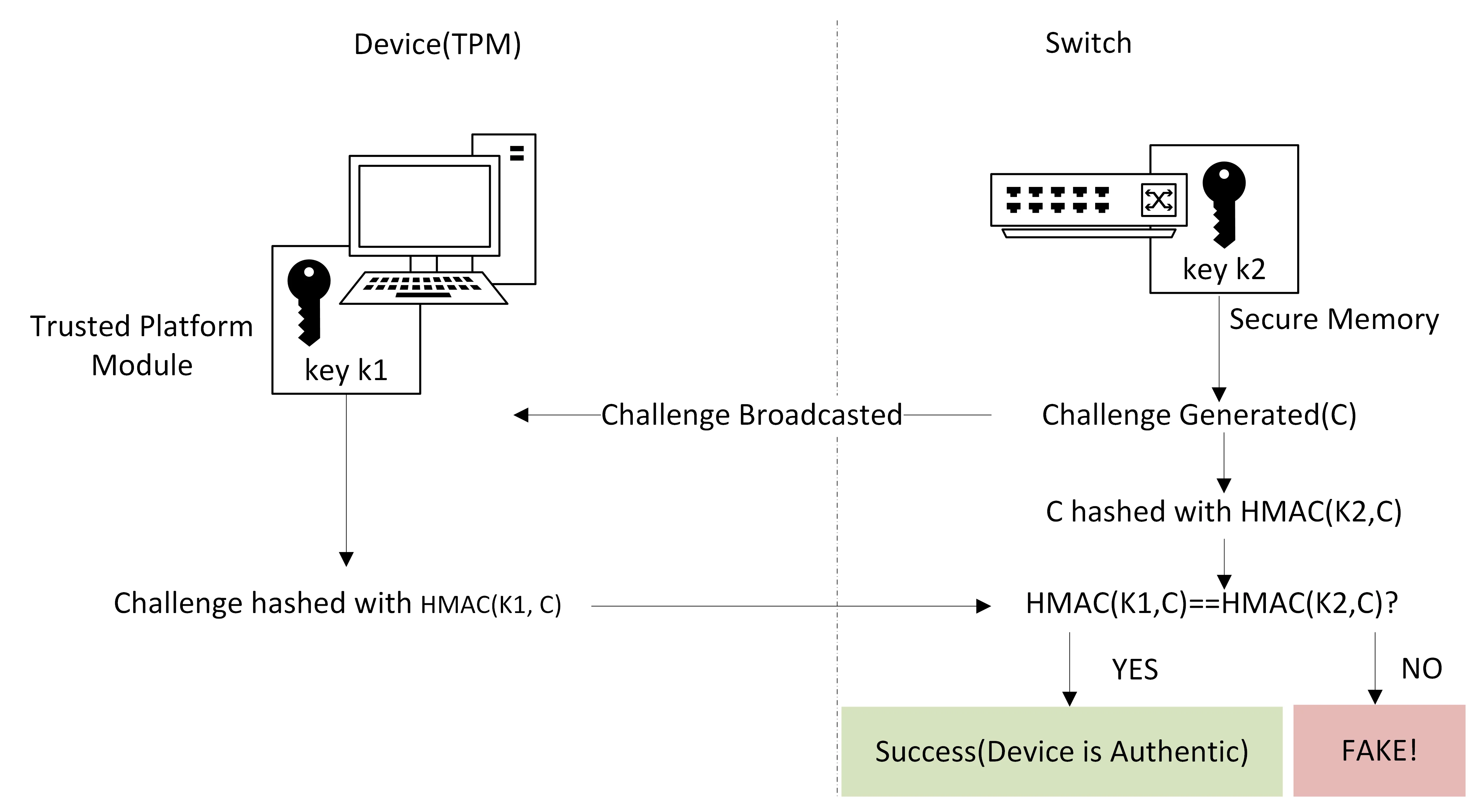
アブストラクト(原文)
Modern switches rely on Access Control Lists (ACLs) for Media Access Control (MAC)-based access control, leaving networks vulnerable to MAC address spoofing attacks that succeed in 78% of enterprise networks. This paper presents SwitchAuthn, a device-centric TPM 2.0-secured challenge-response mechanism that closes the critical authentication gap before MACsec channel establishment. Unlike IEEE 802.1AE (MACsec) and 802.1X approaches that assume pre-established device trust, SwitchAuthn enforces cryptographic device identity verification at Layer-2 using HMAC-SHA256 with hardware-protected keys. Prototype evaluation using GNS3 with authentic Cisco IOS images (v15.1) and TPM 2.0 simulator demonstrates: (1) mean authentication latency of 2.827 ms (median 2.695 ms, <10 ms target); (2) 100% MAC spoofing prevention across 1,000 test attempts (vs. 0% for baseline port security); (3) <3% CPU overhead under sustained load (7-1000 devices); (4) comprehensive defense against replay attacks (nonce-based), MITM attacks (challenge uniqueness), and DoS attacks (rate-limiting with attestation-bound queues). The protocol achieves RFC 4868, FIPS 180-4/198-1, and ISO/IEC 11889-3 compliance while maintaining seamless IEEE 802.1X/RADIUS integration. Experimental validation demonstrates linear scalability, zero false positives observed over 48-hour continuous operation (1,400+ authentication cycles, 95% confidence interval: 0-0.26% false positive rate), and production-ready deployment architecture addressing rate-limit abuse through three-layer hybrid countermeasures.
引用方法
A. Ghosh and M. Tsukada, “SwitchAuthn: Trusted Hardware-Based Layer-2 Authentication to Prevent MAC Spoofing in Ethernet Networks,” in 40th International Conference on Advanced Information Networking and Applications (AINA 2026), Victoria University of Wellington, New Zealand, 2026, doi: 10.1007/978-3-032-23311-0_5.
BibTeX
@inproceedings{Ghosh2026,
  title         = {SwitchAuthn: Trusted Hardware-Based Layer-2 Authentication to Prevent MAC Spoofing in Ethernet Networks},
  author        = {Anisha Ghosh and Manabu Tsukada},
  doi           = {10.1007/978-3-032-23311-0_5},
  year          = {2026},
  date          = {2026-04-08},
  urldate       = {2026-04-08},
  booktitle     = {40th International Conference on Advanced Information Networking and Applications (AINA 2026)},
  address       = {Victoria University of Wellington, New Zealand},
  abstract      = {Modern switches rely on Access Control Lists (ACLs) for Media Access Control (MAC)-based access control, leaving networks vulnerable to MAC address spoofing attacks that succeed in 78% of enterprise networks. This paper presents SwitchAuthn, a device-centric TPM 2.0-secured challenge-response mechanism that closes the critical authentication gap before MACsec channel establishment. Unlike IEEE 802.1AE (MACsec) and 802.1X approaches that assume pre-established device trust, SwitchAuthn enforces cryptographic device identity verification at Layer-2 using HMAC-SHA256 with hardware-protected keys. Prototype evaluation using GNS3 with authentic Cisco IOS images (v15.1) and TPM 2.0 simulator demonstrates: (1) mean authentication latency of 2.827 ms (median 2.695 ms, <10 ms target); (2) 100% MAC spoofing prevention across 1,000 test attempts (vs. 0% for baseline port security); (3) <3% CPU overhead under sustained load (7-1000 devices); (4) comprehensive defense against replay attacks (nonce-based), MITM attacks (challenge uniqueness), and DoS attacks (rate-limiting with attestation-bound queues). The protocol achieves RFC 4868, FIPS 180-4/198-1, and ISO/IEC 11889-3 compliance while maintaining seamless IEEE 802.1X/RADIUS integration. Experimental validation demonstrates linear scalability, zero false positives observed over 48-hour continuous operation (1,400+ authentication cycles, 95% confidence interval: 0-0.26% false positive rate), and production-ready deployment architecture addressing rate-limit abuse through three-layer hybrid countermeasures.},
  keywords      = {Other},
  pubstate      = {published},
  tppubtype     = {inproceedings}
}