
SwitchAuthn: Trusted Hardware-Based Layer-2 Authentication to Prevent MAC Spoofing in Ethernet Networks
40th International Conference on Advanced Information Networking and Applications (AINA 2026), Victoria University of Wellington, New Zealand, Apr 8, 2026
DOI: 10.1007/978-3-032-23311-0_5
Summary in three lines
- SwitchAuthn strengthens device identity checks on Ethernet switches with hardware-backed authentication.
- A TPM-based challenge–response binds network access to a device-held credential.
- The prototype was tested for resistance to MAC impersonation and for authentication latency and overhead.
Figures from the paper
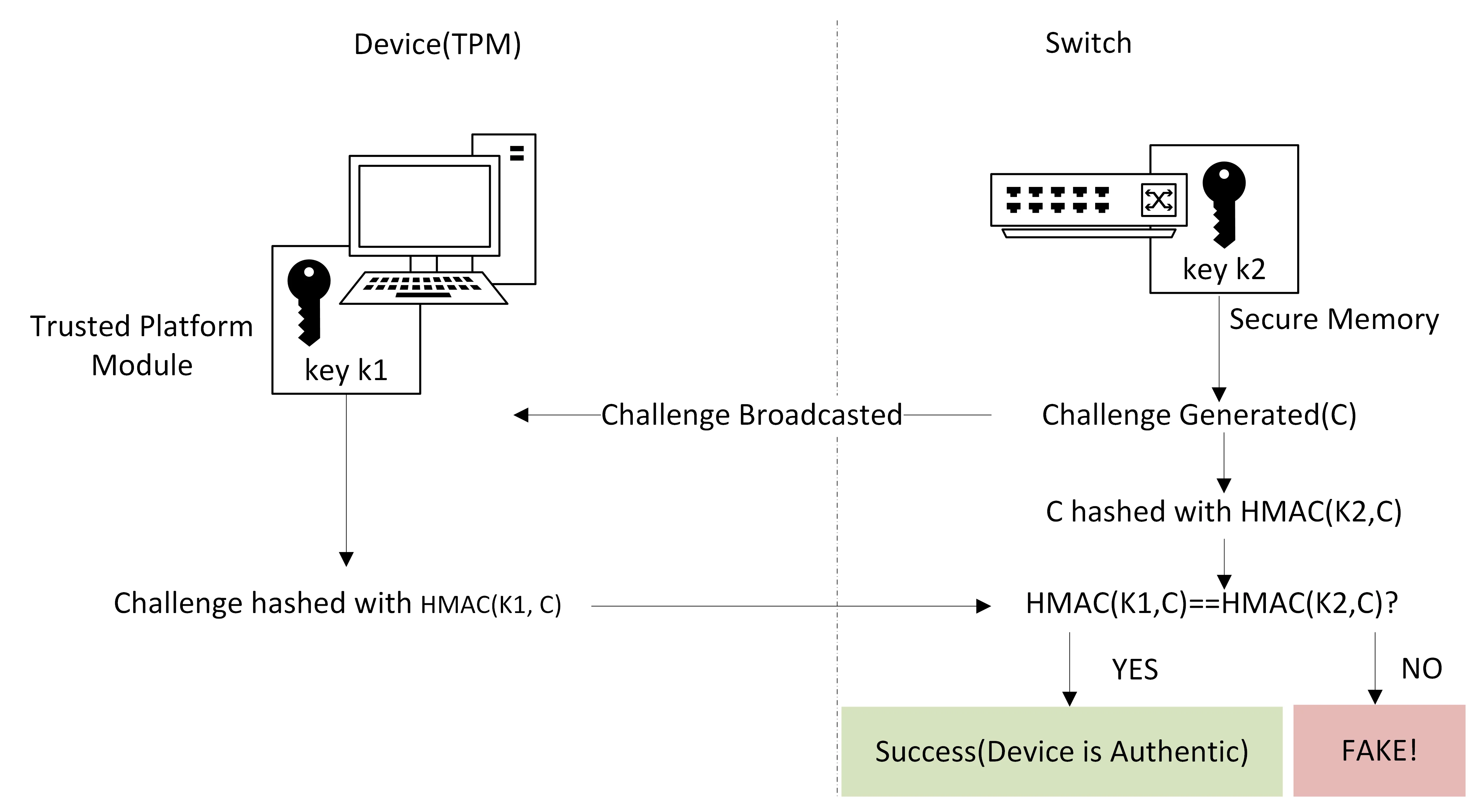
Abstract
Modern switches rely on Access Control Lists (ACLs) for Media Access Control (MAC)-based access control, leaving networks vulnerable to MAC address spoofing attacks that succeed in 78% of enterprise networks. This paper presents SwitchAuthn, a device-centric TPM 2.0-secured challenge-response mechanism that closes the critical authentication gap before MACsec channel establishment. Unlike IEEE 802.1AE (MACsec) and 802.1X approaches that assume pre-established device trust, SwitchAuthn enforces cryptographic device identity verification at Layer-2 using HMAC-SHA256 with hardware-protected keys. Prototype evaluation using GNS3 with authentic Cisco IOS images (v15.1) and TPM 2.0 simulator demonstrates: (1) mean authentication latency of 2.827 ms (median 2.695 ms, <10 ms target); (2) 100% MAC spoofing prevention across 1,000 test attempts (vs. 0% for baseline port security); (3) <3% CPU overhead under sustained load (7-1000 devices); (4) comprehensive defense against replay attacks (nonce-based), MITM attacks (challenge uniqueness), and DoS attacks (rate-limiting with attestation-bound queues). The protocol achieves RFC 4868, FIPS 180-4/198-1, and ISO/IEC 11889-3 compliance while maintaining seamless IEEE 802.1X/RADIUS integration. Experimental validation demonstrates linear scalability, zero false positives observed over 48-hour continuous operation (1,400+ authentication cycles, 95% confidence interval: 0-0.26% false positive rate), and production-ready deployment architecture addressing rate-limit abuse through three-layer hybrid countermeasures.
How to cite
A. Ghosh and M. Tsukada, “SwitchAuthn: Trusted Hardware-Based Layer-2 Authentication to Prevent MAC Spoofing in Ethernet Networks,” in 40th International Conference on Advanced Information Networking and Applications (AINA 2026), Victoria University of Wellington, New Zealand, 2026, doi: 10.1007/978-3-032-23311-0_5.
BibTeX
@inproceedings{Ghosh2026,
  title         = {SwitchAuthn: Trusted Hardware-Based Layer-2 Authentication to Prevent MAC Spoofing in Ethernet Networks},
  author        = {Anisha Ghosh and Manabu Tsukada},
  doi           = {10.1007/978-3-032-23311-0_5},
  year          = {2026},
  date          = {2026-04-08},
  urldate       = {2026-04-08},
  booktitle     = {40th International Conference on Advanced Information Networking and Applications (AINA 2026)},
  address       = {Victoria University of Wellington, New Zealand},
  abstract      = {Modern switches rely on Access Control Lists (ACLs) for Media Access Control (MAC)-based access control, leaving networks vulnerable to MAC address spoofing attacks that succeed in 78% of enterprise networks. This paper presents SwitchAuthn, a device-centric TPM 2.0-secured challenge-response mechanism that closes the critical authentication gap before MACsec channel establishment. Unlike IEEE 802.1AE (MACsec) and 802.1X approaches that assume pre-established device trust, SwitchAuthn enforces cryptographic device identity verification at Layer-2 using HMAC-SHA256 with hardware-protected keys. Prototype evaluation using GNS3 with authentic Cisco IOS images (v15.1) and TPM 2.0 simulator demonstrates: (1) mean authentication latency of 2.827 ms (median 2.695 ms, <10 ms target); (2) 100% MAC spoofing prevention across 1,000 test attempts (vs. 0% for baseline port security); (3) <3% CPU overhead under sustained load (7-1000 devices); (4) comprehensive defense against replay attacks (nonce-based), MITM attacks (challenge uniqueness), and DoS attacks (rate-limiting with attestation-bound queues). The protocol achieves RFC 4868, FIPS 180-4/198-1, and ISO/IEC 11889-3 compliance while maintaining seamless IEEE 802.1X/RADIUS integration. Experimental validation demonstrates linear scalability, zero false positives observed over 48-hour continuous operation (1,400+ authentication cycles, 95% confidence interval: 0-0.26% false positive rate), and production-ready deployment architecture addressing rate-limit abuse through three-layer hybrid countermeasures.},
  keywords      = {Other},
  pubstate      = {published},
  tppubtype     = {inproceedings}
}