
Roadside-assisted Cooperative Planning using Future Path Sharing for Autonomous Driving
IEEE 94th Vehicular Technology Conference (VTC2021-Fall), Online, 2021年9月27日
arXivDOI: 10.1109/VTC2021-Fall52928.2021.9625324
3行要約
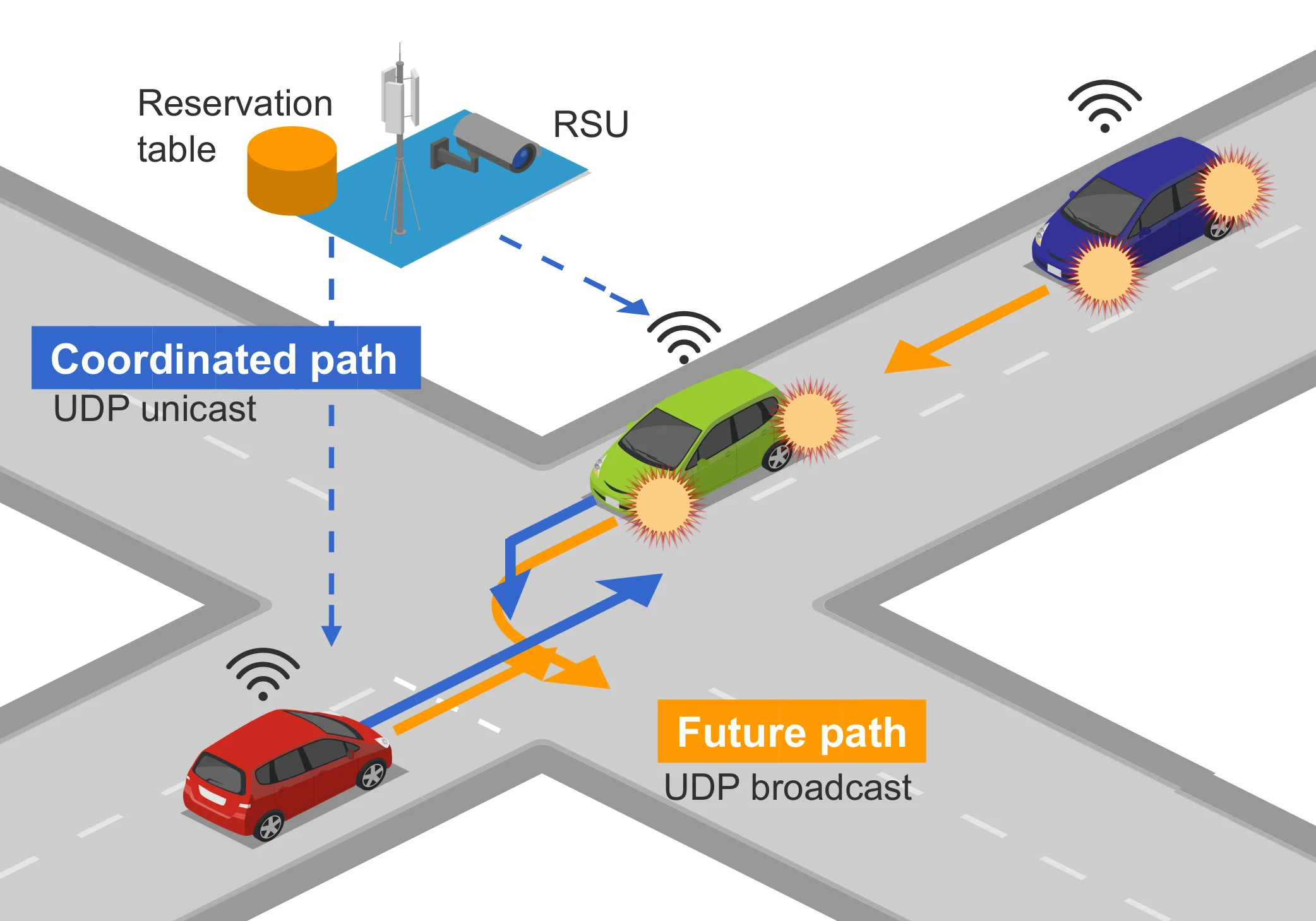
- 交差点で複数の自動運転車が将来の走行経路を共有する方式を提案した。
- 路側機が共有経路から衝突の可能性や加速できる箇所を見つけ、車両の速度計画を調整する。
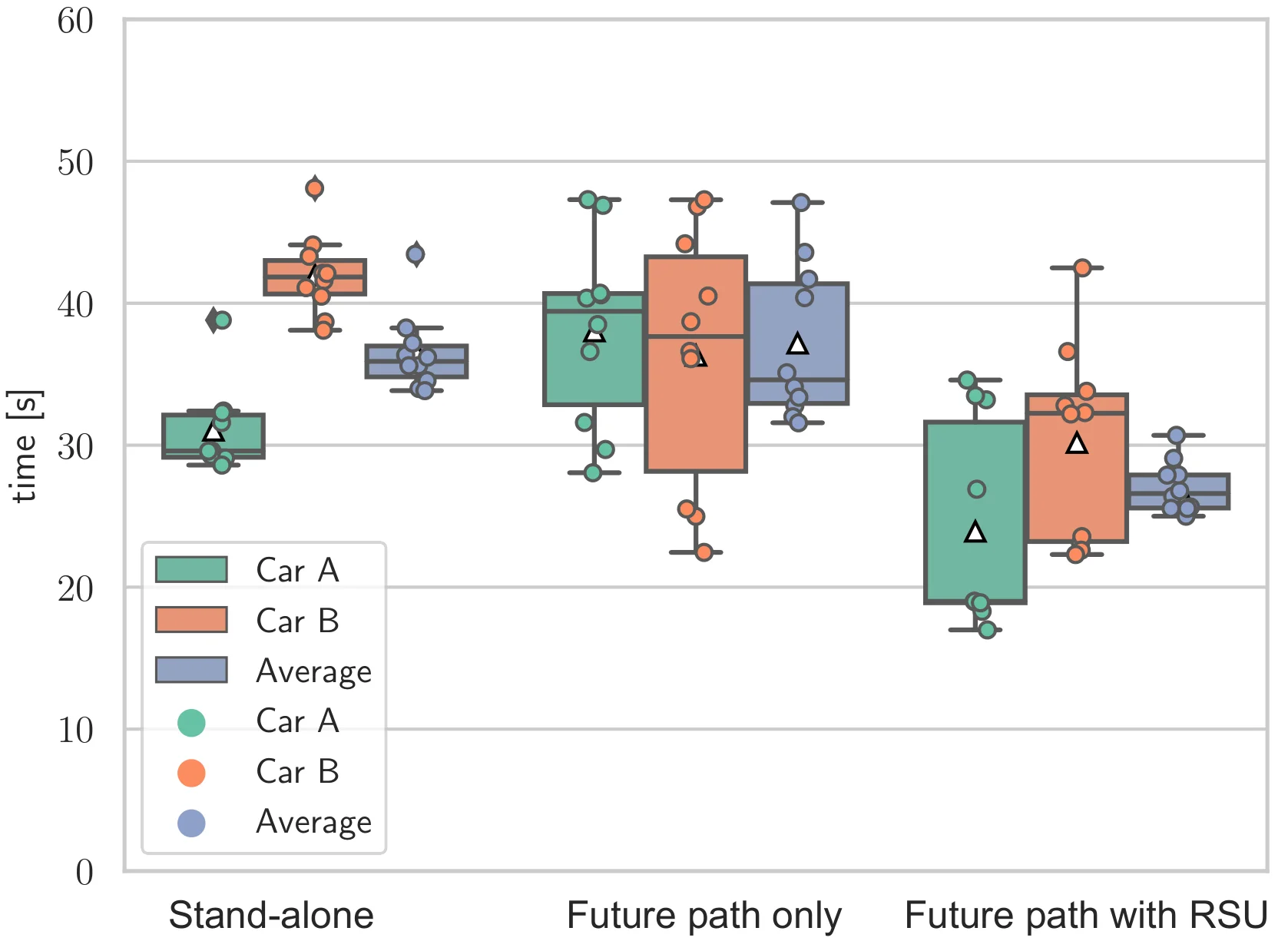
- AutowareとLGSVLによる見通しの悪い交差点のシミュレーションでは、2台の走行所要時間がそれぞれ23.0%、28.1%短縮された。
論文の図
アブストラクト(原文)
Cooperative intelligent transportation systems (ITS) are used by autonomous vehicles to communicate with surrounding autonomous vehicles and roadside units (RSU). Current C-ITS applications focus primarily on real-time information sharing, such as cooperative perception. In addition to real-time information sharing, self-driving cars need to coordinate their action plans to achieve higher safety and efficiency. For this reason, this study defines a vehicle’s future action plan/path and designs a cooperative path-planning model at intersections using future path sharing based on the future path information of multiple vehicles. The notion is that when the RSU detects a potential conflict of vehicle paths or an acceleration opportunity according to the shared future paths, it will generate a coordinated path update that adjusts the speeds of the vehicles. We implemented the proposed method using the open-source Autoware autonomous driving software and evaluated it with the LGSVL autonomous vehicle simulator. We conducted simulation experiments with two vehicles at a blind intersection scenario, finding that each car can travel safely and more efficiently by planning a path that reflects the action plans of all vehicles involved. The time consumed by introducing the RSU is 23.0 % and 28.1 % shorter than that of the stand-alone autonomous driving case at the intersection.
動画
関連する研究・ソフトウェア
引用方法
M. Hirata, M. Tsukada, K. Okumura, Y. Tamura, H. Ochiai, and X. Défago, “Roadside-assisted Cooperative Planning using Future Path Sharing for Autonomous Driving,” in IEEE 94th Vehicular Technology Conference (VTC2021-Fall), Online, 2021, doi: 10.1109/VTC2021-Fall52928.2021.9625324.
BibTeX
@inproceedings{Hirata2021b,
  title         = {Roadside-assisted Cooperative Planning using Future Path Sharing for Autonomous Driving},
  author        = {Mai Hirata and Manabu Tsukada and Keisuke Okumura and Yasumasa Tamura and Hideya Ochiai and Xavier Défago},
  url           = {https://arxiv.org/abs/2108.04629 https://youtu.be/xaBIQC0SClE},
  doi           = {10.1109/VTC2021-Fall52928.2021.9625324},
  year          = {2021},
  date          = {2021-09-27},
  urldate       = {2021-09-27},
  booktitle     = {IEEE 94th Vehicular Technology Conference (VTC2021-Fall)},
  address       = {Online},
  abstract      = {Cooperative intelligent transportation systems (ITS) are used by autonomous vehicles to communicate with surrounding autonomous vehicles and roadside units (RSU). Current C-ITS applications focus primarily on real-time information sharing, such as cooperative perception. In addition to real-time information sharing, self-driving cars need to coordinate their action plans to achieve higher safety and efficiency. For this reason, this study defines a vehicle’s future action plan/path and designs a cooperative path-planning model at intersections using future path sharing based on the future path information of multiple vehicles. The notion is that when the RSU detects a potential conflict of vehicle paths or an acceleration opportunity according to the shared future paths, it will generate a coordinated path update that adjusts the speeds of the vehicles. We implemented the proposed method using the open-source Autoware autonomous driving software and evaluated it with the LGSVL autonomous vehicle simulator. We conducted simulation experiments with two vehicles at a blind intersection scenario, finding that each car can travel safely and more efficiently by planning a path that reflects the action plans of all vehicles involved. The time consumed by introducing the RSU is 23.0 % and 28.1 % shorter than that of the stand-alone autonomous driving case at the intersection.},
  keywords      = {ITS},
  pubstate      = {published},
  tppubtype     = {inproceedings}
}