
Roadside-assisted Cooperative Planning using Future Path Sharing for Autonomous Driving
IEEE 94th Vehicular Technology Conference (VTC2021-Fall), Online, Sep 27, 2021
arXivDOI: 10.1109/VTC2021-Fall52928.2021.9625324
Summary in three lines
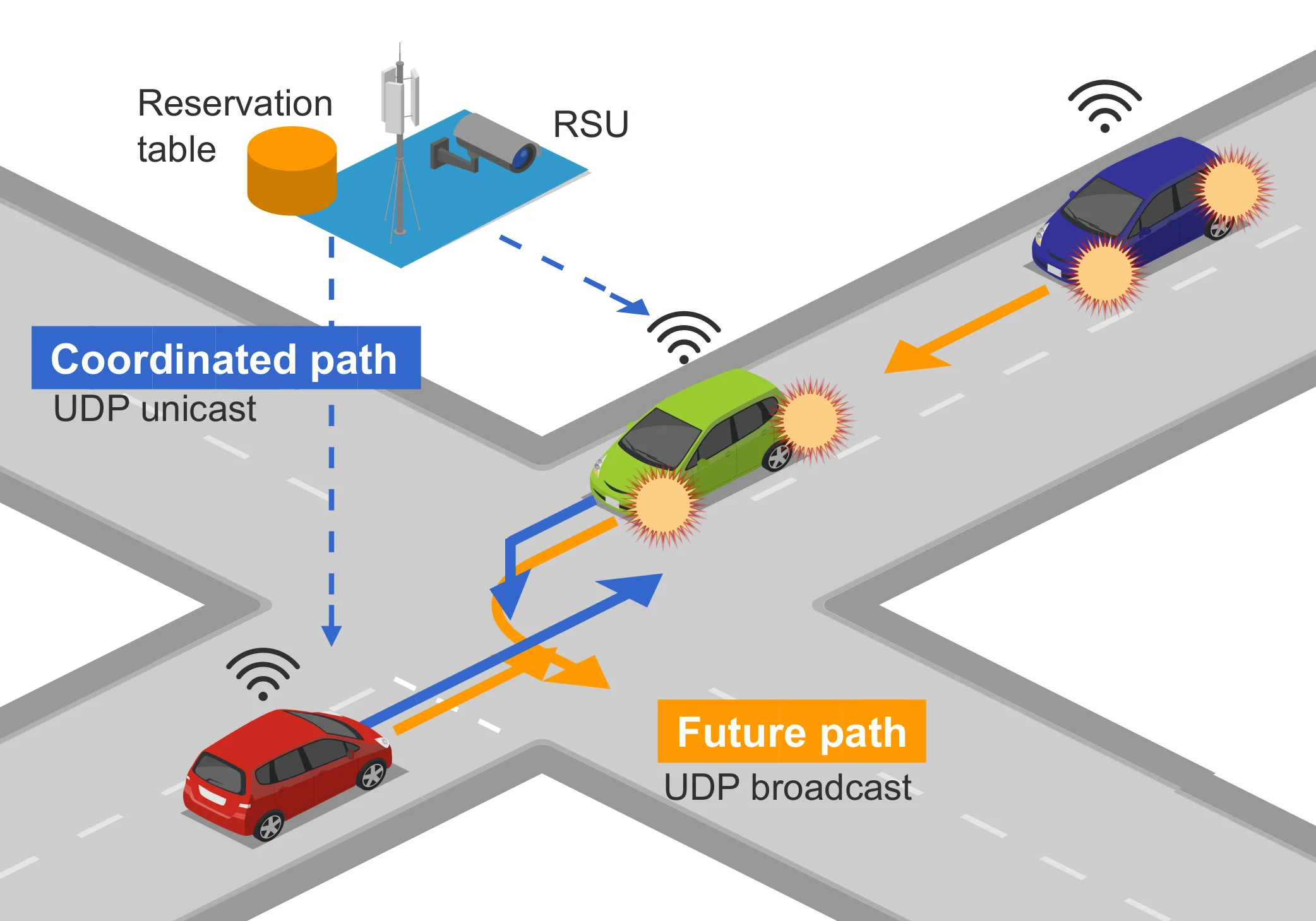
- The paper defines how automated vehicles share planned trajectories at intersections.
- A roadside unit uses those trajectories to detect conflicts or opportunities to accelerate and adjusts vehicle speeds accordingly.
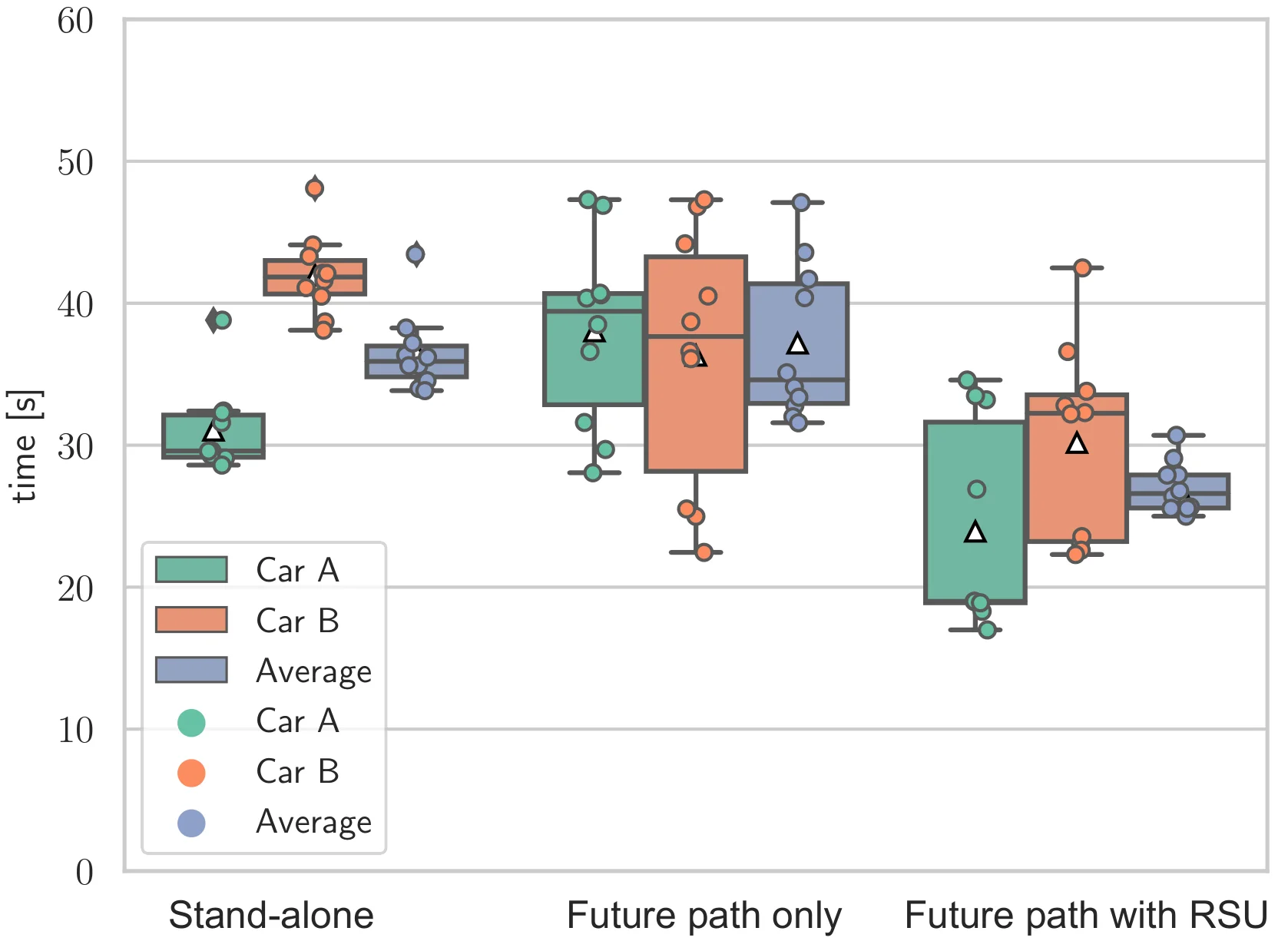
- In an Autoware and LGSVL simulation of a blind intersection, roadside coordination reduced the two vehicles’ travel times by 23.0% and 28.1%, respectively.
Figures from the paper
Abstract
Cooperative intelligent transportation systems (ITS) are used by autonomous vehicles to communicate with surrounding autonomous vehicles and roadside units (RSU). Current C-ITS applications focus primarily on real-time information sharing, such as cooperative perception. In addition to real-time information sharing, self-driving cars need to coordinate their action plans to achieve higher safety and efficiency. For this reason, this study defines a vehicle’s future action plan/path and designs a cooperative path-planning model at intersections using future path sharing based on the future path information of multiple vehicles. The notion is that when the RSU detects a potential conflict of vehicle paths or an acceleration opportunity according to the shared future paths, it will generate a coordinated path update that adjusts the speeds of the vehicles. We implemented the proposed method using the open-source Autoware autonomous driving software and evaluated it with the LGSVL autonomous vehicle simulator. We conducted simulation experiments with two vehicles at a blind intersection scenario, finding that each car can travel safely and more efficiently by planning a path that reflects the action plans of all vehicles involved. The time consumed by introducing the RSU is 23.0 % and 28.1 % shorter than that of the stand-alone autonomous driving case at the intersection.
Video
Related research and software
How to cite
M. Hirata, M. Tsukada, K. Okumura, Y. Tamura, H. Ochiai, and X. Défago, “Roadside-assisted Cooperative Planning using Future Path Sharing for Autonomous Driving,” in IEEE 94th Vehicular Technology Conference (VTC2021-Fall), Online, 2021, doi: 10.1109/VTC2021-Fall52928.2021.9625324.
BibTeX
@inproceedings{Hirata2021b,
  title         = {Roadside-assisted Cooperative Planning using Future Path Sharing for Autonomous Driving},
  author        = {Mai Hirata and Manabu Tsukada and Keisuke Okumura and Yasumasa Tamura and Hideya Ochiai and Xavier Défago},
  url           = {https://arxiv.org/abs/2108.04629 https://youtu.be/xaBIQC0SClE},
  doi           = {10.1109/VTC2021-Fall52928.2021.9625324},
  year          = {2021},
  date          = {2021-09-27},
  urldate       = {2021-09-27},
  booktitle     = {IEEE 94th Vehicular Technology Conference (VTC2021-Fall)},
  address       = {Online},
  abstract      = {Cooperative intelligent transportation systems (ITS) are used by autonomous vehicles to communicate with surrounding autonomous vehicles and roadside units (RSU). Current C-ITS applications focus primarily on real-time information sharing, such as cooperative perception. In addition to real-time information sharing, self-driving cars need to coordinate their action plans to achieve higher safety and efficiency. For this reason, this study defines a vehicle’s future action plan/path and designs a cooperative path-planning model at intersections using future path sharing based on the future path information of multiple vehicles. The notion is that when the RSU detects a potential conflict of vehicle paths or an acceleration opportunity according to the shared future paths, it will generate a coordinated path update that adjusts the speeds of the vehicles. We implemented the proposed method using the open-source Autoware autonomous driving software and evaluated it with the LGSVL autonomous vehicle simulator. We conducted simulation experiments with two vehicles at a blind intersection scenario, finding that each car can travel safely and more efficiently by planning a path that reflects the action plans of all vehicles involved. The time consumed by introducing the RSU is 23.0 % and 28.1 % shorter than that of the stand-alone autonomous driving case at the intersection.},
  keywords      = {ITS},
  pubstate      = {published},
  tppubtype     = {inproceedings}
}