
Enhancing Real-Time Streaming Quality through a Multipath Redundant Communication Framework
IFIP/IEEE Networking 2024, Thessaloniki, Greece, 2024年6月3日
DOI: 10.23919/IFIPNetworking62109.2024.10619885
3行要約
- 複数経路にデータを冗長送信し、リアルタイム配信の安定性を高める。
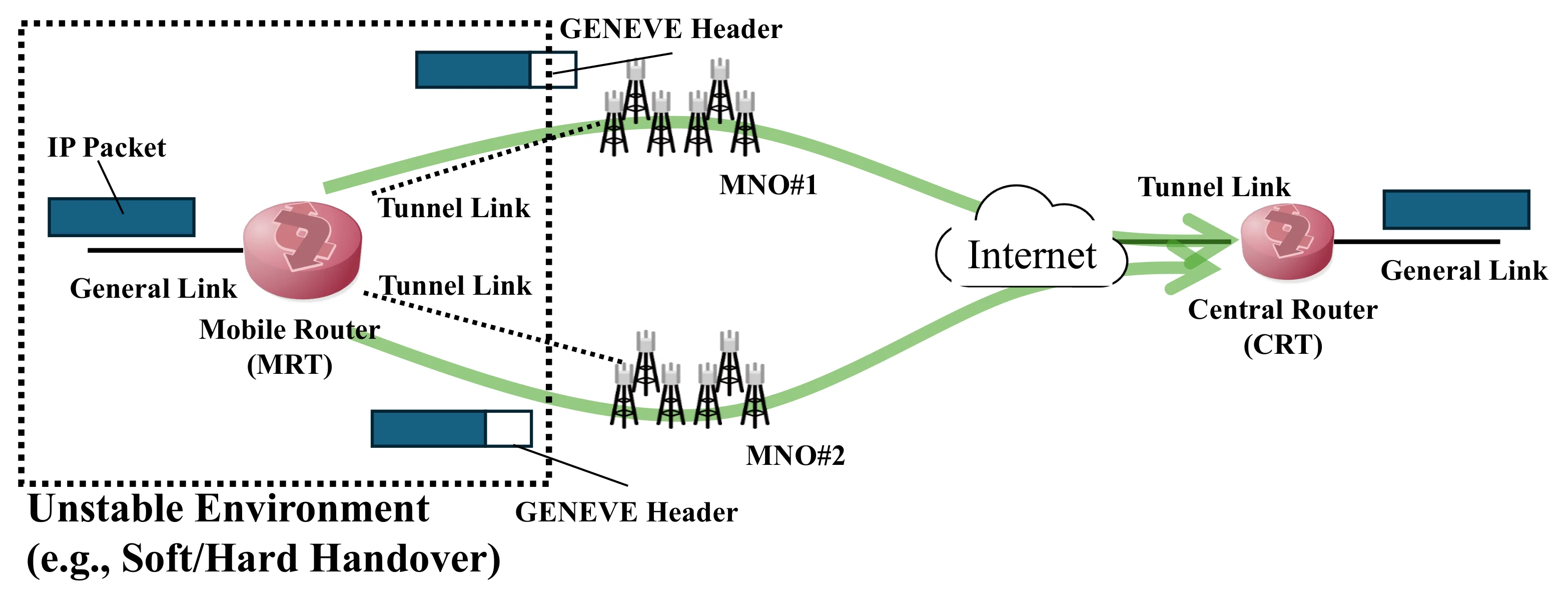
- IP層のトンネルで既存のトランスポートに対応し、受信側のバッファでパケット順序を整える。
- 市街地でのWebRTC配信試験では、輻輳制御を妨げずに損失を減らし、ビットレートを改善した。
論文の図
アブストラクト(原文)
Recently, as networks operate as the infrastructure of modern society, the demands placed on the network by applications have become more complex. In particular, an increasing annual demand for high-capacity and low-latency services, including real-time streaming. 5G services have been launched to meet this demand, but their stability varies de- pending on location and time and can only sometimes be considered sufficient. One method to improve communication stability is multipath redundant communication, and much research has been conducted in this area. However, most of this research has focused on TCP-based communication and cannot be applied to real-time UDP streaming. Hence, we propose a multipath redundant communication framework to improve the quality of real-time media streaming communication. Tunneling at the IP layer in our proposed framework was performed to overcome the limitations of transport layer protocols, which was a challenge for traditional multipath redundant communication systems. Furthermore, to address the packet order inconsistency caused by multipath redundant communication, a buffering mechanism was implemented on the receiving side of our system. Our proposed system was verified using multipath redundant communication and multiple mobile networks from a vehicle moving in an urban area. The experiments used a real-time streaming application based on WebRTC, and the framework significantly reduced packet loss and improved bitrate compared to existing multipath redundant communication systems without interfering with the application’s congestion control.
関連する研究・ソフトウェア
引用方法
K. Ito, J. Nakazato, R. Fontugne, M. Tsukada, and H. Esaki, “Enhancing Real-Time Streaming Quality through a Multipath Redundant Communication Framework,” in IFIP/IEEE Networking 2024, Thessaloniki, Greece, 2024, doi: 10.23919/IFIPNetworking62109.2024.10619885.
BibTeX
@inproceedings{Ito2024,
  title         = {Enhancing Real-Time Streaming Quality through a Multipath Redundant Communication Framework},
  author        = {Koki Ito and Jin Nakazato and Romain Fontugne and Manabu Tsukada and Hiroshi Esaki},
  doi           = {10.23919/IFIPNetworking62109.2024.10619885},
  year          = {2024},
  date          = {2024-06-03},
  urldate       = {2024-06-03},
  booktitle     = {IFIP/IEEE Networking 2024},
  address       = {Thessaloniki, Greece},
  abstract      = {Recently, as networks operate as the infrastructure of modern society, the demands placed on the network by applications have become more complex. In particular, an increasing annual demand for high-capacity and low-latency services, including real-time streaming. 5G services have been launched to meet this demand, but their stability varies de- pending on location and time and can only sometimes be considered sufficient. One method to improve communication stability is multipath redundant communication, and much research has been conducted in this area. However, most of this research has focused on TCP-based communication and cannot be applied to real-time UDP streaming. Hence, we propose a multipath redundant communication framework to improve the quality of real-time media streaming communication. Tunneling at the IP layer in our proposed framework was performed to overcome the limitations of transport layer protocols, which was a challenge for traditional multipath redundant communication systems. Furthermore, to address the packet order inconsistency caused by multipath redundant communication, a buffering mechanism was implemented on the receiving side of our system. Our proposed system was verified using multipath redundant communication and multiple mobile networks from a vehicle moving in an urban area. The experiments used a real-time streaming application based on WebRTC, and the framework significantly reduced packet loss and improved bitrate compared to existing multipath redundant communication systems without interfering with the application’s congestion control.},
  keywords      = {ITS},
  pubstate      = {published},
  tppubtype     = {inproceedings}
}