
Enhancing Real-Time Streaming Quality through a Multipath Redundant Communication Framework
IFIP/IEEE Networking 2024, Thessaloniki, Greece, Jun 3, 2024
DOI: 10.23919/IFIPNetworking62109.2024.10619885
Summary in three lines
- The framework uses redundant paths to make real-time streaming more reliable.
- IP tunneling allows use with existing transport protocols, and receiver-side buffering handles packet reordering.
- Urban driving tests of WebRTC showed lower packet loss and higher bitrate without disrupting congestion control.
Figures from the paper
Abstract
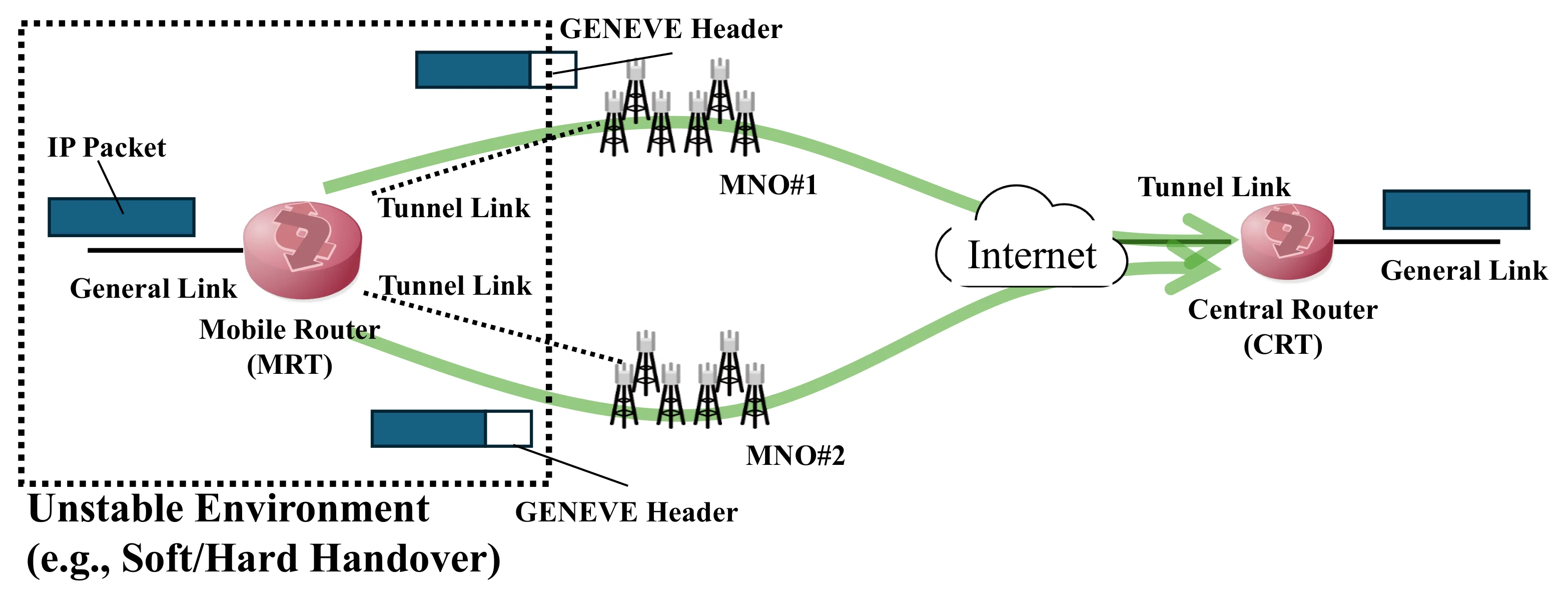
Recently, as networks operate as the infrastructure of modern society, the demands placed on the network by applications have become more complex. In particular, an increasing annual demand for high-capacity and low-latency services, including real-time streaming. 5G services have been launched to meet this demand, but their stability varies de- pending on location and time and can only sometimes be considered sufficient. One method to improve communication stability is multipath redundant communication, and much research has been conducted in this area. However, most of this research has focused on TCP-based communication and cannot be applied to real-time UDP streaming. Hence, we propose a multipath redundant communication framework to improve the quality of real-time media streaming communication. Tunneling at the IP layer in our proposed framework was performed to overcome the limitations of transport layer protocols, which was a challenge for traditional multipath redundant communication systems. Furthermore, to address the packet order inconsistency caused by multipath redundant communication, a buffering mechanism was implemented on the receiving side of our system. Our proposed system was verified using multipath redundant communication and multiple mobile networks from a vehicle moving in an urban area. The experiments used a real-time streaming application based on WebRTC, and the framework significantly reduced packet loss and improved bitrate compared to existing multipath redundant communication systems without interfering with the application’s congestion control.
Related research and software
How to cite
K. Ito, J. Nakazato, R. Fontugne, M. Tsukada, and H. Esaki, “Enhancing Real-Time Streaming Quality through a Multipath Redundant Communication Framework,” in IFIP/IEEE Networking 2024, Thessaloniki, Greece, 2024, doi: 10.23919/IFIPNetworking62109.2024.10619885.
BibTeX
@inproceedings{Ito2024,
  title         = {Enhancing Real-Time Streaming Quality through a Multipath Redundant Communication Framework},
  author        = {Koki Ito and Jin Nakazato and Romain Fontugne and Manabu Tsukada and Hiroshi Esaki},
  doi           = {10.23919/IFIPNetworking62109.2024.10619885},
  year          = {2024},
  date          = {2024-06-03},
  urldate       = {2024-06-03},
  booktitle     = {IFIP/IEEE Networking 2024},
  address       = {Thessaloniki, Greece},
  abstract      = {Recently, as networks operate as the infrastructure of modern society, the demands placed on the network by applications have become more complex. In particular, an increasing annual demand for high-capacity and low-latency services, including real-time streaming. 5G services have been launched to meet this demand, but their stability varies de- pending on location and time and can only sometimes be considered sufficient. One method to improve communication stability is multipath redundant communication, and much research has been conducted in this area. However, most of this research has focused on TCP-based communication and cannot be applied to real-time UDP streaming. Hence, we propose a multipath redundant communication framework to improve the quality of real-time media streaming communication. Tunneling at the IP layer in our proposed framework was performed to overcome the limitations of transport layer protocols, which was a challenge for traditional multipath redundant communication systems. Furthermore, to address the packet order inconsistency caused by multipath redundant communication, a buffering mechanism was implemented on the receiving side of our system. Our proposed system was verified using multipath redundant communication and multiple mobile networks from a vehicle moving in an urban area. The experiments used a real-time streaming application based on WebRTC, and the framework significantly reduced packet loss and improved bitrate compared to existing multipath redundant communication systems without interfering with the application’s congestion control.},
  keywords      = {ITS},
  pubstate      = {published},
  tppubtype     = {inproceedings}
}