
AoI Optimization in 5G NR-V2X Sidelink through Propagation-Aware Dynamic Congestion Control
Sixth International Workshop on Pervasive Computing for Vehicular Systems (PERVEHICLE 2026), Pisa, Italy, 2026年3月16日
DOI: 10.1109/PerComWorkshops68308.2026.11585202
3行要約
- 交通条件が変わる5G NR-V2Xサイドリンクで、固定のセンシング窓に起因する情報鮮度の低下を扱う。
- 分散型の制御器が近傍の送信状況を推定し、半持続的スケジューリングのセンシング窓を調整する。
- 異なる交通密度・移動条件でのシミュレーションで、平均と上位分位の情報鮮度が改善した。
論文の図
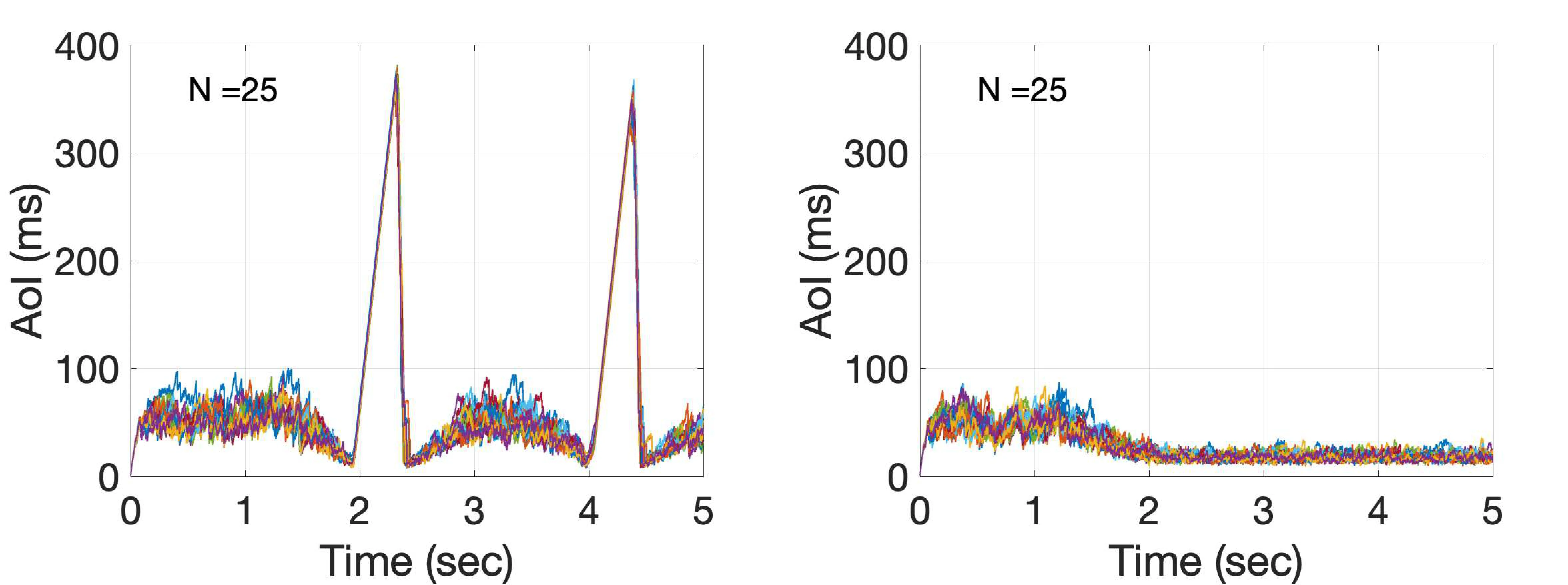
アブストラクト(原文)
Only the chairs can edit Maintaining low Age of Information (AoI) is essential for connected and autonomous vehicles, yet the Semi-Persistent Scheduling (SPS) procedure standardized for 5G NR-V2X sidelink employs a fixed sensing window that cannot adapt to changes in traffic load or vehicle density. This limitation increases resource-selection conflicts and degrades the timeliness required for cooperative perception and cooperative driving. This paper introduces a lightweight, fully distributed congestion-control mechanism that incorporates real-time congestion information into the SPS sensing process. By deriving statistics from neighboring transmission periodicity, the method dynamically adjusts the sensing-window span to reduce collisions and prevent excessive channel occupation. The approach is evaluated in a system-level framework combining microscopic mobility with a detailed wireless channel and SPS access model. Across diverse densities, mobility conditions, and communication ranges, the adaptive sensing-window mechanism consistently improves both mean and tail AoI and enhances the stability of the Resource Reservation Interval. It achieves substantial reductions in information staleness, including significant gains for short-range, safety-critical exchanges. Because it solely refines the sensing-window computation without modifying SPS signaling, the method offers a practical and readily deployable enhancement to NR-V2X Mode 2 congestion control.
引用方法
R. Iwaki, A. Rolich, J. Nakazato, M. Yildiz, M. Tsukada, and A. Baiocchi, “AoI Optimization in 5G NR-V2X Sidelink through Propagation-Aware Dynamic Congestion Control,” in Sixth International Workshop on Pervasive Computing for Vehicular Systems (PERVEHICLE 2026), Pisa, Italy, 2026, doi: 10.1109/PerComWorkshops68308.2026.11585202.
BibTeX
@workshop{Iwaki2026,
  title         = {AoI Optimization in 5G NR-V2X Sidelink through Propagation-Aware Dynamic Congestion Control},
  author        = {Ryo Iwaki and Alexey Rolich and Jin Nakazato and Mert Yildiz and Manabu Tsukada and Andrea Baiocchi},
  doi           = {10.1109/PerComWorkshops68308.2026.11585202},
  year          = {2026},
  date          = {2026-03-16},
  urldate       = {2026-03-16},
  booktitle     = {Sixth International Workshop on Pervasive Computing for Vehicular Systems (PERVEHICLE 2026)},
  address       = {Pisa, Italy},
  abstract      = {Only the chairs can edit Maintaining low Age of Information (AoI) is essential for connected and autonomous vehicles, yet the Semi-Persistent Scheduling (SPS) procedure standardized for 5G NR-V2X sidelink employs a fixed sensing window that cannot adapt to changes in traffic load or vehicle density. This limitation increases resource-selection conflicts and degrades the timeliness required for cooperative perception and cooperative driving. This paper introduces a lightweight, fully distributed congestion-control mechanism that incorporates real-time congestion information into the SPS sensing process. By deriving statistics from neighboring transmission periodicity, the method dynamically adjusts the sensing-window span to reduce collisions and prevent excessive channel occupation. The approach is evaluated in a system-level framework combining microscopic mobility with a detailed wireless channel and SPS access model. Across diverse densities, mobility conditions, and communication ranges, the adaptive sensing-window mechanism consistently improves both mean and tail AoI and enhances the stability of the Resource Reservation Interval. It achieves substantial reductions in information staleness, including significant gains for short-range, safety-critical exchanges. Because it solely refines the sensing-window computation without modifying SPS signaling, the method offers a practical and readily deployable enhancement to NR-V2X Mode 2 congestion control.},
  howpublished  = {Sixth International Workshop on Pervasive Computing for Vehicular Systems (PERVEHICLE 2026)},
  keywords      = {ITS},
  pubstate      = {published},
  tppubtype     = {workshop}
}