
AoI Optimization in 5G NR-V2X Sidelink through Propagation-Aware Dynamic Congestion Control
Sixth International Workshop on Pervasive Computing for Vehicular Systems (PERVEHICLE 2026), Pisa, Italy, Mar 16, 2026
DOI: 10.1109/PerComWorkshops68308.2026.11585202
Summary in three lines
- The work addresses stale messages in 5G NR-V2X sidelink when a fixed sensing window is used across different traffic conditions.
- A distributed controller estimates neighboring activity and adjusts the sensing window for semi-persistent scheduling.
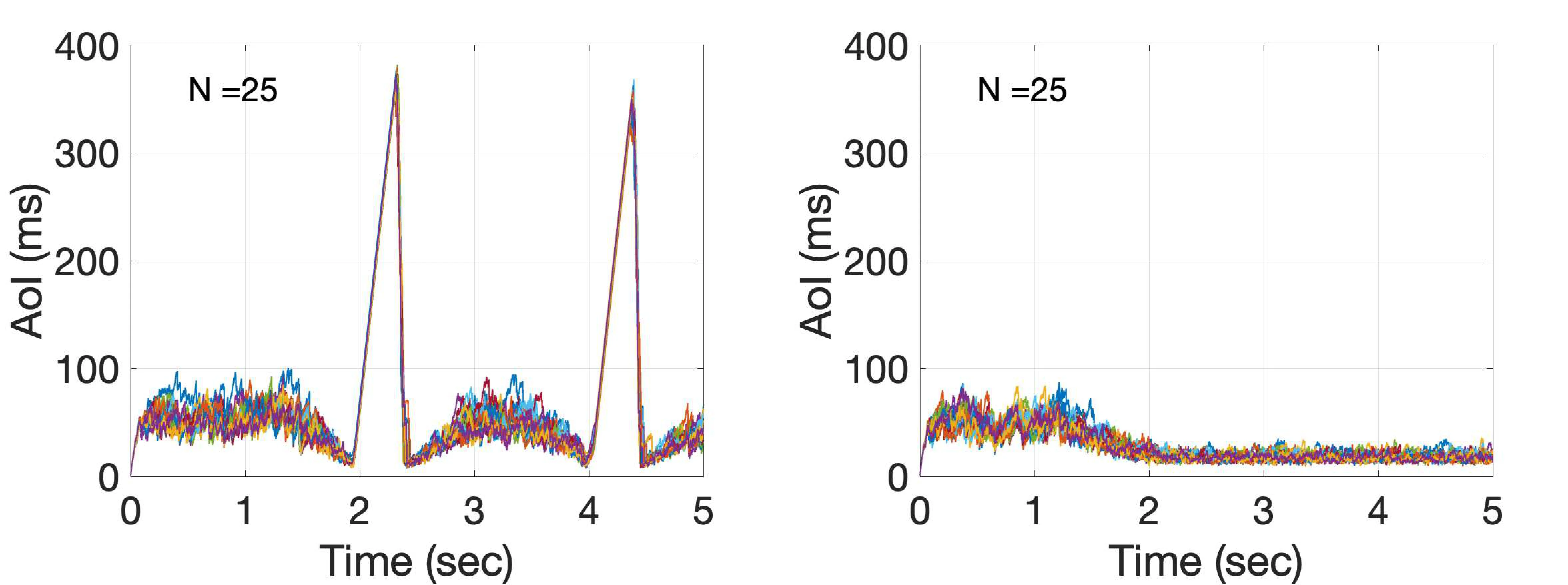
- System-level simulations found improvements in mean and tail Age of Information across several traffic densities and mobility settings.
Figures from the paper
Abstract
Only the chairs can edit Maintaining low Age of Information (AoI) is essential for connected and autonomous vehicles, yet the Semi-Persistent Scheduling (SPS) procedure standardized for 5G NR-V2X sidelink employs a fixed sensing window that cannot adapt to changes in traffic load or vehicle density. This limitation increases resource-selection conflicts and degrades the timeliness required for cooperative perception and cooperative driving. This paper introduces a lightweight, fully distributed congestion-control mechanism that incorporates real-time congestion information into the SPS sensing process. By deriving statistics from neighboring transmission periodicity, the method dynamically adjusts the sensing-window span to reduce collisions and prevent excessive channel occupation. The approach is evaluated in a system-level framework combining microscopic mobility with a detailed wireless channel and SPS access model. Across diverse densities, mobility conditions, and communication ranges, the adaptive sensing-window mechanism consistently improves both mean and tail AoI and enhances the stability of the Resource Reservation Interval. It achieves substantial reductions in information staleness, including significant gains for short-range, safety-critical exchanges. Because it solely refines the sensing-window computation without modifying SPS signaling, the method offers a practical and readily deployable enhancement to NR-V2X Mode 2 congestion control.
How to cite
R. Iwaki, A. Rolich, J. Nakazato, M. Yildiz, M. Tsukada, and A. Baiocchi, “AoI Optimization in 5G NR-V2X Sidelink through Propagation-Aware Dynamic Congestion Control,” in Sixth International Workshop on Pervasive Computing for Vehicular Systems (PERVEHICLE 2026), Pisa, Italy, 2026, doi: 10.1109/PerComWorkshops68308.2026.11585202.
BibTeX
@workshop{Iwaki2026,
  title         = {AoI Optimization in 5G NR-V2X Sidelink through Propagation-Aware Dynamic Congestion Control},
  author        = {Ryo Iwaki and Alexey Rolich and Jin Nakazato and Mert Yildiz and Manabu Tsukada and Andrea Baiocchi},
  doi           = {10.1109/PerComWorkshops68308.2026.11585202},
  year          = {2026},
  date          = {2026-03-16},
  urldate       = {2026-03-16},
  booktitle     = {Sixth International Workshop on Pervasive Computing for Vehicular Systems (PERVEHICLE 2026)},
  address       = {Pisa, Italy},
  abstract      = {Only the chairs can edit Maintaining low Age of Information (AoI) is essential for connected and autonomous vehicles, yet the Semi-Persistent Scheduling (SPS) procedure standardized for 5G NR-V2X sidelink employs a fixed sensing window that cannot adapt to changes in traffic load or vehicle density. This limitation increases resource-selection conflicts and degrades the timeliness required for cooperative perception and cooperative driving. This paper introduces a lightweight, fully distributed congestion-control mechanism that incorporates real-time congestion information into the SPS sensing process. By deriving statistics from neighboring transmission periodicity, the method dynamically adjusts the sensing-window span to reduce collisions and prevent excessive channel occupation. The approach is evaluated in a system-level framework combining microscopic mobility with a detailed wireless channel and SPS access model. Across diverse densities, mobility conditions, and communication ranges, the adaptive sensing-window mechanism consistently improves both mean and tail AoI and enhances the stability of the Resource Reservation Interval. It achieves substantial reductions in information staleness, including significant gains for short-range, safety-critical exchanges. Because it solely refines the sensing-window computation without modifying SPS signaling, the method offers a practical and readily deployable enhancement to NR-V2X Mode 2 congestion control.},
  howpublished  = {Sixth International Workshop on Pervasive Computing for Vehicular Systems (PERVEHICLE 2026)},
  keywords      = {ITS},
  pubstate      = {published},
  tppubtype     = {workshop}
}