
Enhancing Autonomous Vehicle Localization through Cooperative LiDAR and Smart Infrastructure Integration
IEEE Open Journal of Intelligent Transportation Systems, 2026年2月14日
DOI: 10.1109/OJITS.2026.3664106
3行要約
- 路側LiDARから車両の位置情報を補い、自動運転車の測位を改善する。
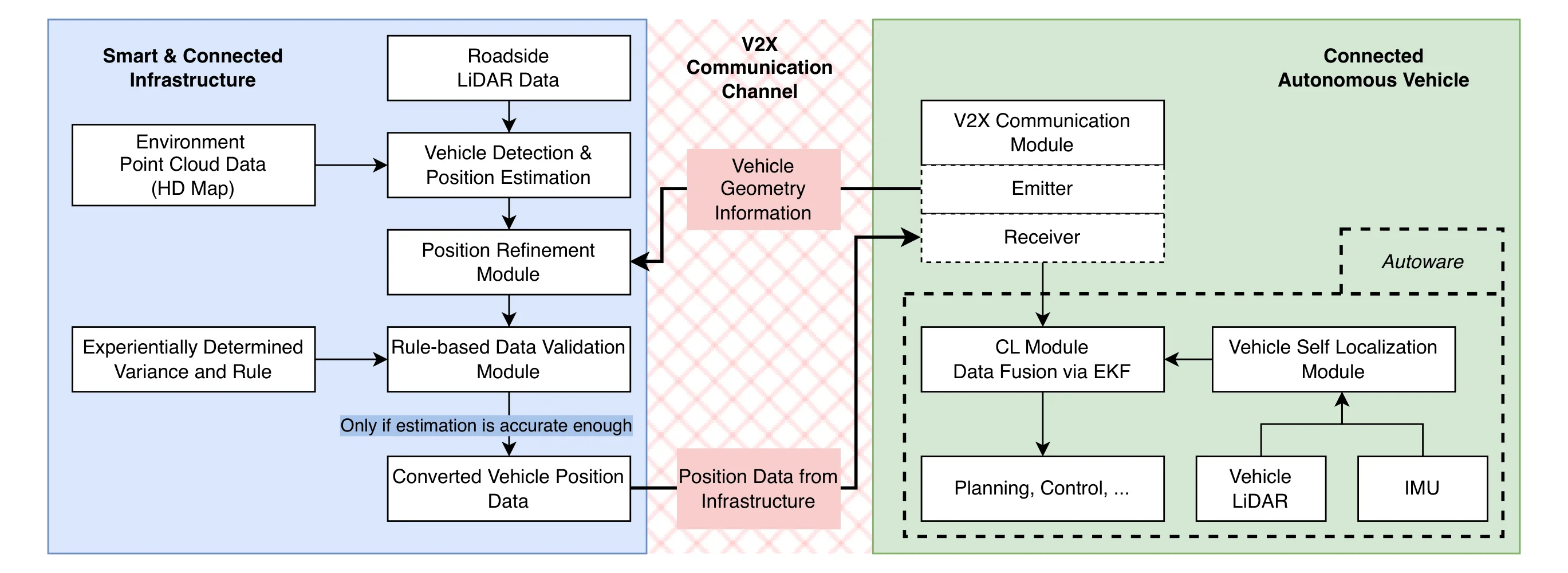
- 路側で車両形状に基づく位置を補正してV2Iで伝送し、車載センサの測定と融合する。
- デジタルツイン実験で、路側情報の追加による車載センサ単独からの改善を定量化した。
論文の図
アブストラクト(原文)
Autonomous driving systems rely on precise localization to ensure safety and performance in dynamic environments. However, standalone vehicle localization methods using onboard sensors often fail to deliver sufficient accuracy in adverse environments, such as tunnels or areas with limited distinguishable features. To address these challenges, we propose a novel cooperative localization framework that leverages roadside LiDAR-equipped infrastructure and vehicle-to-infrastructure (V2I) communication. In our approach, roadside LiDARs detect and estimate vehicle positions using a refined L-shape fitting algorithm, complemented by the vehicle’s geometric data shared over the V2I network. This method mitigates errors associated with partial point cloud data and improves localization precision significantly. By integrating this infrastructure-based positioning data with onboard localization modules via sensor fusion, our framework enhances overall accuracy and robustness in real-time autonomous driving scenarios. Experimental results in a digital twin environment demonstrate that our system achieves over 70% improvement in localization accuracy compared to self-localization methods. Our work highlights the potential of smart infrastructure to enhance localization, reduce onboard sensor dependency, and improve autonomous driving reliability under challenging environment for self-localization.
引用方法
Y. Jiang, E. Javanmardi, M. Tsukada, and H. Esaki, “Enhancing Autonomous Vehicle Localization through Cooperative LiDAR and Smart Infrastructure Integration,” IEEE Open Journal of Intelligent Transportation Systems, 2026, doi: 10.1109/OJITS.2026.3664106.
BibTeX
@article{Jiang2026,
  title         = {Enhancing Autonomous Vehicle Localization through Cooperative LiDAR and Smart Infrastructure Integration},
  author        = {Yuze Jiang and Ehsan Javanmardi and Manabu Tsukada and Hiroshi Esaki},
  doi           = {10.1109/OJITS.2026.3664106},
  issn          = {2687-7813},
  year          = {2026},
  date          = {2026-02-14},
  urldate       = {2026-02-17},
  journal       = {IEEE Open Journal of Intelligent Transportation Systems},
  abstract      = {Autonomous driving systems rely on precise localization to ensure safety and performance in dynamic environments. However, standalone vehicle localization methods using onboard sensors often fail to deliver sufficient accuracy in adverse environments, such as tunnels or areas with limited distinguishable features. To address these challenges, we propose a novel cooperative localization framework that leverages roadside LiDAR-equipped infrastructure and vehicle-to-infrastructure (V2I) communication. In our approach, roadside LiDARs detect and estimate vehicle positions using a refined L-shape fitting algorithm, complemented by the vehicle’s geometric data shared over the V2I network. This method mitigates errors associated with partial point cloud data and improves localization precision significantly. By integrating this infrastructure-based positioning data with onboard localization modules via sensor fusion, our framework enhances overall accuracy and robustness in real-time autonomous driving scenarios. Experimental results in a digital twin environment demonstrate that our system achieves over 70% improvement in localization accuracy compared to self-localization methods. Our work highlights the potential of smart infrastructure to enhance localization, reduce onboard sensor dependency, and improve autonomous driving reliability under challenging environment for self-localization.},
  keywords      = {ITS},
  pubstate      = {published},
  tppubtype     = {article}
}