
Enhancing Autonomous Vehicle Localization through Cooperative LiDAR and Smart Infrastructure Integration
IEEE Open Journal of Intelligent Transportation Systems, Feb 14, 2026
DOI: 10.1109/OJITS.2026.3664106
Summary in three lines
- The paper improves vehicle localization by adding position information from roadside LiDAR.
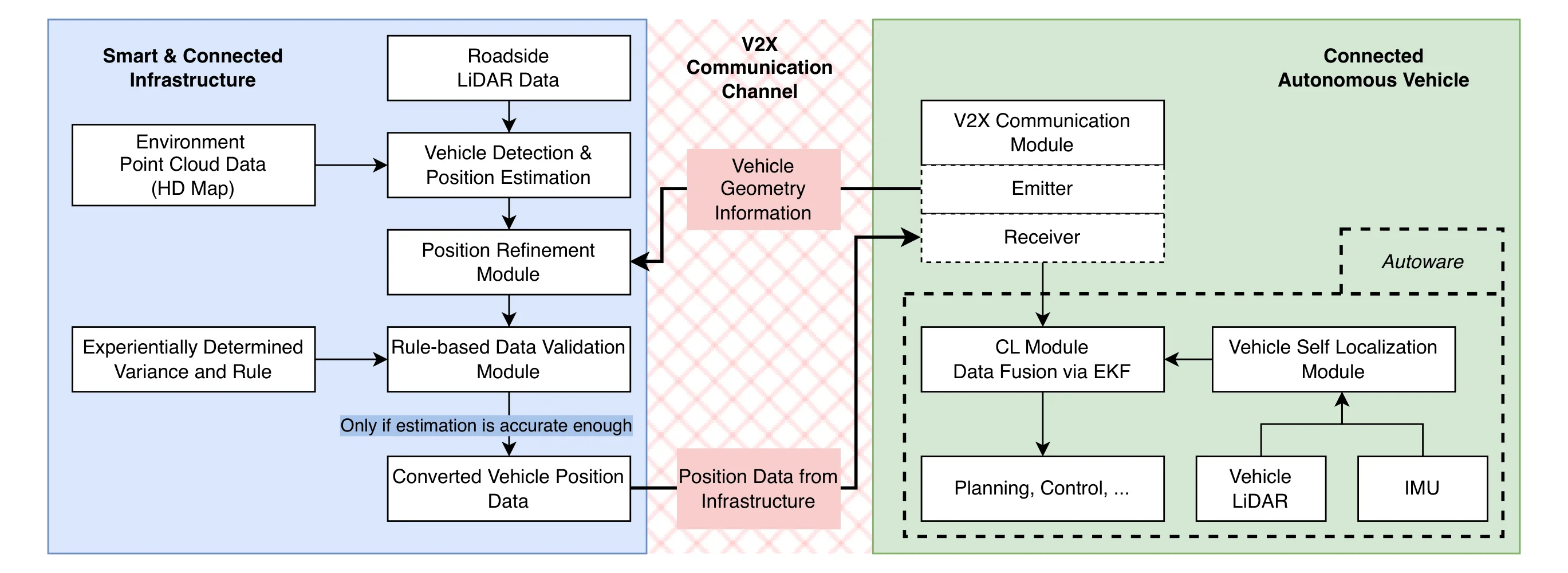
- It refines roadside vehicle geometry estimates, sends them over V2I and combines them with onboard measurements.
- Digital twin experiments quantify when the additional infrastructure improves localization over onboard sensing alone.
Figures from the paper
Abstract
Autonomous driving systems rely on precise localization to ensure safety and performance in dynamic environments. However, standalone vehicle localization methods using onboard sensors often fail to deliver sufficient accuracy in adverse environments, such as tunnels or areas with limited distinguishable features. To address these challenges, we propose a novel cooperative localization framework that leverages roadside LiDAR-equipped infrastructure and vehicle-to-infrastructure (V2I) communication. In our approach, roadside LiDARs detect and estimate vehicle positions using a refined L-shape fitting algorithm, complemented by the vehicle’s geometric data shared over the V2I network. This method mitigates errors associated with partial point cloud data and improves localization precision significantly. By integrating this infrastructure-based positioning data with onboard localization modules via sensor fusion, our framework enhances overall accuracy and robustness in real-time autonomous driving scenarios. Experimental results in a digital twin environment demonstrate that our system achieves over 70% improvement in localization accuracy compared to self-localization methods. Our work highlights the potential of smart infrastructure to enhance localization, reduce onboard sensor dependency, and improve autonomous driving reliability under challenging environment for self-localization.
How to cite
Y. Jiang, E. Javanmardi, M. Tsukada, and H. Esaki, “Enhancing Autonomous Vehicle Localization through Cooperative LiDAR and Smart Infrastructure Integration,” IEEE Open Journal of Intelligent Transportation Systems, 2026, doi: 10.1109/OJITS.2026.3664106.
BibTeX
@article{Jiang2026,
  title         = {Enhancing Autonomous Vehicle Localization through Cooperative LiDAR and Smart Infrastructure Integration},
  author        = {Yuze Jiang and Ehsan Javanmardi and Manabu Tsukada and Hiroshi Esaki},
  doi           = {10.1109/OJITS.2026.3664106},
  issn          = {2687-7813},
  year          = {2026},
  date          = {2026-02-14},
  urldate       = {2026-02-17},
  journal       = {IEEE Open Journal of Intelligent Transportation Systems},
  abstract      = {Autonomous driving systems rely on precise localization to ensure safety and performance in dynamic environments. However, standalone vehicle localization methods using onboard sensors often fail to deliver sufficient accuracy in adverse environments, such as tunnels or areas with limited distinguishable features. To address these challenges, we propose a novel cooperative localization framework that leverages roadside LiDAR-equipped infrastructure and vehicle-to-infrastructure (V2I) communication. In our approach, roadside LiDARs detect and estimate vehicle positions using a refined L-shape fitting algorithm, complemented by the vehicle’s geometric data shared over the V2I network. This method mitigates errors associated with partial point cloud data and improves localization precision significantly. By integrating this infrastructure-based positioning data with onboard localization modules via sensor fusion, our framework enhances overall accuracy and robustness in real-time autonomous driving scenarios. Experimental results in a digital twin environment demonstrate that our system achieves over 70% improvement in localization accuracy compared to self-localization methods. Our work highlights the potential of smart infrastructure to enhance localization, reduce onboard sensor dependency, and improve autonomous driving reliability under challenging environment for self-localization.},
  keywords      = {ITS},
  pubstate      = {published},
  tppubtype     = {article}
}