
Cooperative Path Planning Using Responsibility-Sensitive Safety (RSS)-based Potential Field with Sigmoid Curve
IEEE 95th Vehicular Technology Conference (VTC2022-Spring), Helsinki, Finland, 2022年6月19日
DOI: 10.1109/VTC2022-Spring54318.2022.9860508
3行要約
- ポテンシャル場による経路生成では、障害物付近での振動や局所解が問題になる。
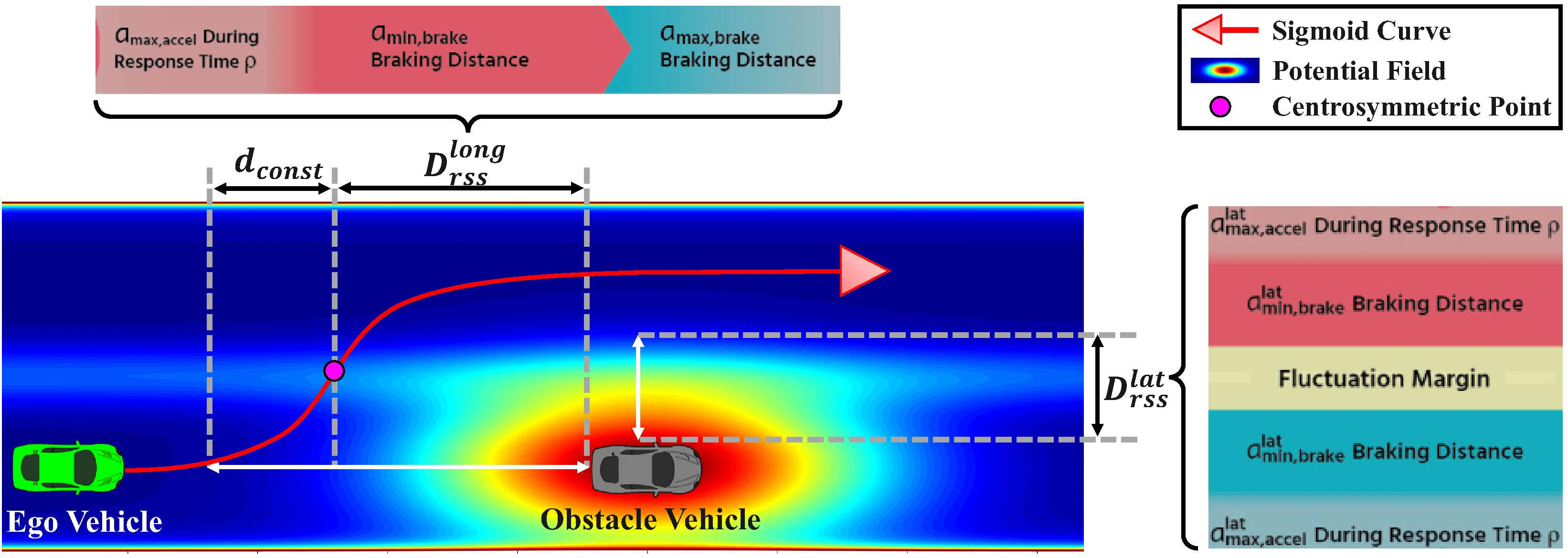
- RSSに基づく安全距離、シグモイド軌跡、車両間通信による協調を組み合わせる。
- 比較評価では、対象のシナリオで衝突を回避しながら計算時間を短縮した。
論文の図
アブストラクト(原文)
Potential field (PF)-based path planning is reported to be highly efficient for autonomous vehicles because it performs risk-aware computation and has a simple structure. However, the inherent limitations of the PF make it vulnerable in some specific traffic scenarios, such as local minima and oscillations in close obstacles. Therefore, a hybrid path planning with the sigmoid curve has recently been presented to generate better trajectories than those generated by the PF for collision avoidance. However, it is time-consuming and less applicable in complex dynamic environments, especially in traffic emergencies. To address these limitations, we propose a cooperative hybrid path planning (CHPP) approach that involves collaboration with adjacent vehicles for emergency collision avoidance via V2V communication. Moreover, the responsibility-sensitive safety (RSS) model is introduced to enhance the PF and sigmoid curve for safe-critical and time-saving requirements. The effectiveness of the proposed CHPP method compared with the state-of-the-art methods is studied through simulation of both static and dynamic traffic emergency scenarios. The simulation results prove that the CHPP approach performs better in terms of computation time (0.02 s faster) and driving safety (avoiding collision) than other methods, which are more supportive for emergency cooperative driving.
動画
関連ニュース
引用方法
P. Lin and M. Tsukada, “Cooperative Path Planning Using Responsibility-Sensitive Safety (RSS)-based Potential Field with Sigmoid Curve,” in IEEE 95th Vehicular Technology Conference (VTC2022-Spring), Helsinki, Finland, 2022, doi: 10.1109/VTC2022-Spring54318.2022.9860508.
BibTeX
@inproceedings{Lin2022b,
  title         = {Cooperative Path Planning Using Responsibility-Sensitive Safety (RSS)-based Potential Field with Sigmoid Curve},
  author        = {Pengfei Lin and Manabu Tsukada},
  url           = {https://youtu.be/AhgptWUyzSc},
  doi           = {10.1109/VTC2022-Spring54318.2022.9860508},
  year          = {2022},
  date          = {2022-06-19},
  urldate       = {2022-06-19},
  booktitle     = {IEEE 95th Vehicular Technology Conference (VTC2022-Spring)},
  address       = {Helsinki, Finland},
  abstract      = {Potential field (PF)-based path planning is reported to be highly efficient for autonomous vehicles because it performs risk-aware computation and has a simple structure. However, the inherent limitations of the PF make it vulnerable in some specific traffic scenarios, such as local minima and oscillations in close obstacles. Therefore, a hybrid path planning with the sigmoid curve has recently been presented to generate better trajectories than those generated by the PF for collision avoidance. However, it is time-consuming and less applicable in complex dynamic environments, especially in traffic emergencies. To address these limitations, we propose a cooperative hybrid path planning (CHPP) approach that involves collaboration with adjacent vehicles for emergency collision avoidance via V2V communication. Moreover, the responsibility-sensitive safety (RSS) model is introduced to enhance the PF and sigmoid curve for safe-critical and time-saving requirements. The effectiveness of the proposed CHPP method compared with the state-of-the-art methods is studied through simulation of both static and dynamic traffic emergency scenarios. The simulation results prove that the CHPP approach performs better in terms of computation time (0.02 s faster) and driving safety (avoiding collision) than other methods, which are more supportive for emergency cooperative driving.},
  keywords      = {ITS},
  pubstate      = {published},
  tppubtype     = {inproceedings}
}