
Cooperative Path Planning Using Responsibility-Sensitive Safety (RSS)-based Potential Field with Sigmoid Curve
IEEE 95th Vehicular Technology Conference (VTC2022-Spring), Helsinki, Finland, Jun 19, 2022
DOI: 10.1109/VTC2022-Spring54318.2022.9860508
Summary in three lines
- Potential-field planning can oscillate near obstacles or become trapped in local minima.
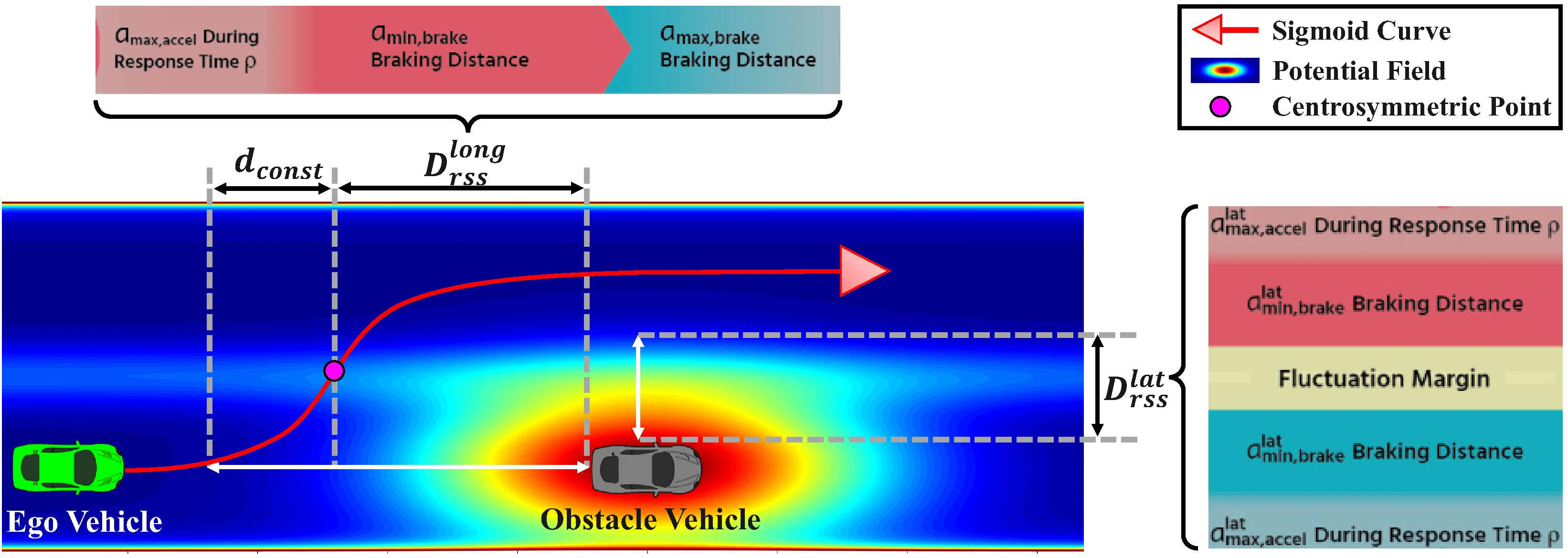
- The planner combines RSS-based safety distances, a sigmoid trajectory, and V2V cooperation.
- The comparison shows that the method can reduce computation time while avoiding collisions in the tested setting.
Figures from the paper
Abstract
Potential field (PF)-based path planning is reported to be highly efficient for autonomous vehicles because it performs risk-aware computation and has a simple structure. However, the inherent limitations of the PF make it vulnerable in some specific traffic scenarios, such as local minima and oscillations in close obstacles. Therefore, a hybrid path planning with the sigmoid curve has recently been presented to generate better trajectories than those generated by the PF for collision avoidance. However, it is time-consuming and less applicable in complex dynamic environments, especially in traffic emergencies. To address these limitations, we propose a cooperative hybrid path planning (CHPP) approach that involves collaboration with adjacent vehicles for emergency collision avoidance via V2V communication. Moreover, the responsibility-sensitive safety (RSS) model is introduced to enhance the PF and sigmoid curve for safe-critical and time-saving requirements. The effectiveness of the proposed CHPP method compared with the state-of-the-art methods is studied through simulation of both static and dynamic traffic emergency scenarios. The simulation results prove that the CHPP approach performs better in terms of computation time (0.02 s faster) and driving safety (avoiding collision) than other methods, which are more supportive for emergency cooperative driving.
Video
Related news
How to cite
P. Lin and M. Tsukada, “Cooperative Path Planning Using Responsibility-Sensitive Safety (RSS)-based Potential Field with Sigmoid Curve,” in IEEE 95th Vehicular Technology Conference (VTC2022-Spring), Helsinki, Finland, 2022, doi: 10.1109/VTC2022-Spring54318.2022.9860508.
BibTeX
@inproceedings{Lin2022b,
  title         = {Cooperative Path Planning Using Responsibility-Sensitive Safety (RSS)-based Potential Field with Sigmoid Curve},
  author        = {Pengfei Lin and Manabu Tsukada},
  url           = {https://youtu.be/AhgptWUyzSc},
  doi           = {10.1109/VTC2022-Spring54318.2022.9860508},
  year          = {2022},
  date          = {2022-06-19},
  urldate       = {2022-06-19},
  booktitle     = {IEEE 95th Vehicular Technology Conference (VTC2022-Spring)},
  address       = {Helsinki, Finland},
  abstract      = {Potential field (PF)-based path planning is reported to be highly efficient for autonomous vehicles because it performs risk-aware computation and has a simple structure. However, the inherent limitations of the PF make it vulnerable in some specific traffic scenarios, such as local minima and oscillations in close obstacles. Therefore, a hybrid path planning with the sigmoid curve has recently been presented to generate better trajectories than those generated by the PF for collision avoidance. However, it is time-consuming and less applicable in complex dynamic environments, especially in traffic emergencies. To address these limitations, we propose a cooperative hybrid path planning (CHPP) approach that involves collaboration with adjacent vehicles for emergency collision avoidance via V2V communication. Moreover, the responsibility-sensitive safety (RSS) model is introduced to enhance the PF and sigmoid curve for safe-critical and time-saving requirements. The effectiveness of the proposed CHPP method compared with the state-of-the-art methods is studied through simulation of both static and dynamic traffic emergency scenarios. The simulation results prove that the CHPP approach performs better in terms of computation time (0.02 s faster) and driving safety (avoiding collision) than other methods, which are more supportive for emergency cooperative driving.},
  keywords      = {ITS},
  pubstate      = {published},
  tppubtype     = {inproceedings}
}