
Adaptive Potential Field with Collision Avoidance for Connected Autonomous Vehicles
13th Asian Control Conference (ASCC 2022), Jeju, Korea, 2022年5月3日
DOI: 10.23919/ASCC56756.2022.9828160
3行要約
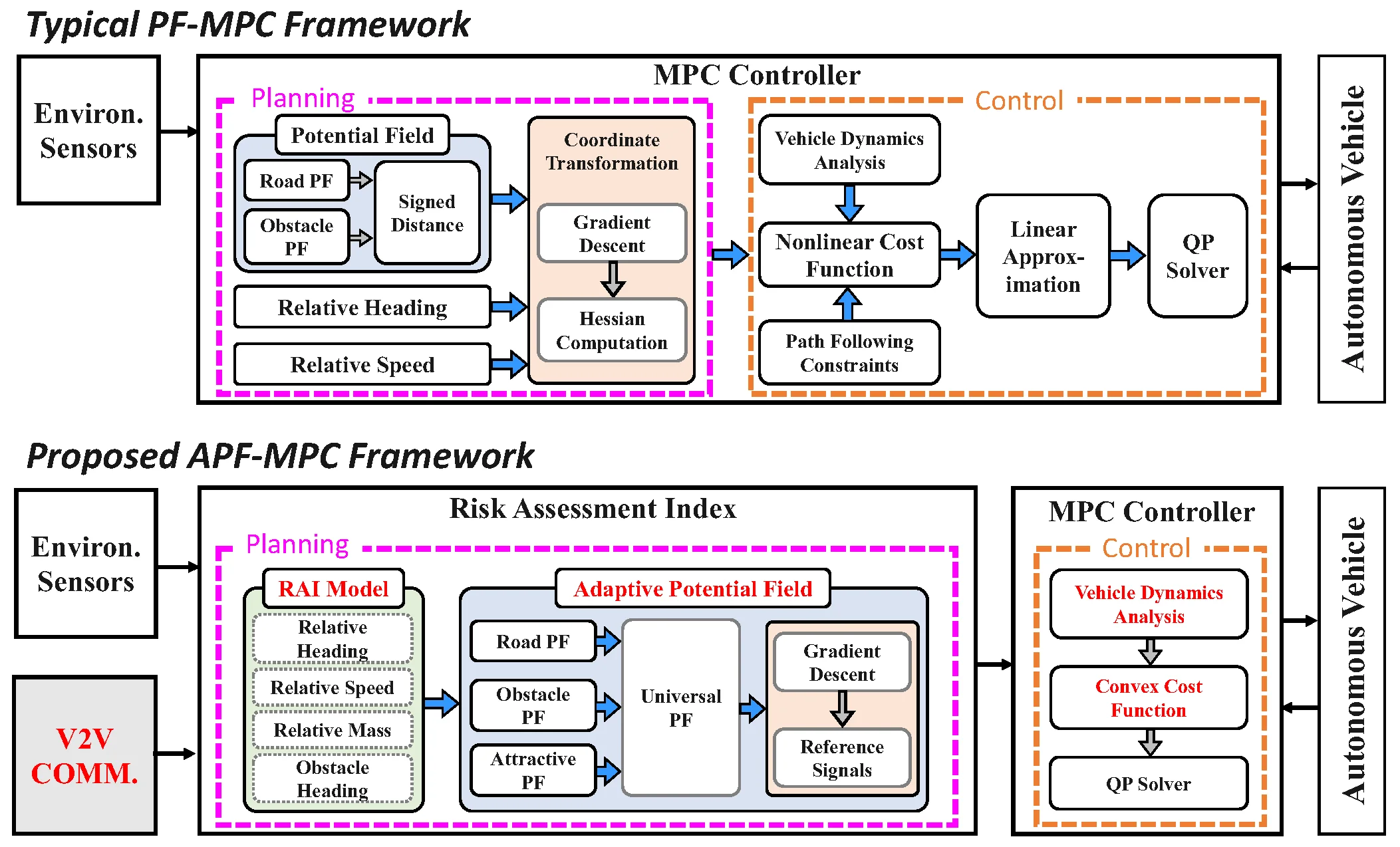
- 従来のポテンシャル場を拡張し、コネクテッド車両の向きや操舵角などを利用する。
- モデル予測制御のコスト関数とは別に、適応型ポテンシャル場で目標軌跡を作る。
- 衝突回避を改善しつつ、計算負荷を減らすことを目指す。
論文の図
アブストラクト(原文)
Potential field (PF), as a risk assessment method, is proposed to enhance autonomous vehicles’ (AVs) safety in collision avoidance. However, current PF targets mainly standalone-mode AVs (SAVs) by evaluating their relative position and velocity. In addition, the risk energy of the PF is usually assigned an infinite value along the z-axis. Therefore, this study presents an adaptive potential field (APF) for connected autonomous vehicles (CAVs). Valuable information (heading angle, steering wheel angle, etc.) other than relative position and velocity is supplemented to PF. Furthermore, we separate the APF from the cost function of the model predictive controller (MPC) to compute the desired reference signals directly, saving more computation time. The proposed APF-MPC is co-simulated in a comparative driving scenario via MATLAB/Simulink and CarSim simulator compared with the latest PF-MPC method.
引用方法
P. Lin and M. Tsukada, “Adaptive Potential Field with Collision Avoidance for Connected Autonomous Vehicles,” in 13th Asian Control Conference (ASCC 2022), Jeju, Korea, 2022, doi: 10.23919/ASCC56756.2022.9828160.
BibTeX
@inproceedings{Lin2022c,
  title         = {Adaptive Potential Field with Collision Avoidance for Connected Autonomous Vehicles},
  author        = {Pengfei Lin and Manabu Tsukada},
  doi           = {10.23919/ASCC56756.2022.9828160},
  year          = {2022},
  date          = {2022-05-03},
  urldate       = {2022-05-03},
  booktitle     = {13th Asian Control Conference (ASCC 2022)},
  address       = {Jeju, Korea},
  abstract      = {Potential field (PF), as a risk assessment method, is proposed to enhance autonomous vehicles’ (AVs) safety in collision avoidance. However, current PF targets mainly standalone-mode AVs (SAVs) by evaluating their relative position and velocity. In addition, the risk energy of the PF is usually assigned an infinite value along the z-axis. Therefore, this study presents an adaptive potential field (APF) for connected autonomous vehicles (CAVs). Valuable information (heading angle, steering wheel angle, etc.) other than relative position and velocity is supplemented to PF. Furthermore, we separate the APF from the cost function of the model predictive controller (MPC) to compute the desired reference signals directly, saving more computation time. The proposed APF-MPC is co-simulated in a comparative driving scenario via MATLAB/Simulink and CarSim simulator compared with the latest PF-MPC method.},
  keywords      = {ITS},
  pubstate      = {published},
  tppubtype     = {inproceedings}
}