
Adaptive Potential Field with Collision Avoidance for Connected Autonomous Vehicles
13th Asian Control Conference (ASCC 2022), Jeju, Korea, May 3, 2022
DOI: 10.23919/ASCC56756.2022.9828160
Summary in three lines
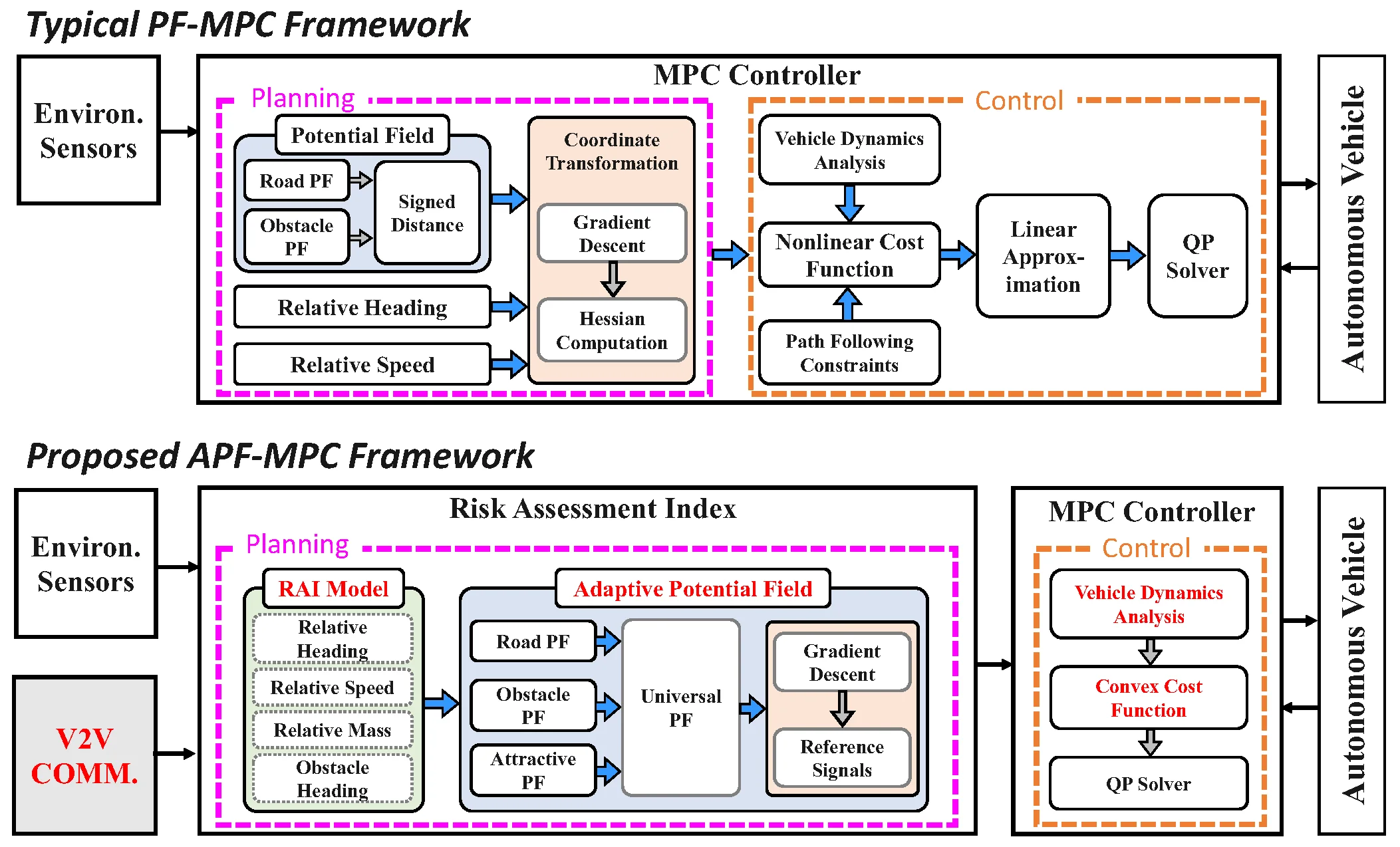
- The study extends conventional potential fields to use connected vehicles’ heading and steering data.
- The adaptive field generates a reference trajectory separately from the model predictive controller’s cost function.
- The resulting architecture aims to improve collision avoidance and reduce computation.
Figures from the paper
Abstract
Potential field (PF), as a risk assessment method, is proposed to enhance autonomous vehicles’ (AVs) safety in collision avoidance. However, current PF targets mainly standalone-mode AVs (SAVs) by evaluating their relative position and velocity. In addition, the risk energy of the PF is usually assigned an infinite value along the z-axis. Therefore, this study presents an adaptive potential field (APF) for connected autonomous vehicles (CAVs). Valuable information (heading angle, steering wheel angle, etc.) other than relative position and velocity is supplemented to PF. Furthermore, we separate the APF from the cost function of the model predictive controller (MPC) to compute the desired reference signals directly, saving more computation time. The proposed APF-MPC is co-simulated in a comparative driving scenario via MATLAB/Simulink and CarSim simulator compared with the latest PF-MPC method.
How to cite
P. Lin and M. Tsukada, “Adaptive Potential Field with Collision Avoidance for Connected Autonomous Vehicles,” in 13th Asian Control Conference (ASCC 2022), Jeju, Korea, 2022, doi: 10.23919/ASCC56756.2022.9828160.
BibTeX
@inproceedings{Lin2022c,
  title         = {Adaptive Potential Field with Collision Avoidance for Connected Autonomous Vehicles},
  author        = {Pengfei Lin and Manabu Tsukada},
  doi           = {10.23919/ASCC56756.2022.9828160},
  year          = {2022},
  date          = {2022-05-03},
  urldate       = {2022-05-03},
  booktitle     = {13th Asian Control Conference (ASCC 2022)},
  address       = {Jeju, Korea},
  abstract      = {Potential field (PF), as a risk assessment method, is proposed to enhance autonomous vehicles’ (AVs) safety in collision avoidance. However, current PF targets mainly standalone-mode AVs (SAVs) by evaluating their relative position and velocity. In addition, the risk energy of the PF is usually assigned an infinite value along the z-axis. Therefore, this study presents an adaptive potential field (APF) for connected autonomous vehicles (CAVs). Valuable information (heading angle, steering wheel angle, etc.) other than relative position and velocity is supplemented to PF. Furthermore, we separate the APF from the cost function of the model predictive controller (MPC) to compute the desired reference signals directly, saving more computation time. The proposed APF-MPC is co-simulated in a comparative driving scenario via MATLAB/Simulink and CarSim simulator compared with the latest PF-MPC method.},
  keywords      = {ITS},
  pubstate      = {published},
  tppubtype     = {inproceedings}
}