
Localizability Estimation for Autonomous Driving: A Deep Learning-Based Place Recognition Approach
IEEE Robotic Computing 2023, California, USA, 2023年12月11日
DOI: 10.1109/IRC59093.2023.00052
3行要約
- LiDARの自己位置推定精度は周辺環境で識別できる特徴に左右される。
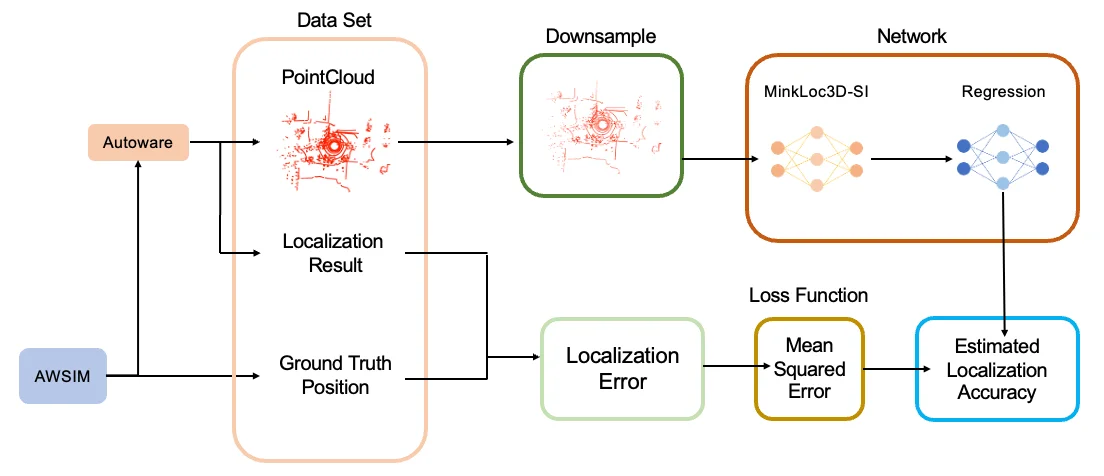
- 自動運転シミュレータで作成したデータから、自己位置推定精度を予測する深層学習モデルを学習する。
- 予測の平均二乗誤差は小さく、他のセンサで補うべき場所の特定に役立つ可能性を示した。
論文の図
アブストラクト(原文)
In recent years, research and development aimed at the societal implementation of autonomous driving have attracted increasing attention. Localization, which involves obtaining in- formation about the surrounding environment from sensor data and estimating the vehicle’s position, is necessary for realizing autonomous driving. Localization is commonly performed with 3D LiDAR as a sensor owing to its high measurement accuracy and immunity to ambient light conditions, which allow for precise localization. However, localization accuracy may decrease when the surrounding area does not have distinctive features. In this study, we proposed a method based on deep learning to estimate localization accuracy for autonomous driving. The overall localization accuracy can be improved by estimating the accuracy of localization using other sensors, such as GNSS and IMU, or pavement markings in areas with poor accuracy. We created a dataset for estimating localization accuracy using an open-source autonomous driving simulator. In an experiment, we applied the proposed method to the created dataset. Estimations with low MSE were obtained. The results indicate that the proposed method can accurately estimate localization accuracy.
引用方法
K. Matsumoto, E. Javanmardi, J. Nakazato, and M. Tsukada, “Localizability Estimation for Autonomous Driving: A Deep Learning-Based Place Recognition Approach,” in IEEE Robotic Computing 2023, California, USA, 2023, doi: 10.1109/IRC59093.2023.00052.
BibTeX
@inproceedings{Matsumoto2023b,
  title         = {Localizability Estimation for Autonomous Driving: A Deep Learning-Based Place Recognition Approach},
  author        = {Kazuto Matsumoto and Ehsan Javanmardi and Jin Nakazato and Manabu Tsukada},
  doi           = {10.1109/IRC59093.2023.00052},
  year          = {2023},
  date          = {2023-12-11},
  urldate       = {2023-12-11},
  booktitle     = {IEEE Robotic Computing 2023},
  address       = {California, USA},
  abstract      = {In recent years, research and development aimed at the societal implementation of autonomous driving have attracted increasing attention. Localization, which involves obtaining in- formation about the surrounding environment from sensor data and estimating the vehicle’s position, is necessary for realizing autonomous driving. Localization is commonly performed with 3D LiDAR as a sensor owing to its high measurement accuracy and immunity to ambient light conditions, which allow for precise localization. However, localization accuracy may decrease when the surrounding area does not have distinctive features. In this study, we proposed a method based on deep learning to estimate localization accuracy for autonomous driving. The overall localization accuracy can be improved by estimating the accuracy of localization using other sensors, such as GNSS and IMU, or pavement markings in areas with poor accuracy. We created a dataset for estimating localization accuracy using an open-source autonomous driving simulator. In an experiment, we applied the proposed method to the created dataset. Estimations with low MSE were obtained. The results indicate that the proposed method can accurately estimate localization accuracy.},
  keywords      = {ITS},
  pubstate      = {published},
  tppubtype     = {inproceedings}
}