
Localizability Estimation for Autonomous Driving: A Deep Learning-Based Place Recognition Approach
IEEE Robotic Computing 2023, California, USA, Dec 11, 2023
DOI: 10.1109/IRC59093.2023.00052
Summary in three lines
- LiDAR localization accuracy depends on how distinctive the surrounding environment is.
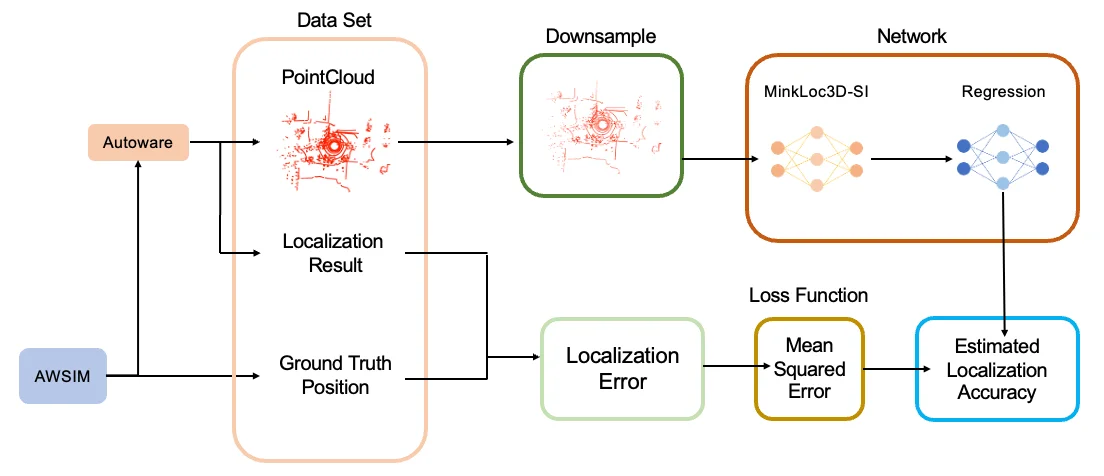
- The authors train a deep learning model to estimate localization accuracy using simulator-generated data.
- The model achieves low mean squared error, supporting identification of areas where other sensors may help.
Figures from the paper
Abstract
In recent years, research and development aimed at the societal implementation of autonomous driving have attracted increasing attention. Localization, which involves obtaining in- formation about the surrounding environment from sensor data and estimating the vehicle’s position, is necessary for realizing autonomous driving. Localization is commonly performed with 3D LiDAR as a sensor owing to its high measurement accuracy and immunity to ambient light conditions, which allow for precise localization. However, localization accuracy may decrease when the surrounding area does not have distinctive features. In this study, we proposed a method based on deep learning to estimate localization accuracy for autonomous driving. The overall localization accuracy can be improved by estimating the accuracy of localization using other sensors, such as GNSS and IMU, or pavement markings in areas with poor accuracy. We created a dataset for estimating localization accuracy using an open-source autonomous driving simulator. In an experiment, we applied the proposed method to the created dataset. Estimations with low MSE were obtained. The results indicate that the proposed method can accurately estimate localization accuracy.
How to cite
K. Matsumoto, E. Javanmardi, J. Nakazato, and M. Tsukada, “Localizability Estimation for Autonomous Driving: A Deep Learning-Based Place Recognition Approach,” in IEEE Robotic Computing 2023, California, USA, 2023, doi: 10.1109/IRC59093.2023.00052.
BibTeX
@inproceedings{Matsumoto2023b,
  title         = {Localizability Estimation for Autonomous Driving: A Deep Learning-Based Place Recognition Approach},
  author        = {Kazuto Matsumoto and Ehsan Javanmardi and Jin Nakazato and Manabu Tsukada},
  doi           = {10.1109/IRC59093.2023.00052},
  year          = {2023},
  date          = {2023-12-11},
  urldate       = {2023-12-11},
  booktitle     = {IEEE Robotic Computing 2023},
  address       = {California, USA},
  abstract      = {In recent years, research and development aimed at the societal implementation of autonomous driving have attracted increasing attention. Localization, which involves obtaining in- formation about the surrounding environment from sensor data and estimating the vehicle’s position, is necessary for realizing autonomous driving. Localization is commonly performed with 3D LiDAR as a sensor owing to its high measurement accuracy and immunity to ambient light conditions, which allow for precise localization. However, localization accuracy may decrease when the surrounding area does not have distinctive features. In this study, we proposed a method based on deep learning to estimate localization accuracy for autonomous driving. The overall localization accuracy can be improved by estimating the accuracy of localization using other sensors, such as GNSS and IMU, or pavement markings in areas with poor accuracy. We created a dataset for estimating localization accuracy using an open-source autonomous driving simulator. In an experiment, we applied the proposed method to the created dataset. Estimations with low MSE were obtained. The results indicate that the proposed method can accurately estimate localization accuracy.},
  keywords      = {ITS},
  pubstate      = {published},
  tppubtype     = {inproceedings}
}