
Tangible sound : a tangible interface for object-based sound system
研究科委員長表彰 (Dean's List Award)Master Thesis, Graduate School of Media Design, Keio University, 2016年3月31日
論文の図
アブストラクト
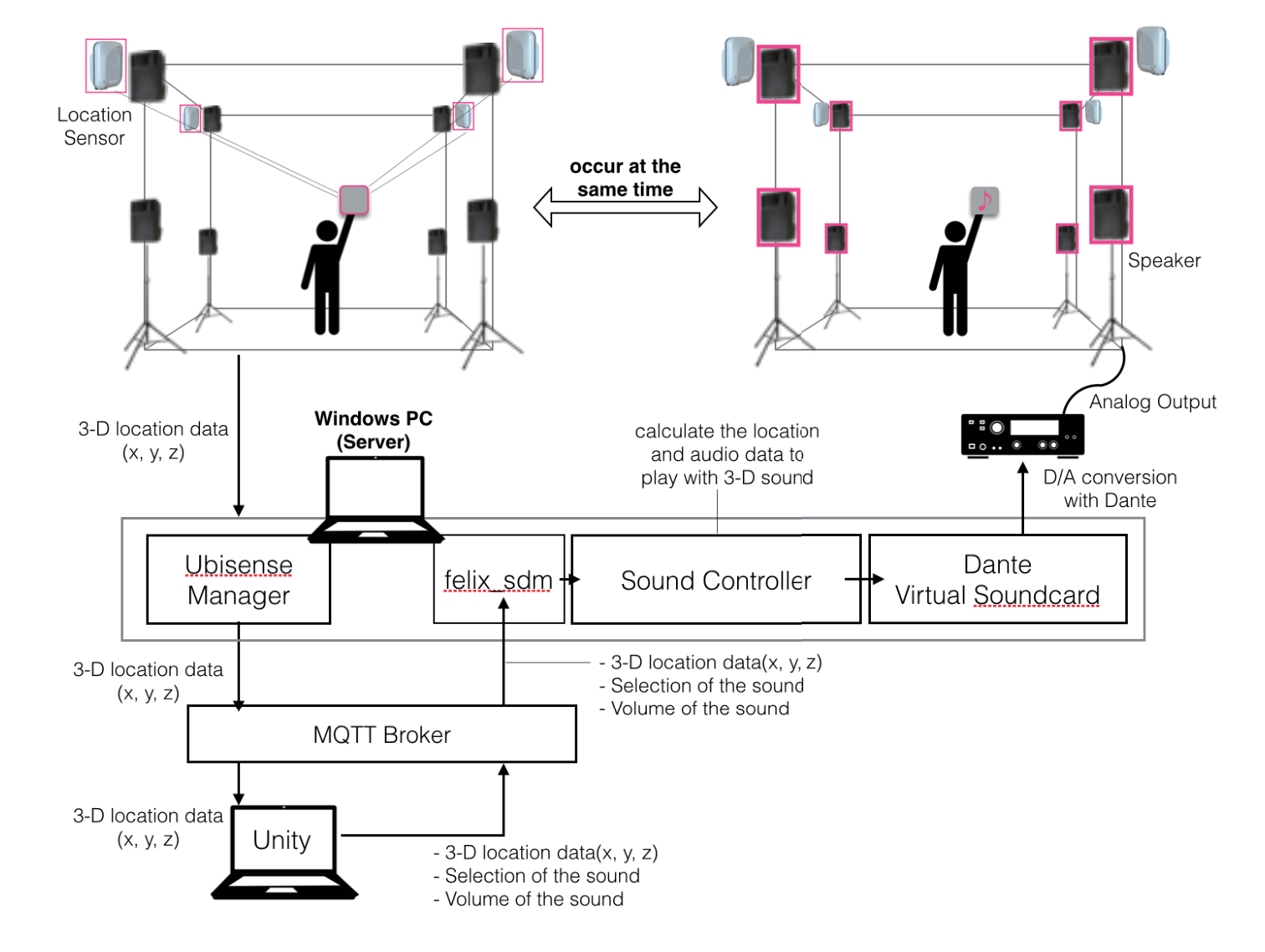
近年、情報技術の発展により、オーディオシステムのアナログ回線に代わってインターネットプロトコル(IP)ネットワークが普及しつつある。これにより、ソフトウェアで簡単に3Dサウンドを制御できるようになる。ドルビーは2012年に自社のシネマサウンドプラットフォーム「Atmos」を劇場に採用した。彼らはサウンドシステムにオブジェクトベースの考え方を採用し、劇場内のどこにでもサウンドオブジェクトを仮想的に配置できるようにした。ただし、オブジェクトベースのサウンドシステムのほとんどはプロ向けである。また、サウンドコンテンツをスピーカーで再生する場合、通常、スピーカーはあらかじめ決められた場所に設置され、コンテンツも既存のオーディオシステムで再生できるように最終的に決定される。ほとんどのサウンドシステムは聴く目的のみに使用され、スピーカーから再生される音との相互作用はない。本論文では、人が音響システムと相互作用できるようにするため、Tangible Soundという手法を検討した。Tangible Sound を使用すると、ユーザーは、位置センサーを使用することにより、ビジュアルインターフェイスを使用せずにリアルタイムで、実空間内でサウンドオブジェクトを直感的に移動および配置できる。この研究を通じて、タンジブルサウンドは、オブジェクトベースのサウンドと位置情報を組み合わせることで、サウンドオブジェクトを物理オブジェクトとして扱うことを可能にする重要な一歩を踏み出したと主張されている。音との空間的インタラクションにより、音を「持つ」「投げる」といった未来の音響体験への扉が開かれ、ライブエンターテインメントや教育分野などで音を新たな表現方法として活用できることが期待される。
引用方法
K. Ogawa, “Tangible sound : a tangible interface for object-based sound system,” in Master Thesis, Graduate School of Media Design, Keio University, 2016.
BibTeX
@mastersthesis{Ogawa2016,
  title         = {Tangible sound : a tangible interface for object-based sound system},
  author        = {Keiko Ogawa},
  url           = {http://koara.lib.keio.ac.jp/xoonips/modules/xoonips/detail.php?koara_id=KO40001001-00002015-0432},
  year          = {2016},
  date          = {2016-03-31},
  urldate       = {2016-03-31},
  school        = {Master Thesis, Graduate School of Media Design, Keio University},
  note          = {研究科委員長表彰 (Dean's List Award)},
  abstract      = {In recent years, due to the development of Information Technology, the Internet Protocol(IP) network is replacing analog lines of audio systems. This enables us to control 3-D sound easily by software. In 2012, Dolby adopted their cinema sound platform “Atmos” to theaters. They adopted object-based method of thinking to the sound system which allows the placement of the sound objects anywhere in the theater virtually. However, most of the object-based sound systems are for professional use. In addition, when we play the sound contents with the speakers, the speakers are normally placed in predefined locations and the contents are also finalized to be played with existing audio systems. Most of the sound systems are only used for the purpose of listening and there are no interaction with the sounds played from the speakers. In this thesis, the author approached Tangible Sound to lead people to have interactions with the audio systems. With the use of Tangible Sound, user could move and place the sound objects intuitively in real space, also in real-time without any visual interfaces by using the location sensors. It is argued through this research that Tangible Sound took an important step in making it possible to handle a sound object as a physical object by combining the object-based sound and the location information. It is expected that the spatial interactions with the sound may open up a door to an acoustic experience of the future such as “holding” and “throwing” the sound, and we will be able to use sounds as new ways of expression in live entertainment, educational field and so on.},
  keywords      = {SDM, Thesis},
  pubstate      = {published},
  tppubtype     = {mastersthesis}
}