
Tangible sound : a tangible interface for object-based sound system
Dean's List AwardMaster Thesis, Graduate School of Media Design, Keio University, Mar 31, 2016
Figures from the paper
Abstract
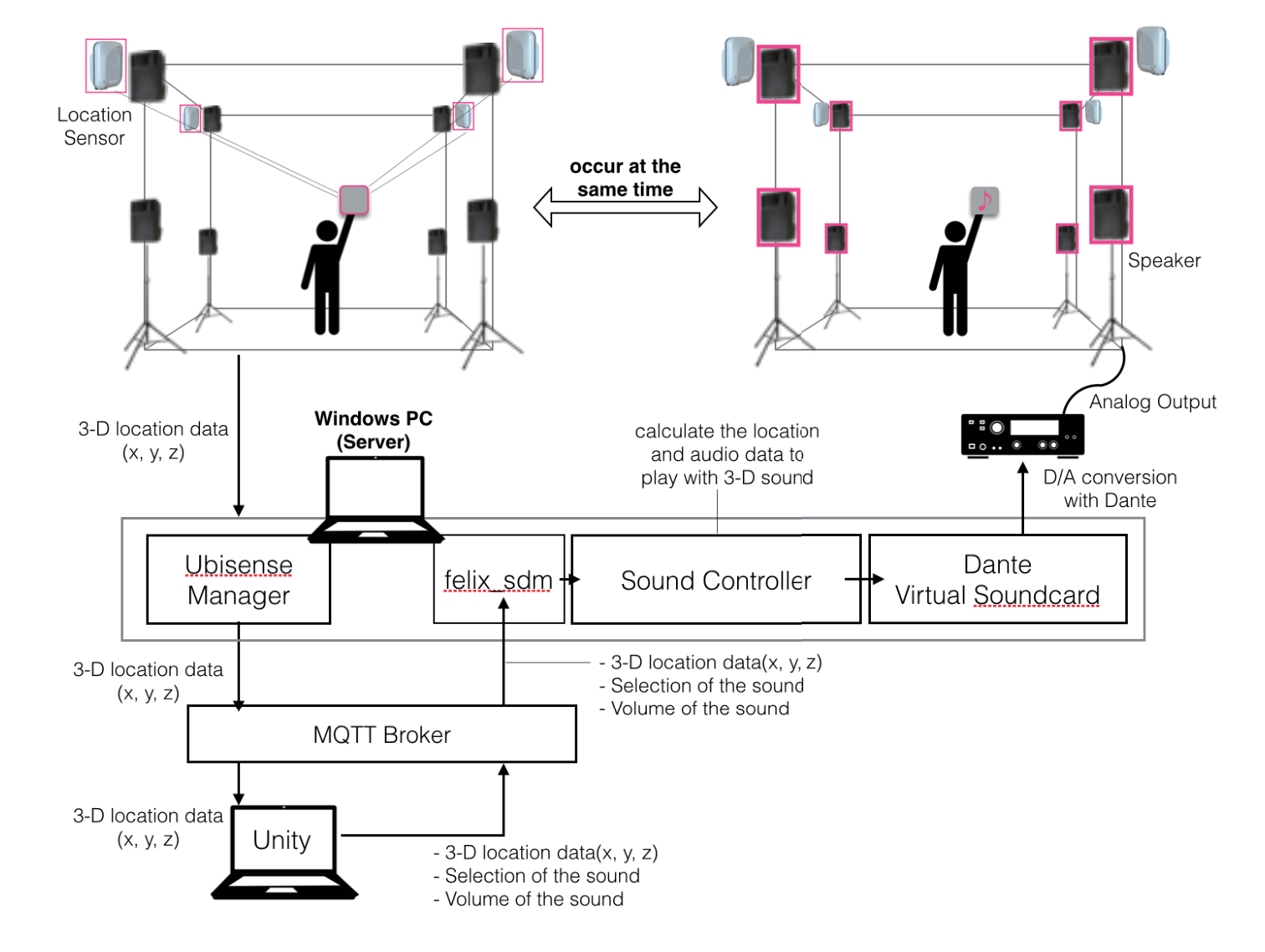
In recent years, due to the development of Information Technology, the Internet Protocol(IP) network is replacing analog lines of audio systems. This enables us to control 3-D sound easily by software. In 2012, Dolby adopted their cinema sound platform “Atmos” to theaters. They adopted object-based method of thinking to the sound system which allows the placement of the sound objects anywhere in the theater virtually. However, most of the object-based sound systems are for professional use. In addition, when we play the sound contents with the speakers, the speakers are normally placed in predefined locations and the contents are also finalized to be played with existing audio systems. Most of the sound systems are only used for the purpose of listening and there are no interaction with the sounds played from the speakers. In this thesis, the author approached Tangible Sound to lead people to have interactions with the audio systems. With the use of Tangible Sound, user could move and place the sound objects intuitively in real space, also in real-time without any visual interfaces by using the location sensors. It is argued through this research that Tangible Sound took an important step in making it possible to handle a sound object as a physical object by combining the object-based sound and the location information. It is expected that the spatial interactions with the sound may open up a door to an acoustic experience of the future such as “holding” and “throwing” the sound, and we will be able to use sounds as new ways of expression in live entertainment, educational field and so on.
How to cite
K. Ogawa, “Tangible sound : a tangible interface for object-based sound system,” in Master Thesis, Graduate School of Media Design, Keio University, 2016.
BibTeX
@mastersthesis{Ogawa2016,
  title     = {Tangible sound : a tangible interface for object-based sound system},
  author    = {Keiko Ogawa},
  url       = {http://koara.lib.keio.ac.jp/xoonips/modules/xoonips/detail.php?koara_id=KO40001001-00002015-0432},
  year      = {2016},
  date      = {2016-03-31},
  urldate   = {2016-03-31},
  school    = {Master Thesis, Graduate School of Media Design, Keio University},
  note      = {Dean's List Award},
  abstract  = {In recent years, due to the development of Information Technology, the Internet Protocol(IP) network is replacing analog lines of audio systems. This enables us to control 3-D sound easily by software. In 2012, Dolby adopted their cinema sound platform “Atmos” to theaters. They adopted object-based method of thinking to the sound system which allows the placement of the sound objects anywhere in the theater virtually. However, most of the object-based sound systems are for professional use. In addition, when we play the sound contents with the speakers, the speakers are normally placed in predefined locations and the contents are also finalized to be played with existing audio systems. Most of the sound systems are only used for the purpose of listening and there are no interaction with the sounds played from the speakers. In this thesis, the author approached Tangible Sound to lead people to have interactions with the audio systems. With the use of Tangible Sound, user could move and place the sound objects intuitively in real space, also in real-time without any visual interfaces by using the location sensors. It is argued through this research that Tangible Sound took an important step in making it possible to handle a sound object as a physical object by combining the object-based sound and the location information. It is expected that the spatial interactions with the sound may open up a door to an acoustic experience of the future such as “holding” and “throwing” the sound, and we will be able to use sounds as new ways of expression in live entertainment, educational field and so on.},
  keywords  = {SDM, Thesis},
  pubstate  = {published},
  tppubtype = {mastersthesis}
}