
Flowsim: A Modular Simulation Platform for Microscopic Behavior Analysis of City-Scale Connected Autonomous Vehicles
26th IEEE International Conference on Intelligent Transportation Systems (ITSC 2023), Bilbao, Bizkaia, Spain, 2023年9月24日
GitHub(コード)arXivDOI: 10.1109/ITSC57777.2023.10421900
3行要約
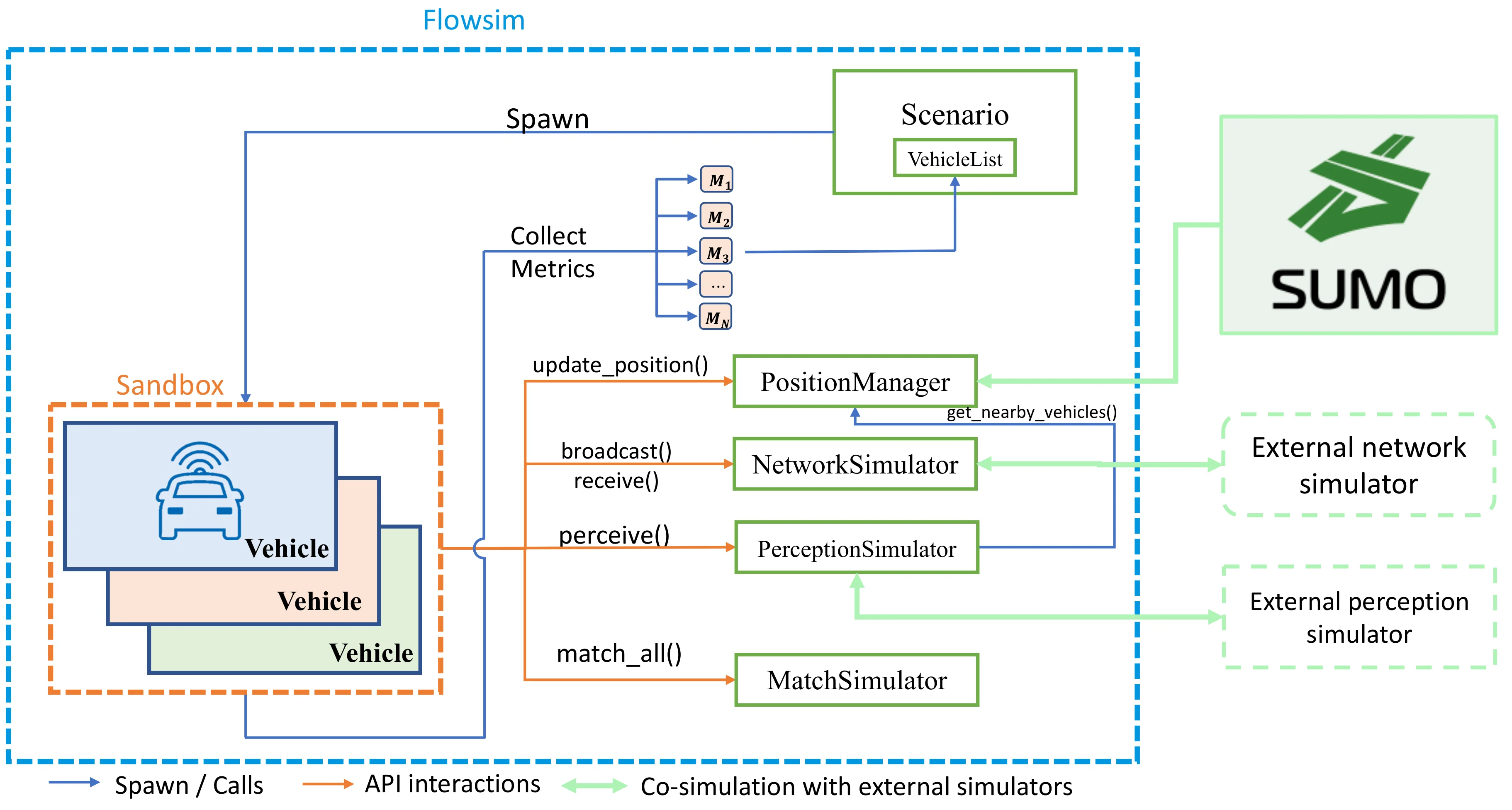
- Flowsimは都市規模のコネクテッド自動運転を扱う、Python製のモジュール型シミュレータである。
- 車両ごとの挙動と通信を統合し、構成要素を差し替えたり拡張したりできる。
- オープンソースで公開し、V2X通信方式や交通管理、施策の評価に利用できる。
論文の図
アブストラクト(原文)
As connected autonomous vehicles (CAVs) become increasingly prevalent, there is a growing need for simulation platforms that can accurately evaluate CAV behavior in large-scale environments. In this paper, we propose Flowsim, a novel simulator specifically designed to meet these requirements. Flowsim offers a modular and extensible architecture that enables the analysis of CAV behaviors in large-scale scenarios. It provides researchers with a customizable platform for studying CAV interactions, evaluating communication and networking protocols, assessing cybersecurity vulnerabilities, optimizing traffic management strategies, and developing and evaluating policies for CAV deployment. Flowsim is implemented in pure Python in approximately 1,500 lines of code, making it highly readable, understandable, and easily modifiable. We verified the functionality and performance of Flowsim via a series of experiments based on realistic traffic scenarios. The results show the effectiveness of Flowsim in providing a flexible and powerful simulation environment for evaluating CAV behavior and data flow. Flowsim is a valuable tool for researchers, policymakers, and industry professionals who are involved in the development, evaluation, and deployment of CAVs. The code of Flowsim is publicly available on GitHub under the MIT license.
コード
関連する研究・ソフトウェア
関連ニュース
引用方法
Y. Tao, E. Javanmardi, J. Nakazato, M. Tsukada, and H. Esaki, “Flowsim: A Modular Simulation Platform for Microscopic Behavior Analysis of City-Scale Connected Autonomous Vehicles,” in 26th IEEE International Conference on Intelligent Transportation Systems (ITSC 2023), Bilbao, Bizkaia, Spain, 2023, doi: 10.1109/ITSC57777.2023.10421900.
BibTeX
@inproceedings{Tao2023c,
  title         = {Flowsim: A Modular Simulation Platform for Microscopic Behavior Analysis of City-Scale Connected Autonomous Vehicles},
  author        = {Ye Tao and Ehsan Javanmardi and Jin Nakazato and Manabu Tsukada and Hiroshi Esaki},
  url           = {https://github.com/tlab-wide/flowsim https://arxiv.org/abs/2306.05738},
  doi           = {10.1109/ITSC57777.2023.10421900},
  year          = {2023},
  date          = {2023-09-24},
  urldate       = {2023-09-24},
  booktitle     = {26th IEEE International Conference on Intelligent Transportation Systems (ITSC 2023)},
  address       = {Bilbao, Bizkaia, Spain},
  abstract      = {As connected autonomous vehicles (CAVs) become increasingly prevalent, there is a growing need for simulation platforms that can accurately evaluate CAV behavior in large-scale environments. In this paper, we propose Flowsim, a novel simulator specifically designed to meet these requirements. Flowsim offers a modular and extensible architecture that enables the analysis of CAV behaviors in large-scale scenarios. It provides researchers with a customizable platform for studying CAV interactions, evaluating communication and networking protocols, assessing cybersecurity vulnerabilities, optimizing traffic management strategies, and developing and evaluating policies for CAV deployment. Flowsim is implemented in pure Python in approximately 1,500 lines of code, making it highly readable, understandable, and easily modifiable. We verified the functionality and performance of Flowsim via a series of experiments based on realistic traffic scenarios. The results show the effectiveness of Flowsim in providing a flexible and powerful simulation environment for evaluating CAV behavior and data flow. Flowsim is a valuable tool for researchers, policymakers, and industry professionals who are involved in the development, evaluation, and deployment of CAVs. The code of Flowsim is publicly available on GitHub under the MIT license.},
  keywords      = {ITS, Software-Data},
  pubstate      = {published},
  tppubtype     = {inproceedings}
}