
Flowsim: A Modular Simulation Platform for Microscopic Behavior Analysis of City-Scale Connected Autonomous Vehicles
26th IEEE International Conference on Intelligent Transportation Systems (ITSC 2023), Bilbao, Bizkaia, Spain, Sep 24, 2023
GitHub (code)arXivDOI: 10.1109/ITSC57777.2023.10421900
Summary in three lines
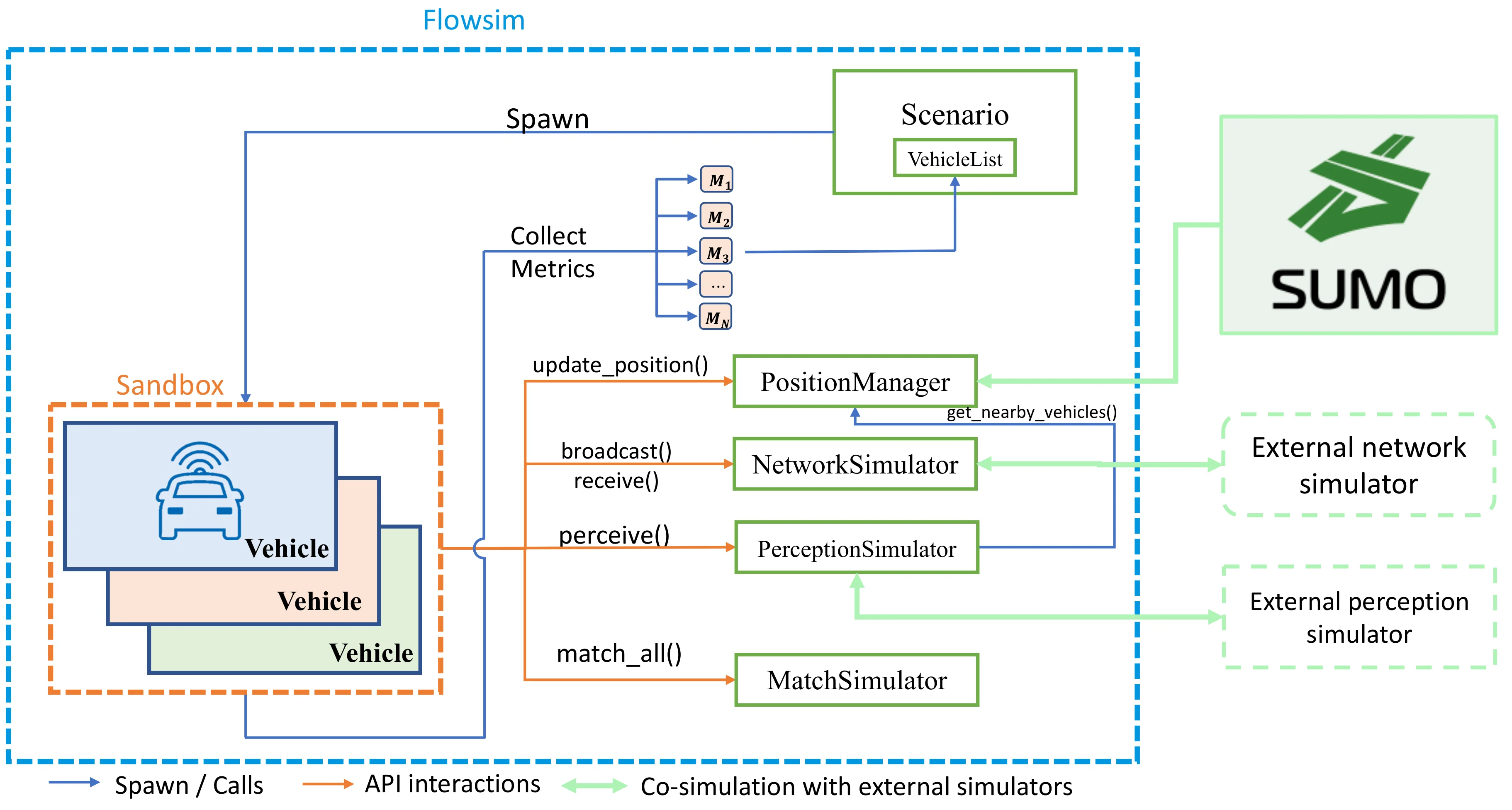
- Flowsim is a modular Python simulator for connected automated vehicles at city scale.
- It combines individual vehicle behavior with communication and allows simulation components to be replaced or extended.
- The open-source platform supports evaluation of V2X protocols, traffic management, and policies.
Figures from the paper
Abstract
As connected autonomous vehicles (CAVs) become increasingly prevalent, there is a growing need for simulation platforms that can accurately evaluate CAV behavior in large-scale environments. In this paper, we propose Flowsim, a novel simulator specifically designed to meet these requirements. Flowsim offers a modular and extensible architecture that enables the analysis of CAV behaviors in large-scale scenarios. It provides researchers with a customizable platform for studying CAV interactions, evaluating communication and networking protocols, assessing cybersecurity vulnerabilities, optimizing traffic management strategies, and developing and evaluating policies for CAV deployment. Flowsim is implemented in pure Python in approximately 1,500 lines of code, making it highly readable, understandable, and easily modifiable. We verified the functionality and performance of Flowsim via a series of experiments based on realistic traffic scenarios. The results show the effectiveness of Flowsim in providing a flexible and powerful simulation environment for evaluating CAV behavior and data flow. Flowsim is a valuable tool for researchers, policymakers, and industry professionals who are involved in the development, evaluation, and deployment of CAVs. The code of Flowsim is publicly available on GitHub under the MIT license.
Code
Related research and software
Related news
How to cite
Y. Tao, E. Javanmardi, J. Nakazato, M. Tsukada, and H. Esaki, “Flowsim: A Modular Simulation Platform for Microscopic Behavior Analysis of City-Scale Connected Autonomous Vehicles,” in 26th IEEE International Conference on Intelligent Transportation Systems (ITSC 2023), Bilbao, Bizkaia, Spain, 2023, doi: 10.1109/ITSC57777.2023.10421900.
BibTeX
@inproceedings{Tao2023c,
  title         = {Flowsim: A Modular Simulation Platform for Microscopic Behavior Analysis of City-Scale Connected Autonomous Vehicles},
  author        = {Ye Tao and Ehsan Javanmardi and Jin Nakazato and Manabu Tsukada and Hiroshi Esaki},
  url           = {https://github.com/tlab-wide/flowsim https://arxiv.org/abs/2306.05738},
  doi           = {10.1109/ITSC57777.2023.10421900},
  year          = {2023},
  date          = {2023-09-24},
  urldate       = {2023-09-24},
  booktitle     = {26th IEEE International Conference on Intelligent Transportation Systems (ITSC 2023)},
  address       = {Bilbao, Bizkaia, Spain},
  abstract      = {As connected autonomous vehicles (CAVs) become increasingly prevalent, there is a growing need for simulation platforms that can accurately evaluate CAV behavior in large-scale environments. In this paper, we propose Flowsim, a novel simulator specifically designed to meet these requirements. Flowsim offers a modular and extensible architecture that enables the analysis of CAV behaviors in large-scale scenarios. It provides researchers with a customizable platform for studying CAV interactions, evaluating communication and networking protocols, assessing cybersecurity vulnerabilities, optimizing traffic management strategies, and developing and evaluating policies for CAV deployment. Flowsim is implemented in pure Python in approximately 1,500 lines of code, making it highly readable, understandable, and easily modifiable. We verified the functionality and performance of Flowsim via a series of experiments based on realistic traffic scenarios. The results show the effectiveness of Flowsim in providing a flexible and powerful simulation environment for evaluating CAV behavior and data flow. Flowsim is a valuable tool for researchers, policymakers, and industry professionals who are involved in the development, evaluation, and deployment of CAVs. The code of Flowsim is publicly available on GitHub under the MIT license.},
  keywords      = {ITS, Software-Data},
  pubstate      = {published},
  tppubtype     = {inproceedings}
}