
A Gamut-Independent Saturated-Red Test for Photosensitive Epilepsy Detection in HDR Video
15th IEEE International Conference on Consumer Electronics - Berlin (ICCE-Berlin 2026), Berlin, Germany, 2026年9月5日
3行要約
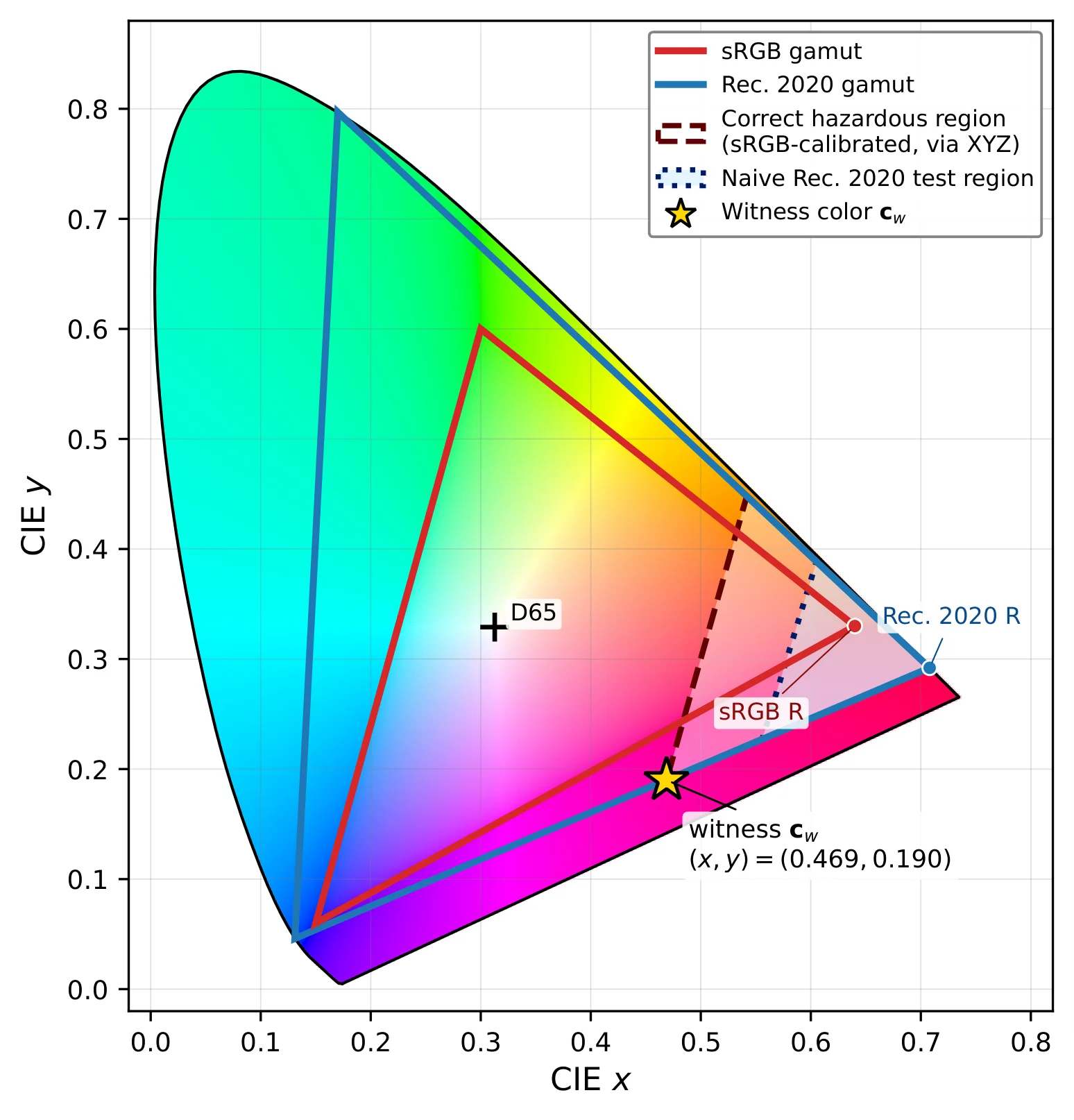
- HDR動画では、同じRGB比でも色域が変わると検出される高彩度の赤が変わる。
- sRGBで較正された境界をCIE XYZで表し、色域をまたいで一貫して判定できるようにした。
- Rec. 2020の一様サンプルでは、比率を直接使うと較正済みの判定が捉える色の73.3%を見逃した。
論文の図
アブストラクト(原文)
Modern HDR streaming and consumer displays encode video in Rec. 2020, a wider color gamut than sRGB. The legacy accessibility test for photosensitive epilepsy hazards uses the ratio R/(R+G+B) ≥ 0.8 to flag saturated-red flashes, but the standards do not specify in which color space this ratio is computed, and deployed tools apply it in the content's native RGB encoding. We show that the same 0.8 threshold, applied in Rec. 2020 coordinates, flags a strictly different set of colors as hazardous than when applied in sRGB coordinates. We resolve this by lifting the test to CIE XYZ. The test becomes a single dot product n_XYZ^T c_XYZ ≥ 0, gives the same result on sRGB content, and works for any target gamut without re-calibration. For tools that cannot adopt the XYZ form, we derive a closed-form covering threshold t* that restores the ratio test for any target gamut. On a uniform sample of the Rec. 2020 gamut, the 0.8 ratio test in Rec. 2020 coordinates misses 73.3% of the colors that the sRGB-calibrated test flags. The XYZ-plane test recovers all of them by construction.
引用方法
Y. Tong, Y. Tao, and M. Tsukada, “A Gamut-Independent Saturated-Red Test for Photosensitive Epilepsy Detection in HDR Video,” in 15th IEEE International Conference on Consumer Electronics - Berlin (ICCE-Berlin 2026), Berlin, Germany, 2026.
BibTeX
@inproceedings{Tong2026,
  title         = {A Gamut-Independent Saturated-Red Test for Photosensitive Epilepsy Detection in HDR Video},
  author        = {Yige Tong and Ye Tao and Manabu Tsukada},
  year          = {2026},
  date          = {2026-09-05},
  urldate       = {2026-09-05},
  booktitle     = {15th IEEE International Conference on Consumer Electronics - Berlin (ICCE-Berlin 2026)},
  address       = {Berlin, Germany},
  abstract      = {Modern HDR streaming and consumer displays encode video in Rec. 2020, a wider color gamut than sRGB. The legacy accessibility test for photosensitive epilepsy hazards uses the ratio R/(R+G+B) ≥ 0.8 to flag saturated-red flashes, but the standards do not specify in which color space this ratio is computed, and deployed tools apply it in the content's native RGB encoding. We show that the same 0.8 threshold, applied in Rec. 2020 coordinates, flags a strictly different set of colors as hazardous than when applied in sRGB coordinates. We resolve this by lifting the test to CIE XYZ. The test becomes a single dot product n_XYZ^T c_XYZ ≥ 0, gives the same result on sRGB content, and works for any target gamut without re-calibration. For tools that cannot adopt the XYZ form, we derive a closed-form covering threshold t* that restores the ratio test for any target gamut. On a uniform sample of the Rec. 2020 gamut, the 0.8 ratio test in Rec. 2020 coordinates misses 73.3% of the colors that the sRGB-calibrated test flags. The XYZ-plane test recovers all of them by construction.},
  keywords      = {Other},
  pubstate      = {published},
  tppubtype     = {inproceedings}
}