
A Gamut-Independent Saturated-Red Test for Photosensitive Epilepsy Detection in HDR Video
15th IEEE International Conference on Consumer Electronics - Berlin (ICCE-Berlin 2026), Berlin, Germany, Sep 5, 2026
Summary in three lines
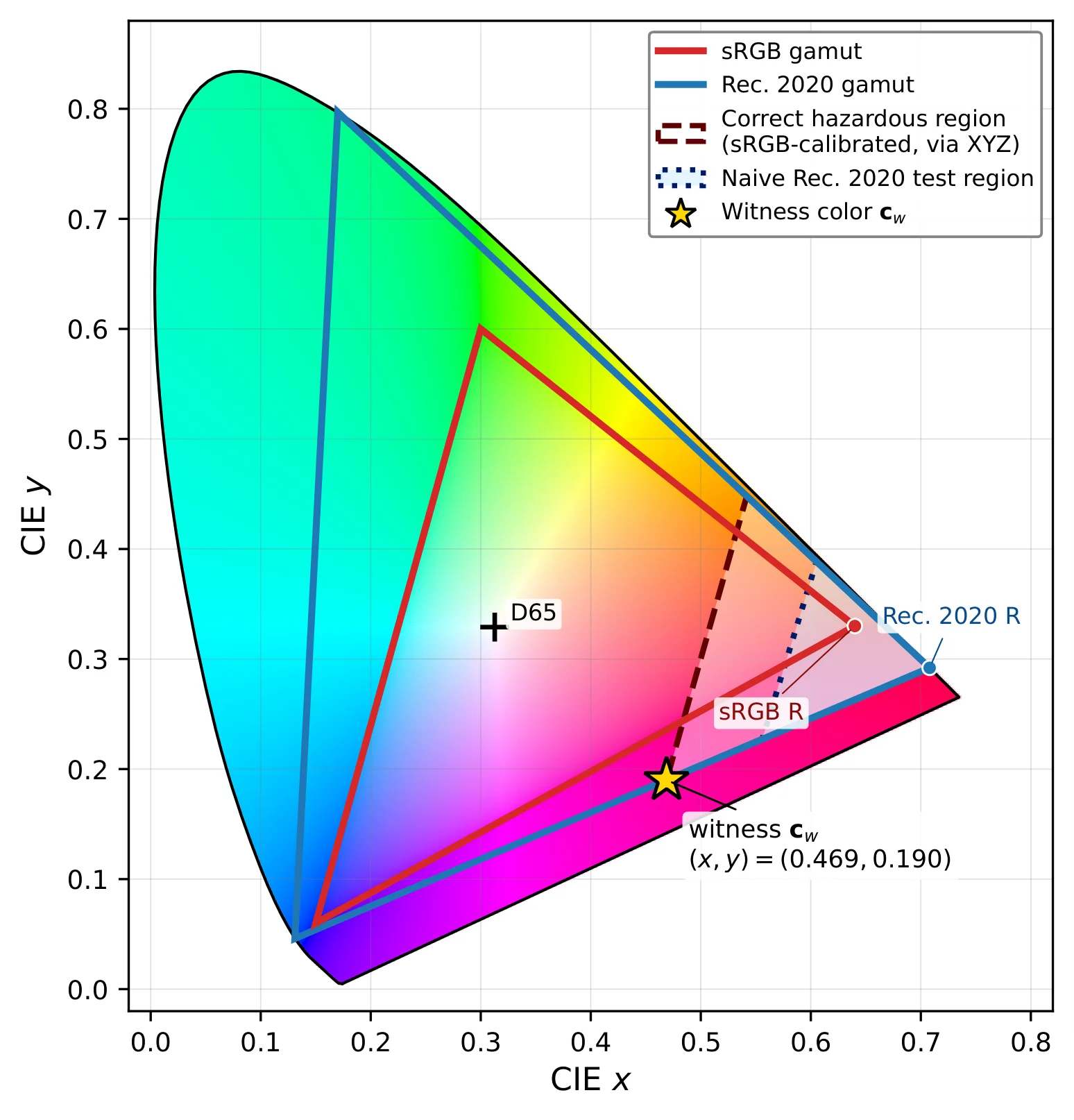
- Applying the same RGB ratio to different gamuts changes which saturated reds are flagged in HDR video.
- The paper expresses the sRGB-calibrated boundary in CIE XYZ so it can be evaluated consistently across gamuts.
- Under uniform Rec. 2020 sampling, the direct ratio test missed 73.3% of colors flagged by the calibrated test.
Figures from the paper
Abstract
Modern HDR streaming and consumer displays encode video in Rec. 2020, a wider color gamut than sRGB. The legacy accessibility test for photosensitive epilepsy hazards uses the ratio R/(R+G+B) ≥ 0.8 to flag saturated-red flashes, but the standards do not specify in which color space this ratio is computed, and deployed tools apply it in the content's native RGB encoding. We show that the same 0.8 threshold, applied in Rec. 2020 coordinates, flags a strictly different set of colors as hazardous than when applied in sRGB coordinates. We resolve this by lifting the test to CIE XYZ. The test becomes a single dot product n_XYZ^T c_XYZ ≥ 0, gives the same result on sRGB content, and works for any target gamut without re-calibration. For tools that cannot adopt the XYZ form, we derive a closed-form covering threshold t* that restores the ratio test for any target gamut. On a uniform sample of the Rec. 2020 gamut, the 0.8 ratio test in Rec. 2020 coordinates misses 73.3% of the colors that the sRGB-calibrated test flags. The XYZ-plane test recovers all of them by construction.
How to cite
Y. Tong, Y. Tao, and M. Tsukada, “A Gamut-Independent Saturated-Red Test for Photosensitive Epilepsy Detection in HDR Video,” in 15th IEEE International Conference on Consumer Electronics - Berlin (ICCE-Berlin 2026), Berlin, Germany, 2026.
BibTeX
@inproceedings{Tong2026,
  title         = {A Gamut-Independent Saturated-Red Test for Photosensitive Epilepsy Detection in HDR Video},
  author        = {Yige Tong and Ye Tao and Manabu Tsukada},
  year          = {2026},
  date          = {2026-09-05},
  urldate       = {2026-09-05},
  booktitle     = {15th IEEE International Conference on Consumer Electronics - Berlin (ICCE-Berlin 2026)},
  address       = {Berlin, Germany},
  abstract      = {Modern HDR streaming and consumer displays encode video in Rec. 2020, a wider color gamut than sRGB. The legacy accessibility test for photosensitive epilepsy hazards uses the ratio R/(R+G+B) ≥ 0.8 to flag saturated-red flashes, but the standards do not specify in which color space this ratio is computed, and deployed tools apply it in the content's native RGB encoding. We show that the same 0.8 threshold, applied in Rec. 2020 coordinates, flags a strictly different set of colors as hazardous than when applied in sRGB coordinates. We resolve this by lifting the test to CIE XYZ. The test becomes a single dot product n_XYZ^T c_XYZ ≥ 0, gives the same result on sRGB content, and works for any target gamut without re-calibration. For tools that cannot adopt the XYZ form, we derive a closed-form covering threshold t* that restores the ratio test for any target gamut. On a uniform sample of the Rec. 2020 gamut, the 0.8 ratio test in Rec. 2020 coordinates misses 73.3% of the colors that the sRGB-calibrated test flags. The XYZ-plane test recovers all of them by construction.},
  keywords      = {Other},
  pubstate      = {published},
  tppubtype     = {inproceedings}
}