
DUPE: Duplicated Unicasting Packet Encapsulation in Position Based Routing VANET
Master Thesis, Graduate School of Information Science and Technology, The University of Tokyo (Esaki, Ochiai Lab), 2016年3月31日
論文の図
アブストラクト
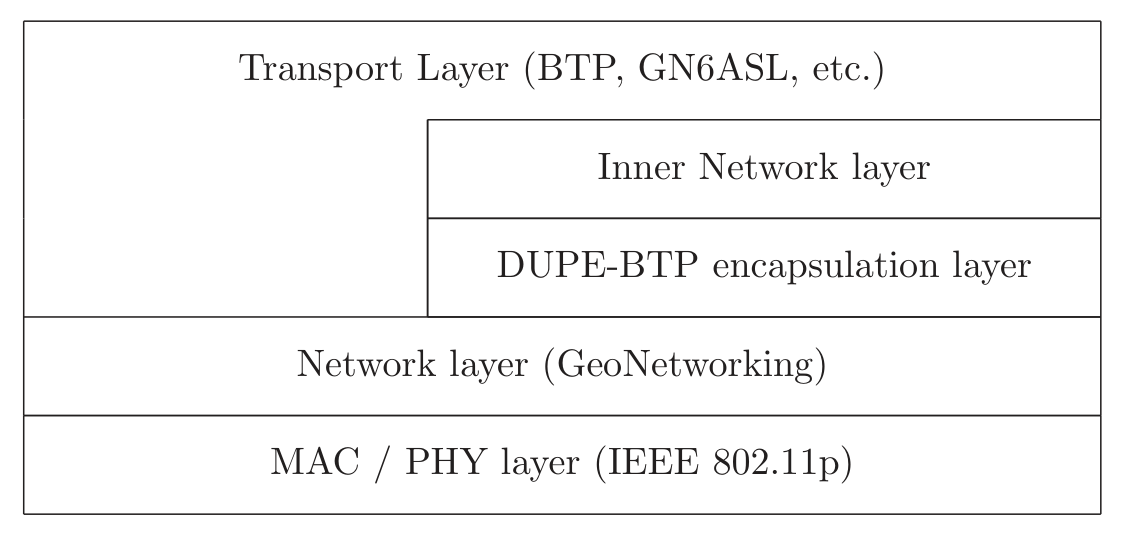
車両アドホックネットワーク (VANET) は、ノードが車両として存在する特定のタイプのモバイルアドホックネットワークである。位置ベースのルーティング VANET (PBR-VANET) は、ノードの地理位置情報に基づいてルーティングを決定する、トポロジフリーのルーティングアルゴリズムである。GeoNetworking は、高速車両の動きに適応する位置ベースのルーティングを組み込んだ VANET 標準である。ただし、PBR-VANET ルーティングプロトコルは、トポロジが頻繁に変更されるため、大量のパケット損失が大きく発生する。論文では、PBR-VANET の特殊性を分析し、ルーティングプロトコルの問題点を強調する。新しいルーティングプロトコルの要件について説明し、Duplicated Unicast Packet Encapsulation (DUPE) と呼ばれるルーティングカプセル化プロトコルを提案する。このプロトコルは、元の GeoNetworking 標準と互換性があり、GeoNetworking インフラストラクチャやユーザーアプリケーションを変更することなく、既存の実装と連携できる。このプロトコルは、GeoNetworking パケットを BTP パケット (GeoNetworking のレイヤー 4 プロトコル) にカプセル化し、元のパケットを別のパスに複製して、障害や古いパスによって引き起こされるパケット損失を削減する。さらに、さまざまなシナリオでプロトコルを評価するために、実際のテストベッドとシミュレーターの間の結合現実的評価ワークフロー (CREW) を提案する。キャリブレーションはテストベッドの結果を使用して実行され、その後シミュレーターは同じソフトウェア実装の現実的な結果を生成する可能性がある。各シナリオでDUPEをCREWにより評価した結果、標準のGeoNetworkingで最悪の場合94.5%に達するパケット損失が、特定のシナリオでは妥当な遅延と帯域のオーバーヘッドのもとで解消されることが示唆された。DUPE の考え方は、あらゆる PBR-VANET に容易に適用でき、通信品質を大幅に向上させる可能性がある。
引用方法
Y. Tao, “DUPE: Duplicated Unicasting Packet Encapsulation in Position Based Routing VANET,” in Master Thesis, Graduate School of Information Science and Technology, The University of Tokyo (Esaki, Ochiai Lab), 2016.
BibTeX
@mastersthesis{Ye2016,
  title         = {DUPE: Duplicated Unicasting Packet Encapsulation in Position Based Routing VANET},
  author        = {Ye Tao},
  year          = {2016},
  date          = {2016-03-31},
  urldate       = {2016-03-31},
  school        = {Master Thesis, Graduate School of Information Science and Technology, The University of Tokyo (Esaki, Ochiai Lab)},
  abstract      = {Vehicular Ad-hoc Network (VANET) is a specific type of mobile Ad-hoc network where the nodes are present as vehicles. Position-based routing VANET (PBR-VANET) is a topology-free routing algorithm that decides routing based on the geolocation information of nodes. GeoNetworking is a VANET standard envolving position based routing to adapt high-speed vehicle movements. However, PBR-VANET routing protocols greatly suffer from mass packet loss due to frequent changes in topology. In the dissertation, we analyze the specialty of PBR-VANET, highlighting its issues in the routing protocols. We discuss the requirements of the new routing protocol and propose a routing encapsulation protocol called Duplicated Unicast Packet Encapsulation (DUPE). The protocol is compatible with original GeoNetworking standard, and can co-operate with the existing implementations without modification to neither GeoNetworking infrastructure nor user applications. The protocol encapsulates GeoNetworking packet in BTP packet (a Layer 4 protocol in GeoNetworking) and duplicates the original packet into different paths to reduce packet loss caused by failures and stale paths. Further, to evaluate the protocols in different scenarios, we propose a Combined Realistic Evaluation Workflow (CREW) between real testbed and simulator. Calibration is accomplished using the results of testbed, and the simulator may produce realistic results of the same software implementation thereafter. CREW evaluations on DUPE in different scenarios suggest that, with reasonable latency and bandwidth overhead achived, packet loss in certain scenarios is eliminated, where standard GeoNetworking protocol has packet loss of up to 94.5% in worst case. The idea of DUPE can be readily adapted to any PBR-VANETs and may significantly improve communication quality.},
  keywords      = {ITS, Thesis},
  pubstate      = {published},
  tppubtype     = {mastersthesis}
}