
DUPE: Duplicated Unicasting Packet Encapsulation in Position Based Routing VANET
Master Thesis, Graduate School of Information Science and Technology, The University of Tokyo (Esaki, Ochiai Lab), Mar 31, 2016
Figures from the paper
Abstract
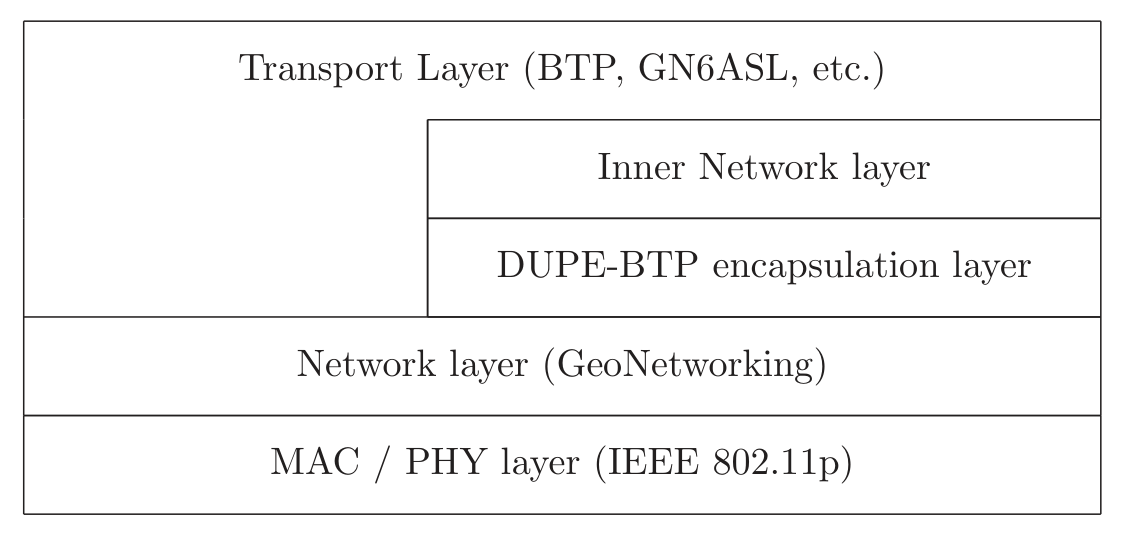
Vehicular Ad-hoc Network (VANET) is a specific type of mobile Ad-hoc network where the nodes are present as vehicles. Position-based routing VANET (PBR-VANET) is a topology-free routing algorithm that decides routing based on the geolocation information of nodes. GeoNetworking is a VANET standard envolving position based routing to adapt high-speed vehicle movements. However, PBR-VANET routing protocols greatly suffer from mass packet loss due to frequent changes in topology. In the dissertation, we analyze the specialty of PBR-VANET, highlighting its issues in the routing protocols. We discuss the requirements of the new routing protocol and propose a routing encapsulation protocol called Duplicated Unicast Packet Encapsulation (DUPE). The protocol is compatible with original GeoNetworking standard, and can co-operate with the existing implementations without modification to neither GeoNetworking infrastructure nor user applications. The protocol encapsulates GeoNetworking packet in BTP packet (a Layer 4 protocol in GeoNetworking) and duplicates the original packet into different paths to reduce packet loss caused by failures and stale paths. Further, to evaluate the protocols in different scenarios, we propose a Combined Realistic Evaluation Workflow (CREW) between real testbed and simulator. Calibration is accomplished using the results of testbed, and the simulator may produce realistic results of the same software implementation thereafter. CREW evaluations on DUPE in different scenarios suggest that, with reasonable latency and bandwidth overhead achived, packet loss in certain scenarios is eliminated, where standard GeoNetworking protocol has packet loss of up to 94.5% in worst case. The idea of DUPE can be readily adapted to any PBR-VANETs and may significantly improve communication quality.
How to cite
Y. Tao, “DUPE: Duplicated Unicasting Packet Encapsulation in Position Based Routing VANET,” in Master Thesis, Graduate School of Information Science and Technology, The University of Tokyo (Esaki, Ochiai Lab), 2016.
BibTeX
@mastersthesis{Ye2016,
  title         = {DUPE: Duplicated Unicasting Packet Encapsulation in Position Based Routing VANET},
  author        = {Ye Tao},
  year          = {2016},
  date          = {2016-03-31},
  urldate       = {2016-03-31},
  school        = {Master Thesis, Graduate School of Information Science and Technology, The University of Tokyo (Esaki, Ochiai Lab)},
  abstract      = {Vehicular Ad-hoc Network (VANET) is a specific type of mobile Ad-hoc network where the nodes are present as vehicles. Position-based routing VANET (PBR-VANET) is a topology-free routing algorithm that decides routing based on the geolocation information of nodes. GeoNetworking is a VANET standard envolving position based routing to adapt high-speed vehicle movements. However, PBR-VANET routing protocols greatly suffer from mass packet loss due to frequent changes in topology. In the dissertation, we analyze the specialty of PBR-VANET, highlighting its issues in the routing protocols. We discuss the requirements of the new routing protocol and propose a routing encapsulation protocol called Duplicated Unicast Packet Encapsulation (DUPE). The protocol is compatible with original GeoNetworking standard, and can co-operate with the existing implementations without modification to neither GeoNetworking infrastructure nor user applications. The protocol encapsulates GeoNetworking packet in BTP packet (a Layer 4 protocol in GeoNetworking) and duplicates the original packet into different paths to reduce packet loss caused by failures and stale paths. Further, to evaluate the protocols in different scenarios, we propose a Combined Realistic Evaluation Workflow (CREW) between real testbed and simulator. Calibration is accomplished using the results of testbed, and the simulator may produce realistic results of the same software implementation thereafter. CREW evaluations on DUPE in different scenarios suggest that, with reasonable latency and bandwidth overhead achived, packet loss in certain scenarios is eliminated, where standard GeoNetworking protocol has packet loss of up to 94.5% in worst case. The idea of DUPE can be readily adapted to any PBR-VANETs and may significantly improve communication quality.},
  keywords      = {ITS, Thesis},
  pubstate      = {published},
  tppubtype     = {mastersthesis}
}