
Mixed-traffic Intersection Management using Traffic-load-responsive Reservation and V2X-enabled Speed Coordination
26th IEEE International Conference on Intelligent Transportation Systems (ITSC 2023), Bilbao, Bizkaia, Spain, 2023年9月24日
PDFDOI: 10.1109/ITSC57777.2023.10422248
3行要約
- 車両グループ、交通量、通過の緊急度に基づき、混在交通の交差点で通行を割り当てる。
- 路側機がコネクテッド車両の速度を調整し、非コネクテッド車両は信号で誘導する。
- 車両構成と交通量を変えたシミュレーションで、通過台数と待ち時間を比較した。
論文の図
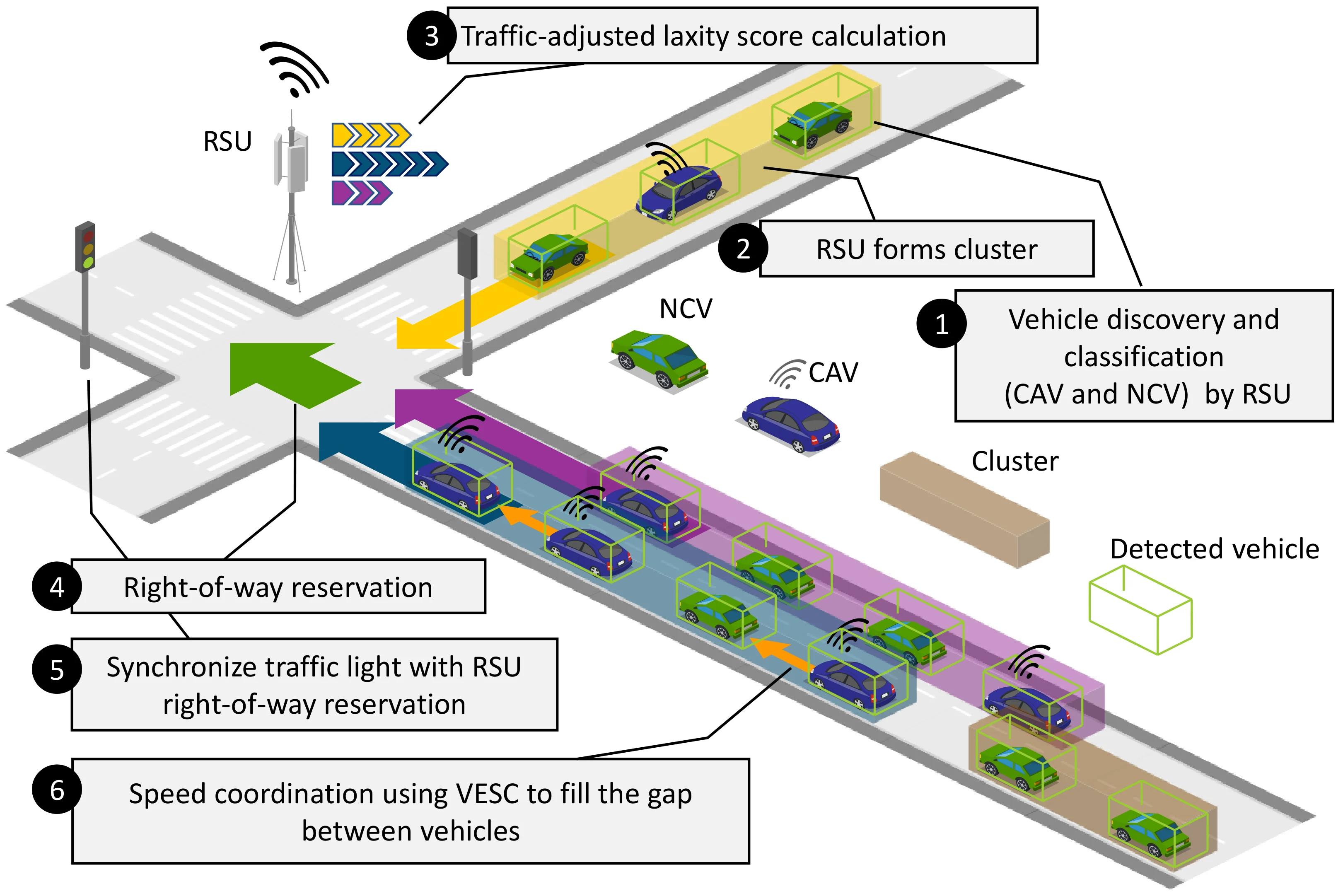
アブストラクト(原文)
Vehicle-to-everything (V2X) communication enables connected autonomous vehicles (CAVs) to share information and generate optimal decisions. The networking abilities of CAVs have led to the development of unsignalized autonomous intersection management (AIM) methods that leverage CAVs to significantly improve traffic flows. However, AIM methods assume 100% CAV market penetration, which is currently unrealistic owing to the gradual adoption of CAVs. Therefore, CAVs must share road usage with nonconnected vehicles (NCVs). Thus, we propose a mixed-traffic intersection management method that considers NCVs while ensuring high traffic flow, called traffic-load-responsive reservation for intersection management (TLRRIM). In TLRRIM, the roadside unit (RSU) first classifies vehicles and groups them into clusters before selecting a reservation cluster to cross an intersection. The reservation cluster selection considers both traffic load and crossing urgency. In addition, the RSU utilizes V2X-enabled speed coordination (VESC) for CAVs within the reservation cluster to further improve traffic flow, while utilizing traffic lights to guide NCVs. Simulation-based experiments using OpenCDA and CARLA showed that TLRRIM can increase throughput and reduce waiting time by up to 89.63% and 60.71%, respectively, compared with the fixed-time signaling method. Moreover, adding VESC can increase throughput by 12.21% and reduce waiting time by 10.80%, further enhancing traffic flow.
関連ニュース
引用方法
N. D. Yosodipuro, E. Javanmardi, J. Nakazato, Y. Tamura, X. Défago, and M. Tsukada, “Mixed-traffic Intersection Management using Traffic-load-responsive Reservation and V2X-enabled Speed Coordination,” in 26th IEEE International Conference on Intelligent Transportation Systems (ITSC 2023), Bilbao, Bizkaia, Spain, 2023, doi: 10.1109/ITSC57777.2023.10422248.
BibTeX
@inproceedings{Yosodipuro2023,
  title         = {Mixed-traffic Intersection Management using Traffic-load-responsive Reservation and V2X-enabled Speed Coordination},
  author        = {Nicholaus Danispadmanaba Yosodipuro and Ehsan Javanmardi and Jin Nakazato and Yasumasa Tamura and Xavier Défago and Manabu Tsukada},
  url           = {https://www.researchgate.net/profile/Jin-Nakazato/publication/374470825_Mixed-traffic_Intersection_Management_using_Traffic-load-responsive_Reservation_and_V2X-enabled_Speed_Coordination/links/651ee8d63ab6cb4ec6bde79a/Mixed-traffic-Intersection-Management-using-Traffic-load-responsive-Reservation-and-V2X-enabled-Speed-Coordination.pdf},
  doi           = {10.1109/ITSC57777.2023.10422248},
  year          = {2023},
  date          = {2023-09-24},
  urldate       = {2023-09-24},
  booktitle     = {26th IEEE International Conference on Intelligent Transportation Systems (ITSC 2023)},
  address       = {Bilbao, Bizkaia, Spain},
  abstract      = {Vehicle-to-everything (V2X) communication enables connected autonomous vehicles (CAVs) to share information and generate optimal decisions. The networking abilities of CAVs have led to the development of unsignalized autonomous intersection management (AIM) methods that leverage CAVs to significantly improve traffic flows. However, AIM methods assume 100% CAV market penetration, which is currently unrealistic owing to the gradual adoption of CAVs. Therefore, CAVs must share road usage with nonconnected vehicles (NCVs). Thus, we propose a mixed-traffic intersection management method that considers NCVs while ensuring high traffic flow, called traffic-load-responsive reservation for intersection management (TLRRIM). In TLRRIM, the roadside unit (RSU) first classifies vehicles and groups them into clusters before selecting a reservation cluster to cross an intersection. The reservation cluster selection considers both traffic load and crossing urgency. In addition, the RSU utilizes V2X-enabled speed coordination (VESC) for CAVs within the reservation cluster to further improve traffic flow, while utilizing traffic lights to guide NCVs. Simulation-based experiments using OpenCDA and CARLA showed that TLRRIM can increase throughput and reduce waiting time by up to 89.63% and 60.71%, respectively, compared with the fixed-time signaling method. Moreover, adding VESC can increase throughput by 12.21% and reduce waiting time by 10.80%, further enhancing traffic flow.},
  keywords      = {ITS},
  pubstate      = {published},
  tppubtype     = {inproceedings}
}