
Mixed-traffic Intersection Management using Traffic-load-responsive Reservation and V2X-enabled Speed Coordination
26th IEEE International Conference on Intelligent Transportation Systems (ITSC 2023), Bilbao, Bizkaia, Spain, Sep 24, 2023
PDFDOI: 10.1109/ITSC57777.2023.10422248
Summary in three lines
- The paper proposes intersection reservations for mixed traffic based on vehicle groups, traffic demand, and urgency.
- A roadside unit coordinates connected vehicles’ speeds while traffic lights guide non-connected vehicles.
- Simulation compares throughput and waiting times across traffic mixes and loads.
Figures from the paper
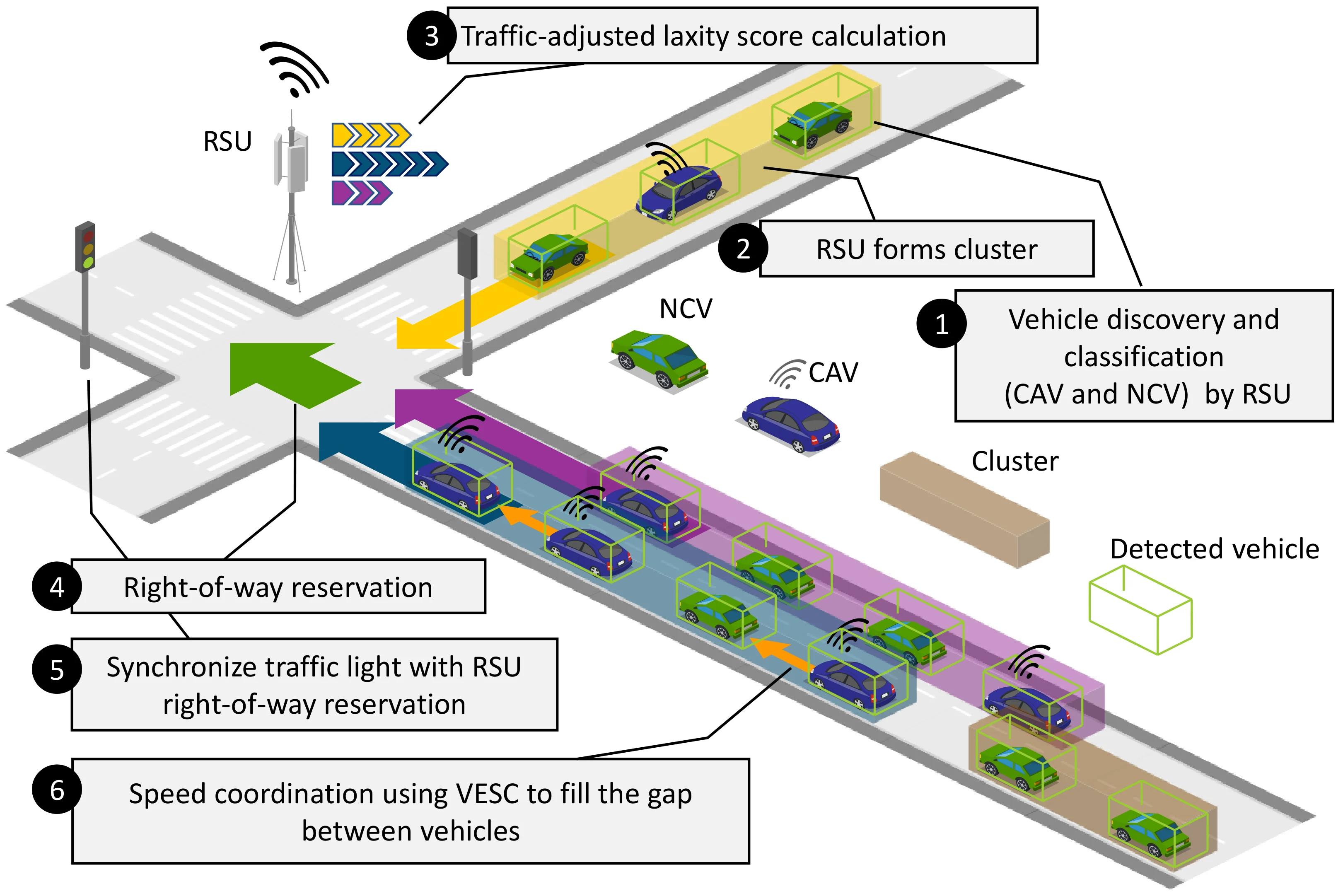
Abstract
Vehicle-to-everything (V2X) communication enables connected autonomous vehicles (CAVs) to share information and generate optimal decisions. The networking abilities of CAVs have led to the development of unsignalized autonomous intersection management (AIM) methods that leverage CAVs to significantly improve traffic flows. However, AIM methods assume 100% CAV market penetration, which is currently unrealistic owing to the gradual adoption of CAVs. Therefore, CAVs must share road usage with nonconnected vehicles (NCVs). Thus, we propose a mixed-traffic intersection management method that considers NCVs while ensuring high traffic flow, called traffic-load-responsive reservation for intersection management (TLRRIM). In TLRRIM, the roadside unit (RSU) first classifies vehicles and groups them into clusters before selecting a reservation cluster to cross an intersection. The reservation cluster selection considers both traffic load and crossing urgency. In addition, the RSU utilizes V2X-enabled speed coordination (VESC) for CAVs within the reservation cluster to further improve traffic flow, while utilizing traffic lights to guide NCVs. Simulation-based experiments using OpenCDA and CARLA showed that TLRRIM can increase throughput and reduce waiting time by up to 89.63% and 60.71%, respectively, compared with the fixed-time signaling method. Moreover, adding VESC can increase throughput by 12.21% and reduce waiting time by 10.80%, further enhancing traffic flow.
Related news
How to cite
N. D. Yosodipuro, E. Javanmardi, J. Nakazato, Y. Tamura, X. Défago, and M. Tsukada, “Mixed-traffic Intersection Management using Traffic-load-responsive Reservation and V2X-enabled Speed Coordination,” in 26th IEEE International Conference on Intelligent Transportation Systems (ITSC 2023), Bilbao, Bizkaia, Spain, 2023, doi: 10.1109/ITSC57777.2023.10422248.
BibTeX
@inproceedings{Yosodipuro2023,
  title         = {Mixed-traffic Intersection Management using Traffic-load-responsive Reservation and V2X-enabled Speed Coordination},
  author        = {Nicholaus Danispadmanaba Yosodipuro and Ehsan Javanmardi and Jin Nakazato and Yasumasa Tamura and Xavier Défago and Manabu Tsukada},
  url           = {https://www.researchgate.net/profile/Jin-Nakazato/publication/374470825_Mixed-traffic_Intersection_Management_using_Traffic-load-responsive_Reservation_and_V2X-enabled_Speed_Coordination/links/651ee8d63ab6cb4ec6bde79a/Mixed-traffic-Intersection-Management-using-Traffic-load-responsive-Reservation-and-V2X-enabled-Speed-Coordination.pdf},
  doi           = {10.1109/ITSC57777.2023.10422248},
  year          = {2023},
  date          = {2023-09-24},
  urldate       = {2023-09-24},
  booktitle     = {26th IEEE International Conference on Intelligent Transportation Systems (ITSC 2023)},
  address       = {Bilbao, Bizkaia, Spain},
  abstract      = {Vehicle-to-everything (V2X) communication enables connected autonomous vehicles (CAVs) to share information and generate optimal decisions. The networking abilities of CAVs have led to the development of unsignalized autonomous intersection management (AIM) methods that leverage CAVs to significantly improve traffic flows. However, AIM methods assume 100% CAV market penetration, which is currently unrealistic owing to the gradual adoption of CAVs. Therefore, CAVs must share road usage with nonconnected vehicles (NCVs). Thus, we propose a mixed-traffic intersection management method that considers NCVs while ensuring high traffic flow, called traffic-load-responsive reservation for intersection management (TLRRIM). In TLRRIM, the roadside unit (RSU) first classifies vehicles and groups them into clusters before selecting a reservation cluster to cross an intersection. The reservation cluster selection considers both traffic load and crossing urgency. In addition, the RSU utilizes V2X-enabled speed coordination (VESC) for CAVs within the reservation cluster to further improve traffic flow, while utilizing traffic lights to guide NCVs. Simulation-based experiments using OpenCDA and CARLA showed that TLRRIM can increase throughput and reduce waiting time by up to 89.63% and 60.71%, respectively, compared with the fixed-time signaling method. Moreover, adding VESC can increase throughput by 12.21% and reduce waiting time by 10.80%, further enhancing traffic flow.},
  keywords      = {ITS},
  pubstate      = {published},
  tppubtype     = {inproceedings}
}