
Joint Capacity Planning and Resource Allocation for UAV-Assisted Vehicular Fog Computing Using Deep Reinforcement Learning
IEEE International Conference on Future Machine Learning and Data Science (FMLDS 2026), Kobe, Japan, 2026年11月20日
3行要約
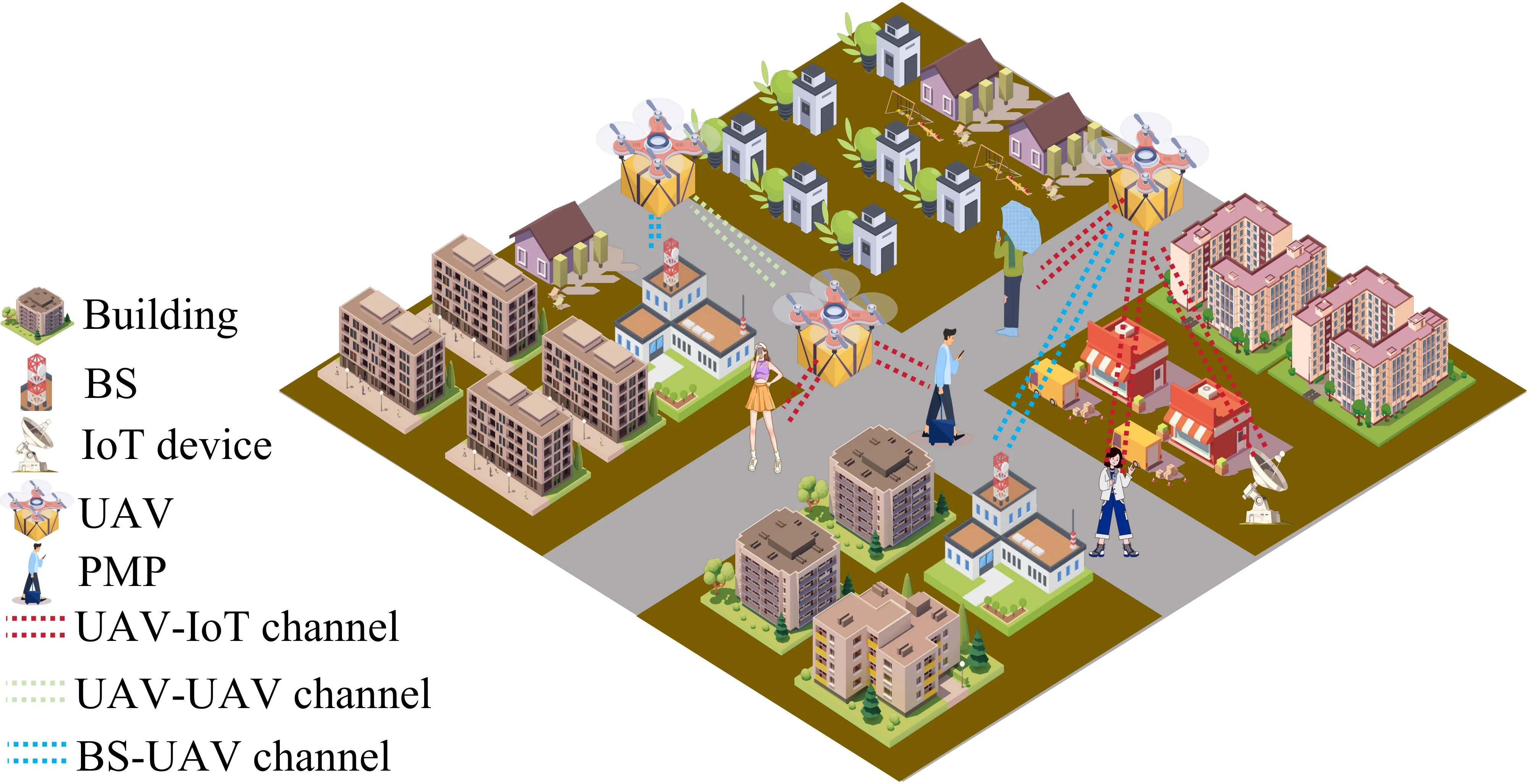
- 車両の計算需要が時空間で変化する状況で、UAV搭載のフォグノードが基地局のフォグノードを補う。
- 深層強化学習でUAVの軌道とIoT端末の受信電力割り当てを同時に最適化する。
- シミュレーションでは、片方の種類のノードだけを用いる2つの方式に比べて遅延が18.72%、33.90%減少した。
論文の図
アブストラクト(原文)
Fog computing shortens network latency by moving computational resources close to where data is generated. On this basis, Unmanned Aerial Vehicle (UAV)-assisted Vehicular Fog Computing (VFC) utilizes fog nodes carried by UAVs to complement the stationary fog nodes co-located with cellular base stations to meet the spatio-temporal varying demand cost-efficiently. By exploiting UAV mobility, the joint capacity planning and resource allocation problem is reformulated as a coupled optimization of UAV trajectories and received power allocation for IoT devices. Owing to its high complexity, we model the problem as a Markov Decision Process (MDP) and solve it using Deep Reinforcement Learning (DRL). Experimental results demonstrate that the proposed UAV-assisted VFC scheme reduces network latency by 18.72% and 33.90% compared with baseline approaches that rely solely on CFNs or VFNs, respectively. In addition, the rewards and key performance metrics, including average latency, task completion time, communication quality, and inference time, are compared across different DRL algorithms.
引用方法
Q. Zhou, W. Mao, M. Tsukada, and Y. Xiao, “Joint Capacity Planning and Resource Allocation for UAV-Assisted Vehicular Fog Computing Using Deep Reinforcement Learning,” in IEEE International Conference on Future Machine Learning and Data Science (FMLDS 2026), Kobe, Japan, 2026.
BibTeX
@inproceedings{Zhou2026f,
  title         = {Joint Capacity Planning and Resource Allocation for UAV-Assisted Vehicular Fog Computing Using Deep Reinforcement Learning},
  author        = {Quanxi Zhou and Wencan Mao and Manabu Tsukada and Yu Xiao},
  year          = {2026},
  date          = {2026-11-20},
  urldate       = {2026-11-20},
  booktitle     = {IEEE International Conference on Future Machine Learning and Data Science (FMLDS 2026)},
  address       = {Kobe, Japan},
  abstract      = {Fog computing shortens network latency by moving computational resources close to where data is generated. On this basis, Unmanned Aerial Vehicle (UAV)-assisted Vehicular Fog Computing (VFC) utilizes fog nodes carried by UAVs to complement the stationary fog nodes co-located with cellular base stations to meet the spatio-temporal varying demand cost-efficiently. By exploiting UAV mobility, the joint capacity planning and resource allocation problem is reformulated as a coupled optimization of UAV trajectories and received power allocation for IoT devices. Owing to its high complexity, we model the problem as a Markov Decision Process (MDP) and solve it using Deep Reinforcement Learning (DRL). Experimental results demonstrate that the proposed UAV-assisted VFC scheme reduces network latency by 18.72% and 33.90% compared with baseline approaches that rely solely on CFNs or VFNs, respectively. In addition, the rewards and key performance metrics, including average latency, task completion time, communication quality, and inference time, are compared across different DRL algorithms.},
  keywords      = {Other},
  tppubtype     = {inproceedings}
}