
Joint Capacity Planning and Resource Allocation for UAV-Assisted Vehicular Fog Computing Using Deep Reinforcement Learning
IEEE International Conference on Future Machine Learning and Data Science (FMLDS 2026), Kobe, Japan, Nov 20, 2026
Summary in three lines
- UAV-carried fog nodes complement base-station fog nodes as vehicle computing demand shifts across locations and time.
- Deep reinforcement learning jointly optimizes UAV trajectories and received-power allocation for IoT devices.
- The proposed scheme reduced simulated network latency by 18.72% and 33.90% versus the two single-node-type baselines.
Figures from the paper
Abstract
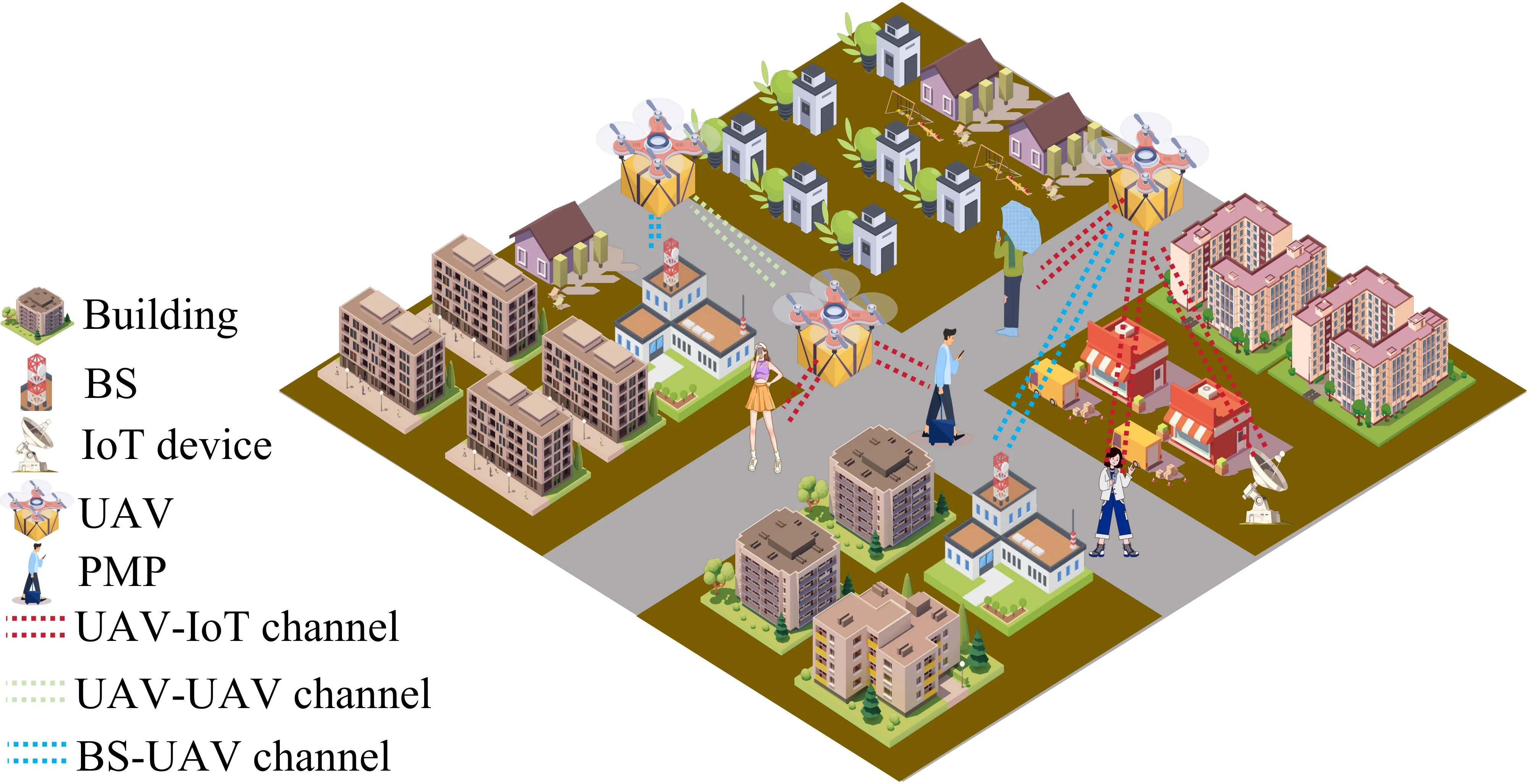
Fog computing shortens network latency by moving computational resources close to where data is generated. On this basis, Unmanned Aerial Vehicle (UAV)-assisted Vehicular Fog Computing (VFC) utilizes fog nodes carried by UAVs to complement the stationary fog nodes co-located with cellular base stations to meet the spatio-temporal varying demand cost-efficiently. By exploiting UAV mobility, the joint capacity planning and resource allocation problem is reformulated as a coupled optimization of UAV trajectories and received power allocation for IoT devices. Owing to its high complexity, we model the problem as a Markov Decision Process (MDP) and solve it using Deep Reinforcement Learning (DRL). Experimental results demonstrate that the proposed UAV-assisted VFC scheme reduces network latency by 18.72% and 33.90% compared with baseline approaches that rely solely on CFNs or VFNs, respectively. In addition, the rewards and key performance metrics, including average latency, task completion time, communication quality, and inference time, are compared across different DRL algorithms.
How to cite
Q. Zhou, W. Mao, M. Tsukada, and Y. Xiao, “Joint Capacity Planning and Resource Allocation for UAV-Assisted Vehicular Fog Computing Using Deep Reinforcement Learning,” in IEEE International Conference on Future Machine Learning and Data Science (FMLDS 2026), Kobe, Japan, 2026.
BibTeX
@inproceedings{Zhou2026f,
  title         = {Joint Capacity Planning and Resource Allocation for UAV-Assisted Vehicular Fog Computing Using Deep Reinforcement Learning},
  author        = {Quanxi Zhou and Wencan Mao and Manabu Tsukada and Yu Xiao},
  year          = {2026},
  date          = {2026-11-20},
  urldate       = {2026-11-20},
  booktitle     = {IEEE International Conference on Future Machine Learning and Data Science (FMLDS 2026)},
  address       = {Kobe, Japan},
  abstract      = {Fog computing shortens network latency by moving computational resources close to where data is generated. On this basis, Unmanned Aerial Vehicle (UAV)-assisted Vehicular Fog Computing (VFC) utilizes fog nodes carried by UAVs to complement the stationary fog nodes co-located with cellular base stations to meet the spatio-temporal varying demand cost-efficiently. By exploiting UAV mobility, the joint capacity planning and resource allocation problem is reformulated as a coupled optimization of UAV trajectories and received power allocation for IoT devices. Owing to its high complexity, we model the problem as a Markov Decision Process (MDP) and solve it using Deep Reinforcement Learning (DRL). Experimental results demonstrate that the proposed UAV-assisted VFC scheme reduces network latency by 18.72% and 33.90% compared with baseline approaches that rely solely on CFNs or VFNs, respectively. In addition, the rewards and key performance metrics, including average latency, task completion time, communication quality, and inference time, are compared across different DRL algorithms.},
  keywords      = {Other},
  tppubtype     = {inproceedings}
}