
Roadside Pedestrian Interaction: Reducing Negotiation Burden in Shared Spaces with Autonomous Vehicles
Ph.D. Thesis, The University of Tokyo, Sep 30, 2026
Summary in three lines
- Shared spaces with autonomous vehicles place a negotiation burden on pedestrians when driver cues disappear.
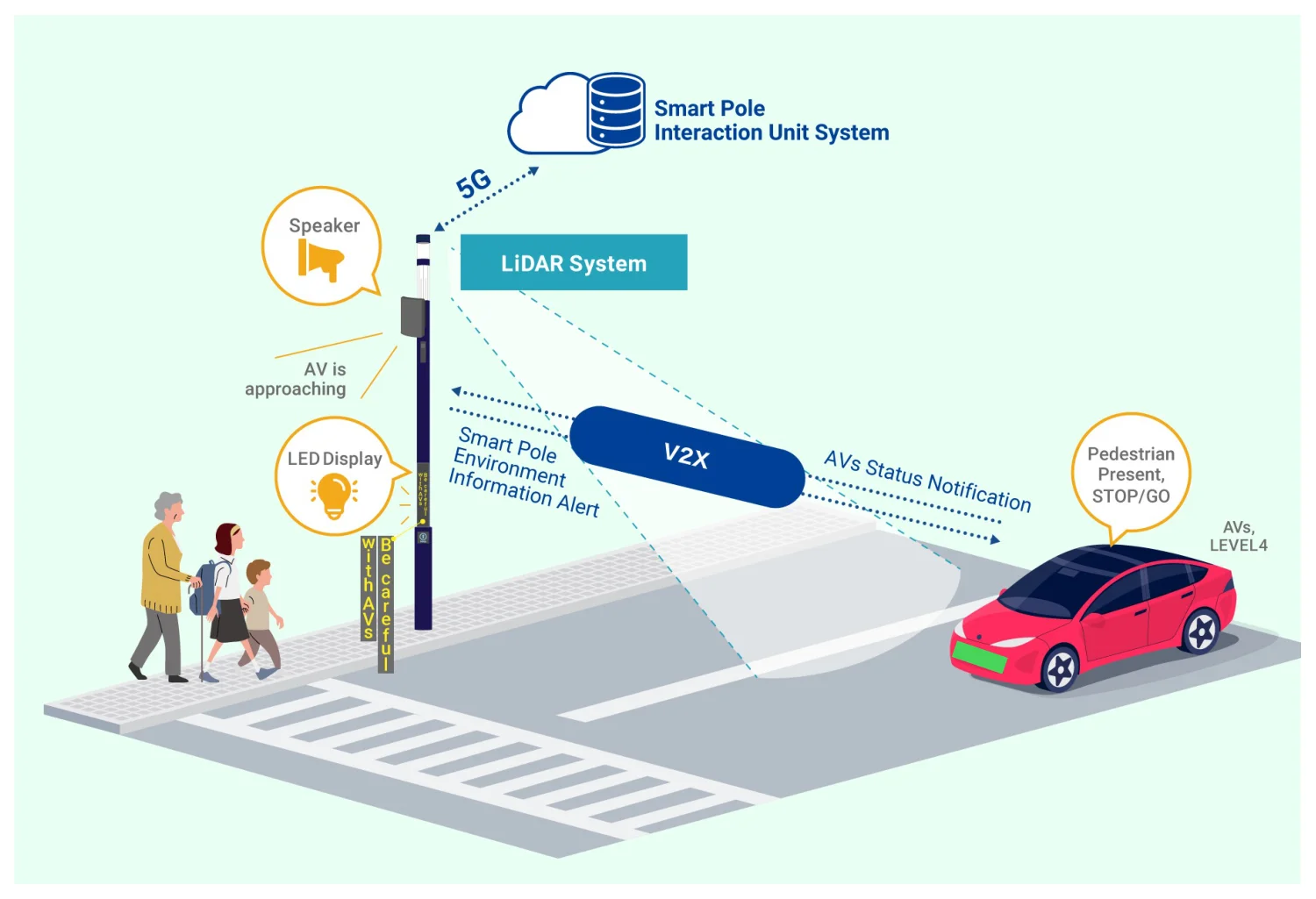
- The thesis proposes a roadside Smart Pole Interaction Unit that conveys crossing cues and can follow pedestrians.
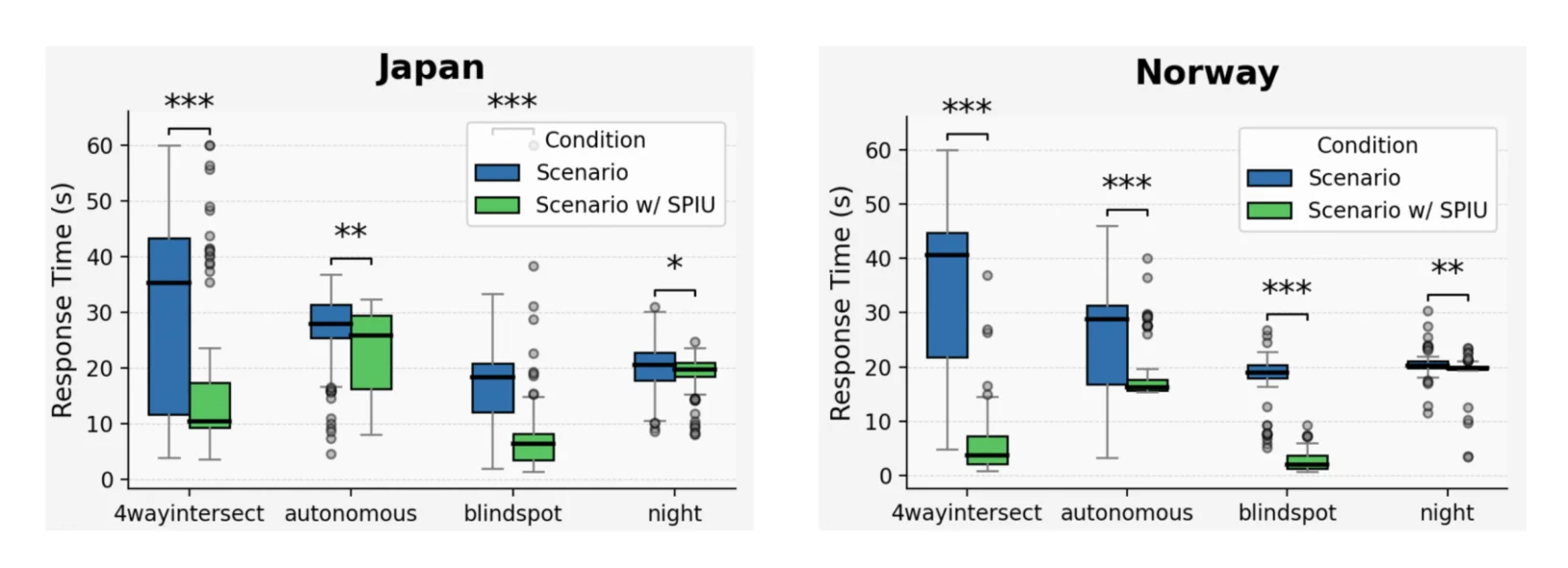
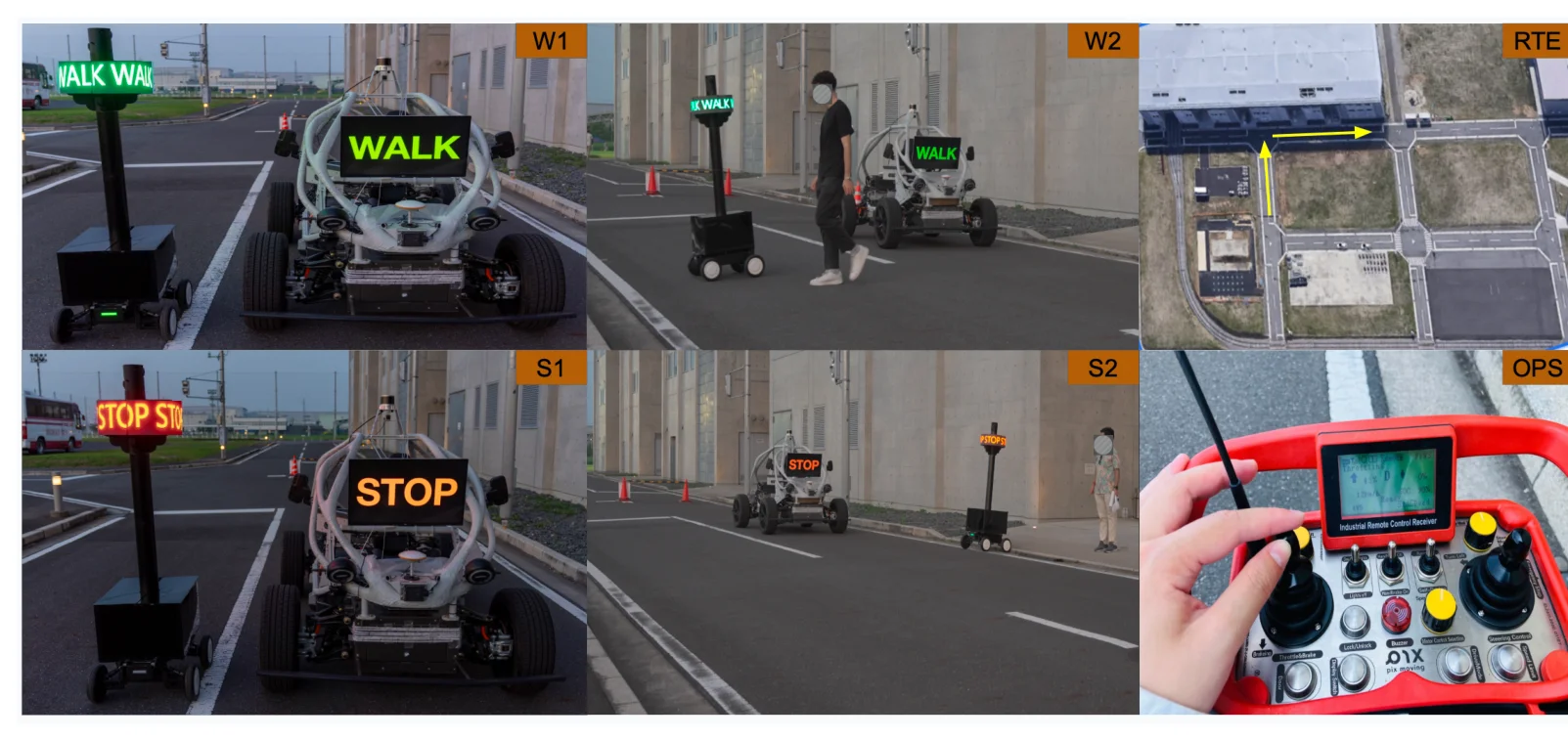
- VR, cross-cultural and field studies evaluate reaction time, interpretation and workload.
Figures from the paper
Abstract
When autonomous vehicles (AVs) enter shared spaces—streets where pedestrians, cyclists, and slow vehicles negotiate informally—pedestrians lose the eye contact, gestures, and yielding cues they relied on with human drivers. Vehicle-mounted external human–machine interfaces (eHMI) only partly close this gap: they fail under occlusion, vary across manufacturers, and lose meaning when several AVs or delivery robots approach at once. Shared spaces amplify each of these failures, because negotiation there is continuous rather than signal-bound. This thesis proposes the Smart Pole Interaction Unit (SPIU): a pedestrian-side, infrastructure-based interface that receives or infers AV intent and presents legible, encounter-specific cues at the pedestrian’s decision point in a shared space. SPIU complements rather than replaces traffic signals and vehicle eHMI, and is most useful under occlusion, blind spots, multi-agent ambiguity, or low visibility—the conditions that make shared-space negotiation hardest. The thesis frames pedestrian–AV interaction as mediated negotiation—a communication problem, not only a vehicle-control one. Four studies develop and test the concept in shared-space scenarios. A VR pilot (Electronics 2023
How to cite
V. Chauhan, “Roadside Pedestrian Interaction: Reducing Negotiation Burden in Shared Spaces with Autonomous Vehicles,” in Ph.D. Thesis, The University of Tokyo, 2026.
BibTeX
@phdthesis{Chauhan2026c,
  title         = {Roadside Pedestrian Interaction: Reducing Negotiation Burden in Shared Spaces with Autonomous Vehicles},
  author        = {Vishal Chauhan},
  year          = {2026},
  date          = {2026-09-30},
  urldate       = {2026-09-30},
  school        = {Ph.D. Thesis, The University of Tokyo},
  abstract      = {When autonomous vehicles (AVs) enter shared spaces—streets where pedestrians, cyclists, and slow vehicles negotiate informally—pedestrians lose the eye contact, gestures, and yielding cues they relied on with human drivers. Vehicle-mounted external human–machine interfaces (eHMI) only partly close this gap: they fail under occlusion, vary across manufacturers, and lose meaning when several AVs or delivery robots approach at once. Shared spaces amplify each of these failures, because negotiation there is continuous rather than signal-bound. This thesis proposes the Smart Pole Interaction Unit (SPIU): a pedestrian-side, infrastructure-based interface that receives or infers AV intent and presents legible, encounter-specific cues at the pedestrian’s decision point in a shared space. SPIU complements rather than replaces traffic signals and vehicle eHMI, and is most useful under occlusion, blind spots, multi-agent ambiguity, or low visibility—the conditions that make shared-space negotiation hardest. The thesis frames pedestrian–AV interaction as mediated negotiation—a communication problem, not only a vehicle-control one. Four studies develop and test the concept in shared-space scenarios. A VR pilot (Electronics 2023},
  keywords      = {Thesis},
  pubstate      = {published},
  tppubtype     = {phdthesis}
}