
Model Predictive Path-Planning Controller with Potential Function for Emergency Collision Avoidance on Highway Driving
IEEE Robotics and Automation Letters (RA-L) with IEEE International Conference on Robotics and Automation (ICRA) option, vol. 7, pp. 4662–4669, Apr 22, 2022
Summary in three lines
- Conventional potential-field planning can struggle during sudden highway emergencies.
- The method incorporates a sigmoid-shaped safe passage into model predictive control and detects when emergency guidance is needed.
- In simulations, the method suppressed steering oscillations compared with potential-field control alone.
Figures from the paper
Abstract
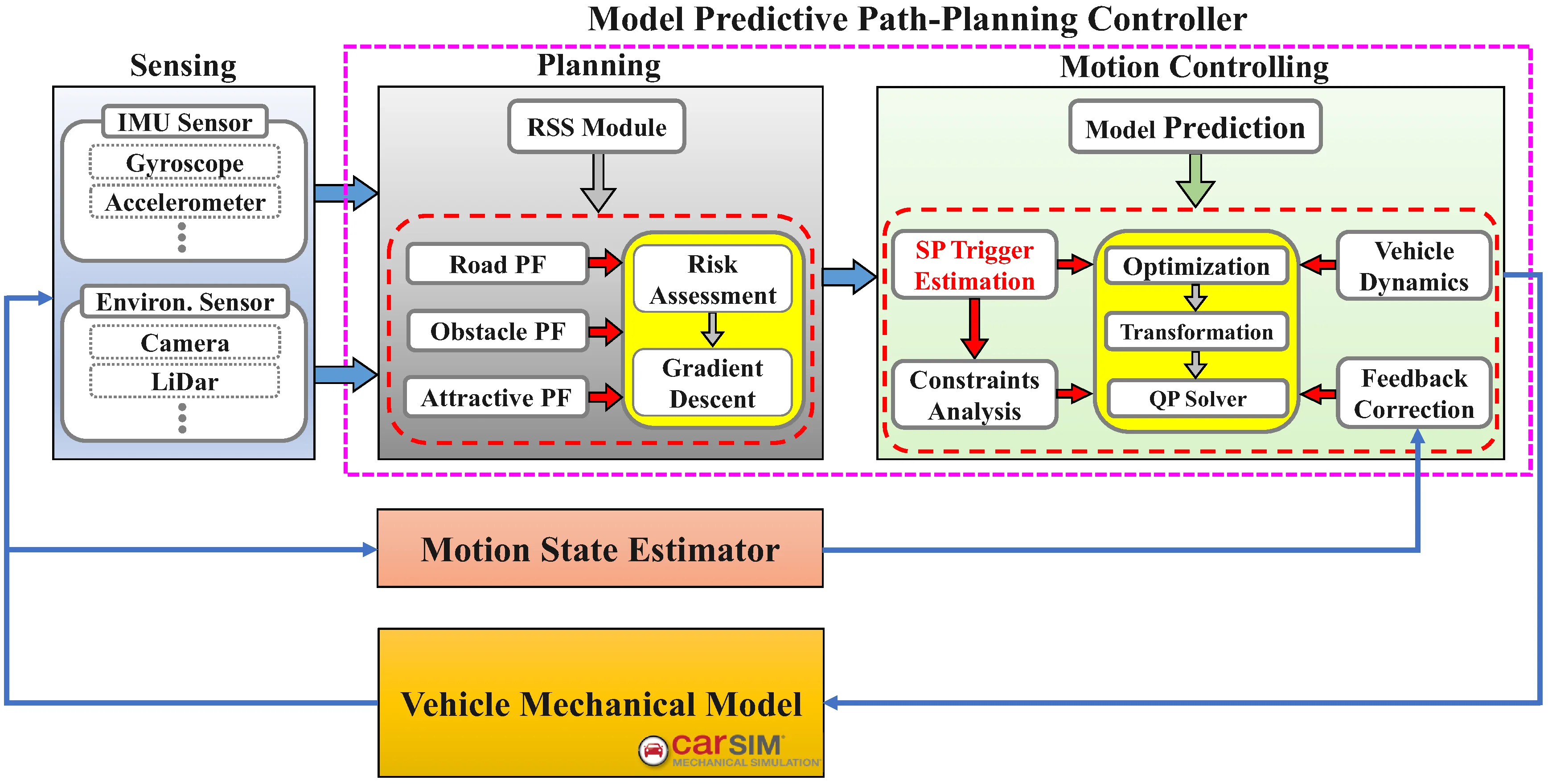
Existing potential functions (PFs) utilized in autonomous vehicles mainly focus on solving the path-planning problems in some conventional driving scenarios; thus, their performance may not be satisfactory in the context of emergency obstacle avoidance. Therefore, we propose a novel model predictive path-planning controller (MPPC) combined with PFs to handle complex traffic scenarios (e.g., emergency avoidance when a sudden accident occurs). Specifically, to enhance the safety of the PFs, we developed an MPPC to handle an emergency case with a sigmoid-based safe passage embedded in the MPC constraints (SPMPC) with a specific triggering analysis algorithm on monitoring traffic emergencies. The presented PF-SPMPC algorithm was compiled in a comparative simulation study using MATLAB/Simulink and CarSim. The algorithm outperformed the latest PF-MPC approach to eliminate the severe tire oscillations and guarantee autonomous driving safety when handling the traffic emergency avoidance scenario.
How to cite
P. Lin and M. Tsukada, “Model Predictive Path-Planning Controller with Potential Function for Emergency Collision Avoidance on Highway Driving,” IEEE Robotics and Automation Letters (RA-L) with IEEE International Conference on Robotics and Automation (ICRA) option, vol. 7, pp. 4662–4669, 2022, doi: 10.1109/LRA.2022.3152693.
BibTeX
@article{Lin2022,
  title         = {Model Predictive Path-Planning Controller with Potential Function for Emergency Collision Avoidance on Highway Driving},
  author        = {Pengfei Lin and Manabu Tsukada},
  doi           = {10.1109/LRA.2022.3152693},
  isbn          = {2377-3766},
  year          = {2022},
  date          = {2022-04-22},
  urldate       = {2022-04-22},
  journal       = {IEEE Robotics and Automation Letters (RA-L) with IEEE International Conference on Robotics and Automation (ICRA) option},
  volume        = {7},
  issue         = {2},
  pages         = {4662--4669},
  abstract      = {Existing potential functions (PFs) utilized in autonomous vehicles mainly focus on solving the path-planning problems in some conventional driving scenarios; thus, their performance may not be satisfactory in the context of emergency obstacle avoidance. Therefore, we propose a novel model predictive path-planning controller (MPPC) combined with PFs to handle complex traffic scenarios (e.g., emergency avoidance when a sudden accident occurs). Specifically, to enhance the safety of the PFs, we developed an MPPC to handle an emergency case with a sigmoid-based safe passage embedded in the MPC constraints (SPMPC) with a specific triggering analysis algorithm on monitoring traffic emergencies. The presented PF-SPMPC algorithm was compiled in a comparative simulation study using MATLAB/Simulink and CarSim. The algorithm outperformed the latest PF-MPC approach to eliminate the severe tire oscillations and guarantee autonomous driving safety when handling the traffic emergency avoidance scenario.},
  keywords      = {ITS},
  pubstate      = {published},
  tppubtype     = {article}
}