
Clothoid Curve-based Emergency Stopping Path-Planning with Adaptive Potential Field for Autonomous Vehicles
IEEE Transactions on Vehicular Technology, vol. 73, pp. 9747–9762, Jul 24, 2024
arXivDOI: 10.1109/TVT.2024.3380745
Summary in three lines
- A rigid road potential field can trap a vehicle in a local minimum when another vehicle merges suddenly.
- The proposed planner detects this situation, identifies a stopping point, and fits a clothoid path.
- It reduced wheel-slip duration by 61.9% and peak steering angle amplitude by 76.9% in the reported comparison.
Figures from the paper
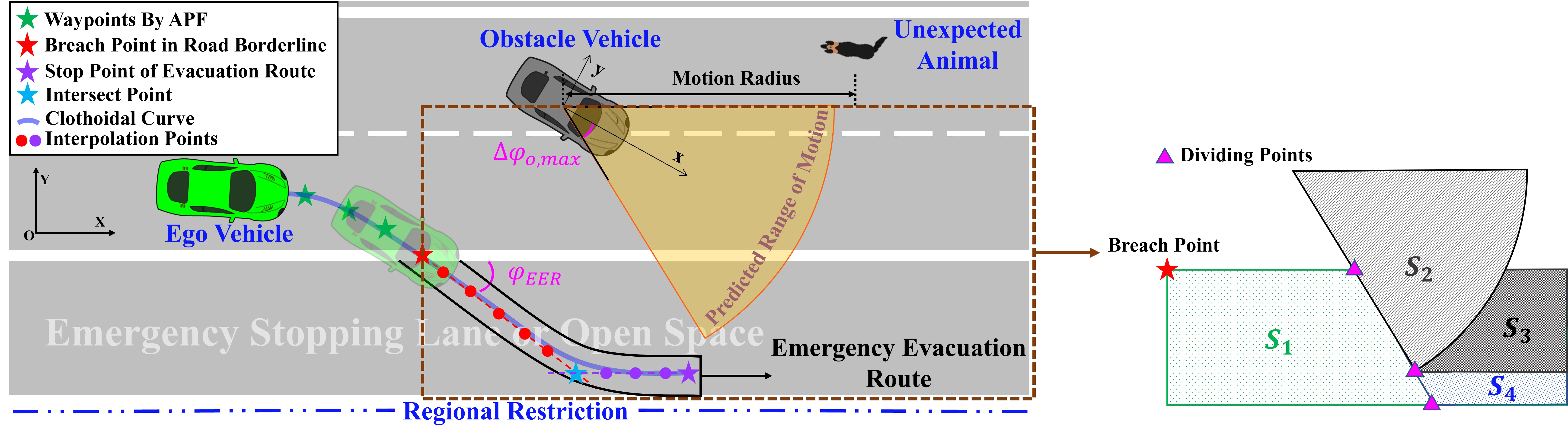
Abstract
Potential Field-based path planning methods are widely embraced in the context of autonomous vehicles due to their real-time efficiency and simplicity. While the potential field effectively enforces a rigid road boundary to keep the vehicle within the confines of the road, it can lead to the “blind alley” problem caused by local minima in specific high- speed scenarios, resulting in indecision, erratic behavior, or even accidents. Therefore, the objective of this research is to anticipate and address the aforementioned problem in order to proactively avoid potential collisions. We have also found that existing methods do not offer a root cause analysis or practical solutions for this issue, which limits the practicality of the potential field in handling complicated traffic situations. In this paper, we propose an Emergency-Stopping Path Planning (ESPP) approach that incorporates an adaptive potential field with the clothoid curve. First, we design an emergency triggering estimation to detect the ”blind alley” problem. Second, we regionalize the driving scene to search for the optimal breach point on the road PF and the final stopping point for the vehicle by considering the motion range of the obstacle. Finally, we use the optimized clothoid curve to fit these calculated points under vehicle dynamics constraints to generate a smooth emergency avoidance path. The proposed ESPP method was evaluated by conducting the co-simulation between MATLAB/Simulink and CarSim Simulator in a freeway scene. The simulation results reveal that the proposed method shows increased performance in emergency collision avoidance and renders the vehicle safer, in which the duration of wheel slip is 61.9% shorter, and the maximum steering angle amplitude is 76.9% lower than other potential field-based methods.
How to cite
P. Lin, E. Javanmardi, and M. Tsukada, “Clothoid Curve-based Emergency Stopping Path-Planning with Adaptive Potential Field for Autonomous Vehicles,” IEEE Transactions on Vehicular Technology, vol. 73, pp. 9747–9762, 2024, doi: 10.1109/TVT.2024.3380745.
BibTeX
@article{Lin2024b,
  title         = {Clothoid Curve-based Emergency Stopping Path-Planning with Adaptive Potential Field for Autonomous Vehicles},
  author        = {Pengfei Lin and Ehsan Javanmardi and Manabu Tsukada},
  doi           = {10.1109/TVT.2024.3380745},
  issn          = {0018-9545},
  url           = {https://arxiv.org/abs/2308.10049},
  eprint        = {2308.10049},
  archiveprefix = {arXiv},
  primaryclass  = {cs.RO},
  year          = {2024},
  date          = {2024-07-24},
  urldate       = {2024-03-22},
  journal       = {IEEE Transactions on Vehicular Technology},
  volume        = {73},
  issue         = {7},
  pages         = {9747--9762},
  abstract      = {Potential Field-based path planning methods are widely embraced in the context of autonomous vehicles due to their real-time efficiency and simplicity. While the potential field effectively enforces a rigid road boundary to keep the vehicle within the confines of the road, it can lead to the “blind alley” problem caused by local minima in specific high- speed scenarios, resulting in indecision, erratic behavior, or even accidents. Therefore, the objective of this research is to anticipate and address the aforementioned problem in order to proactively avoid potential collisions. We have also found that existing methods do not offer a root cause analysis or practical solutions for this issue, which limits the practicality of the potential field in handling complicated traffic situations. In this paper, we propose an Emergency-Stopping Path Planning (ESPP) approach that incorporates an adaptive potential field with the clothoid curve. First, we design an emergency triggering estimation to detect the ”blind alley” problem. Second, we regionalize the driving scene to search for the optimal breach point on the road PF and the final stopping point for the vehicle by considering the motion range of the obstacle. Finally, we use the optimized clothoid curve to fit these calculated points under vehicle dynamics constraints to generate a smooth emergency avoidance path. The proposed ESPP method was evaluated by conducting the co-simulation between MATLAB/Simulink and CarSim Simulator in a freeway scene. The simulation results reveal that the proposed method shows increased performance in emergency collision avoidance and renders the vehicle safer, in which the duration of wheel slip is 61.9% shorter, and the maximum steering angle amplitude is 76.9% lower than other potential field-based methods.},
  keywords      = {ITS},
  pubstate      = {published},
  tppubtype     = {article}
}