
A Rule-Compliance Path Planner for Lane-Merge Scenarios Based on Responsibility-Sensitive Safety
18th International Conference on Control, Automation, Robotics and Vision (ICARCV 2024), Dubai, UAE, Dec 12, 2024
arXivDOI: 10.1109/ICARCV63323.2024.10821557
Summary in three lines
- Lane merging can oscillate when vehicles have ambiguous intentions or right of way.
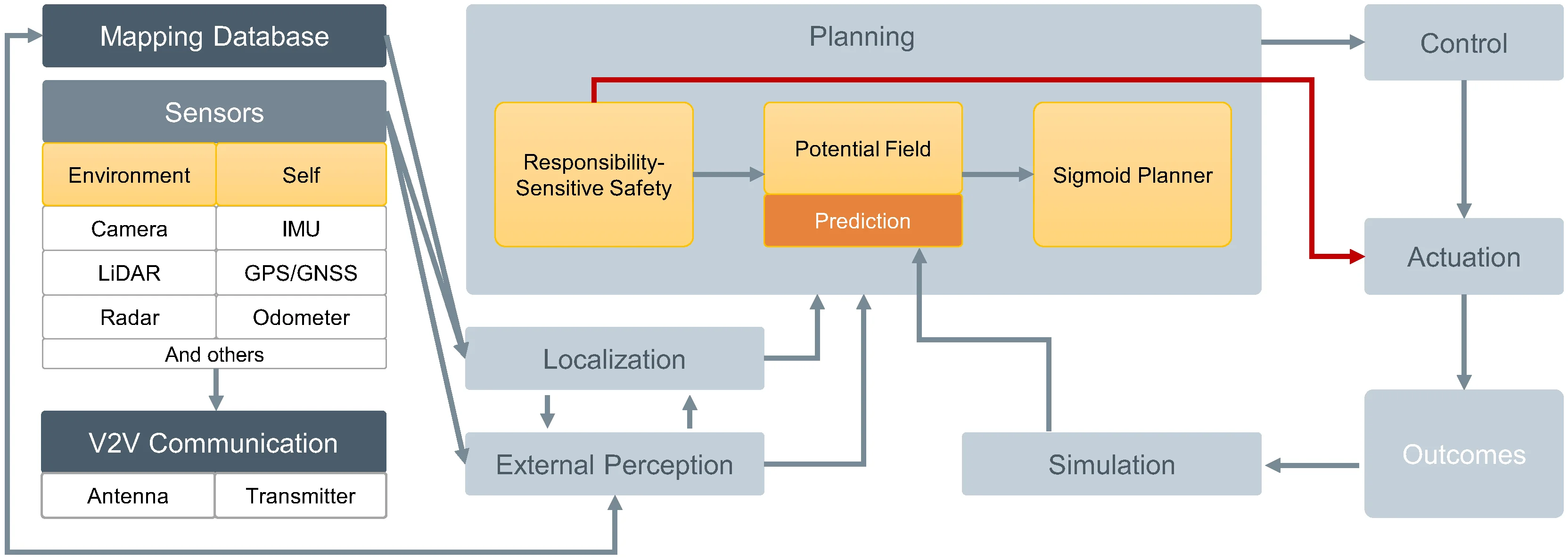
- The planner uses extended RSS to determine priority, a sigmoid potential-field planner to generate paths, and V2V to share information.
- In simulation, it eliminated oscillation and cut merge time by 72.3% and path length by 53.4%.
Figures from the paper
Abstract
Lane merging is one of the critical tasks for selfdriving cars, and how to perform lane-merge maneuvers effectively and safely has become one of the important standards in measuring the capability of autonomous driving systems. However, due to the ambiguity in driving intentions and right-of-way issues, the lane merging process in autonomous driving remains deficient in terms of maintaining or ceding the right-of-way and attributing liability, which could result in protracted durations for merging and problems such as trajectory oscillation. Hence, we present a rule-compliance path planner (RCPP) for lane-merge scenarios, which initially employs the extended responsibility-sensitive safety (RSS) to elucidate the right-of-way, followed by the potential field-based sigmoid planner for path generation. In the simulation, we have validated the efficacy of the proposed algorithm. The algorithm demonstrated superior performance over previous approaches in aspects such as merging time (Saved 72.3%), path length (reduced 53.4%), and eliminating the trajectory oscillation.
How to cite
P. Lin, E. Javanmardi, Y. Jiang, and M. Tsukada, “A Rule-Compliance Path Planner for Lane-Merge Scenarios Based on Responsibility-Sensitive Safety,” in 18th International Conference on Control, Automation, Robotics and Vision (ICARCV 2024), Dubai, UAE, 2024, doi: 10.1109/ICARCV63323.2024.10821557.
BibTeX
@inproceedings{Lin2024c,
  title         = {A Rule-Compliance Path Planner for Lane-Merge Scenarios Based on Responsibility-Sensitive Safety},
  author        = {Pengfei Lin and Ehsan Javanmardi and Yuze Jiang and Manabu Tsukada},
  doi           = {10.1109/ICARCV63323.2024.10821557},
  url           = {https://arxiv.org/abs/2403.13251},
  year          = {2024},
  date          = {2024-12-12},
  urldate       = {2024-12-12},
  booktitle     = {18th International Conference on Control, Automation, Robotics and Vision (ICARCV 2024)},
  address       = {Dubai, UAE},
  abstract      = {Lane merging is one of the critical tasks for selfdriving cars, and how to perform lane-merge maneuvers effectively and safely has become one of the important standards in measuring the capability of autonomous driving systems. However, due to the ambiguity in driving intentions and right-of-way issues, the lane merging process in autonomous driving remains deficient in terms of maintaining or ceding the right-of-way and attributing liability, which could result in protracted durations for merging and problems such as trajectory oscillation. Hence, we present a rule-compliance path planner (RCPP) for lane-merge scenarios, which initially employs the extended responsibility-sensitive safety (RSS) to elucidate the right-of-way, followed by the potential field-based sigmoid planner for path generation. In the simulation, we have validated the efficacy of the proposed algorithm. The algorithm demonstrated superior performance over previous approaches in aspects such as merging time (Saved 72.3%), path length (reduced 53.4%), and eliminating the trajectory oscillation.},
  keywords      = {ITS},
  pubstate      = {published},
  tppubtype     = {inproceedings}
}