
Criteria for Reinforcement Learning Suitability in Multi-UAV Precision-Agriculture Coverage: Sensing Cost, Task Structure, and Policy Selection
Master Thesis, Graduate School of Information Science and Technology, The University of Tokyo, Sep 30, 2026
Summary in three lines
- The thesis investigates when reinforcement learning improves multi-UAV coverage for precision irrigation.
- Controlled experiments vary sensing demand, observation windows and policy capacity to separate their effects.
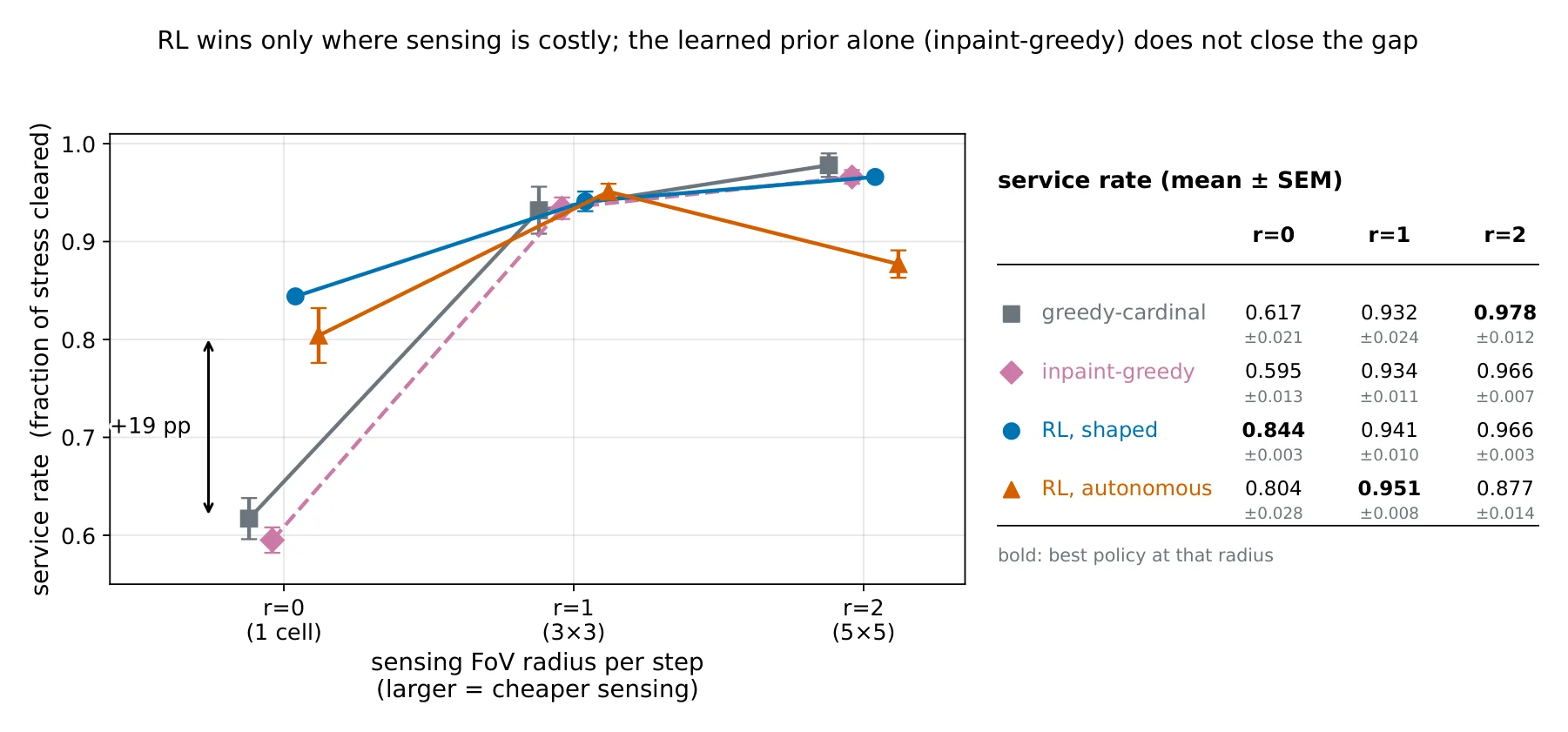
- Learned policies showed substantial gains under sensing scarcity, while simple sweeps remained competitive in several monitoring settings.
Figures from the paper
Abstract
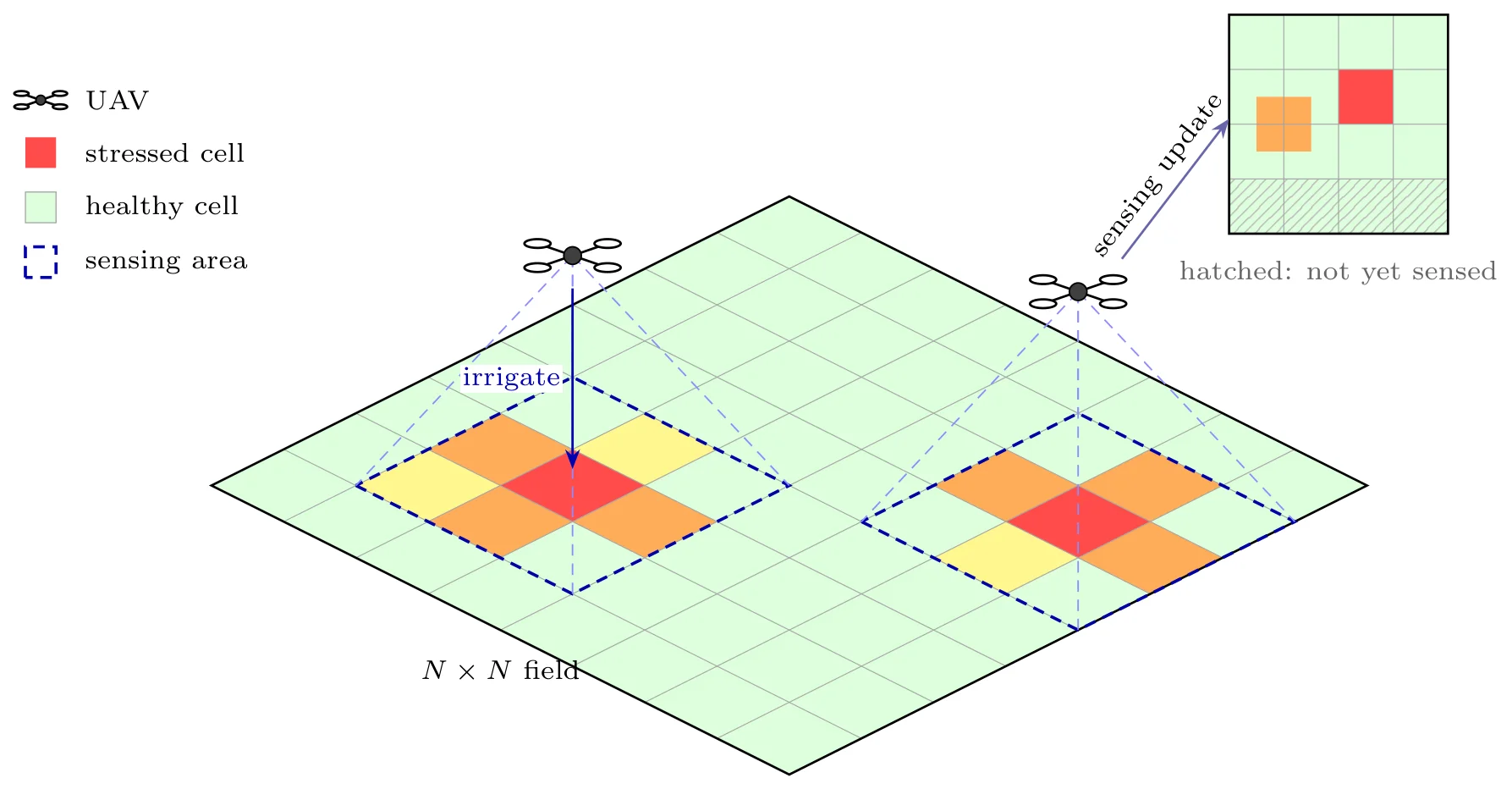
This thesis investigates the application of unmanned aerial vehicles (UAVs) as auxiliary platforms for smart agriculture, performing tasks such as precision detection, recognition, and trajectory planning. We ask when a learned policy outperforms a strong engineered heuristic in multi-agent cooperative coverage, and answer with controlled simulations. By formulating the trajectory planning problem as a Markov decision process (MDP) and employing a decentralized multi-agent reinforcement learning (MARL) framework, we analyze the impact of different sensing modalities, task scales, environmental complexity and reward models on the learning efficiency and coverage performance. Our findings indicate that value-based, feedforward primitive-action policies are effective only when sensing costs are sufficiently high and a single observation suffices to identify the local signal. Based on these insights, we propose a set of criteria grounded in sensing costs and task structure to evaluate the suitability of reinforcement learning for specific UAV coverage scenarios and to guide the selection of appropriate policy types. This provides a theoretical basis and practical guidelines for algorithm selection in similar problems.
How to cite
J. Ma, “Criteria for Reinforcement Learning Suitability in Multi-UAV Precision-Agriculture Coverage: Sensing Cost, Task Structure, and Policy Selection,” in Master Thesis, Graduate School of Information Science and Technology, The University of Tokyo, 2026.
BibTeX
@mastersthesis{Ma2026,
  title         = {Criteria for Reinforcement Learning Suitability in Multi-UAV Precision-Agriculture Coverage: Sensing Cost, Task Structure, and Policy Selection},
  author        = {Junqing Ma},
  year          = {2026},
  date          = {2026-09-30},
  urldate       = {2026-09-30},
  school        = {Master Thesis, Graduate School of Information Science and Technology, The University of Tokyo},
  abstract      = {This thesis investigates the application of unmanned aerial vehicles (UAVs) as auxiliary platforms for smart agriculture, performing tasks such as precision detection, recognition, and trajectory planning. We ask when a learned policy outperforms a strong engineered heuristic in multi-agent cooperative coverage, and answer with controlled simulations. By formulating the trajectory planning problem as a Markov decision process (MDP) and employing a decentralized multi-agent reinforcement learning (MARL) framework, we analyze the impact of different sensing modalities, task scales, environmental complexity and reward models on the learning efficiency and coverage performance. Our findings indicate that value-based, feedforward primitive-action policies are effective only when sensing costs are sufficiently high and a single observation suffices to identify the local signal. Based on these insights, we propose a set of criteria grounded in sensing costs and task structure to evaluate the suitability of reinforcement learning for specific UAV coverage scenarios and to guide the selection of appropriate policy types. This provides a theoretical basis and practical guidelines for algorithm selection in similar problems.},
  keywords      = {Thesis},
  pubstate      = {published},
  tppubtype     = {mastersthesis}
}