
AutoMCM: Maneuver Coordination Service with Abstracted Functions for Autonomous Driving
24th IEEE International Conference on Intelligent Transportation Systems (ITSC 2021), Indianapolis, IN, USA, Sep 19, 2021
arXivDOI: 10.1109/ITSC48978.2021.9564556
Summary in three lines
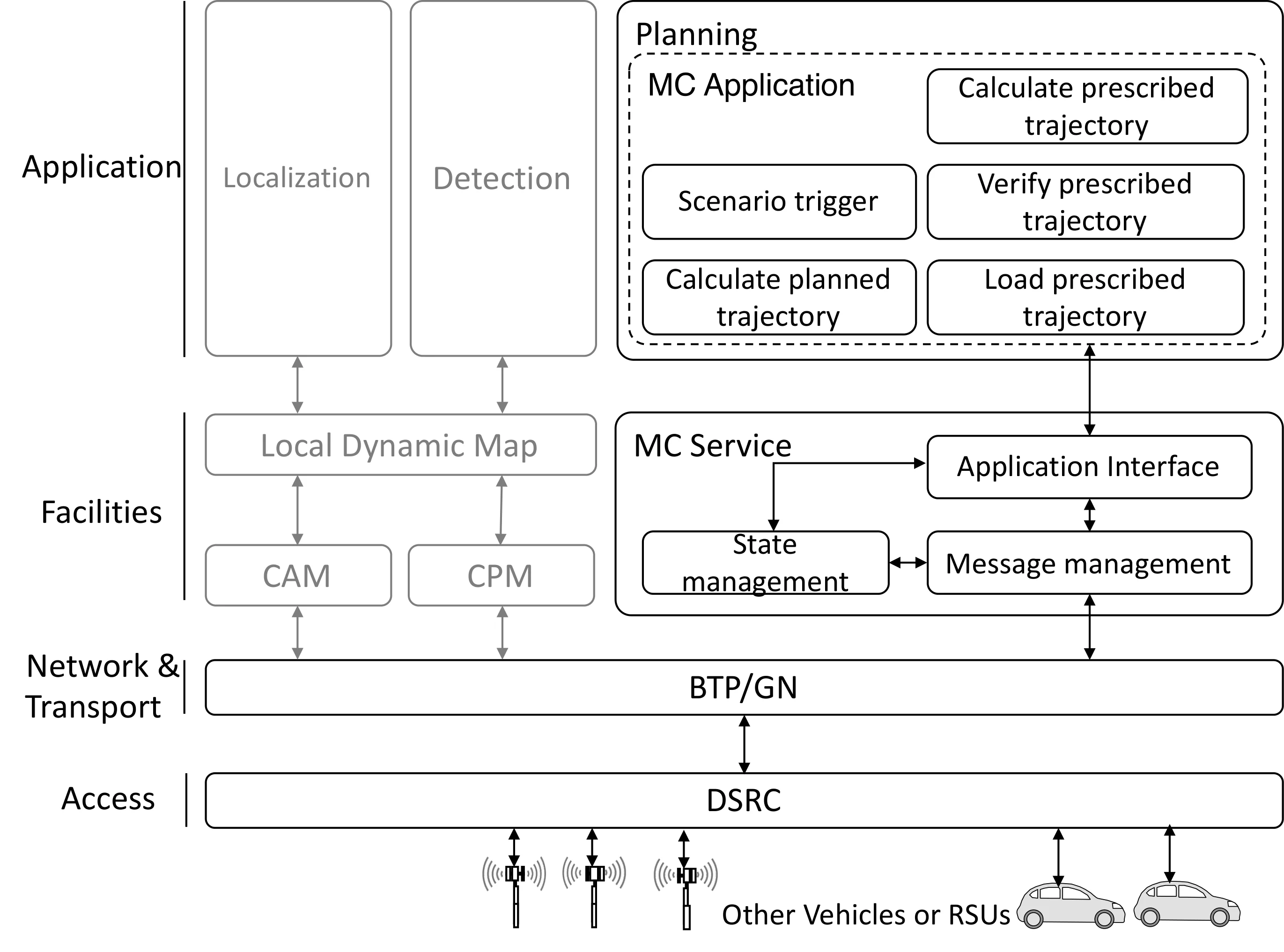
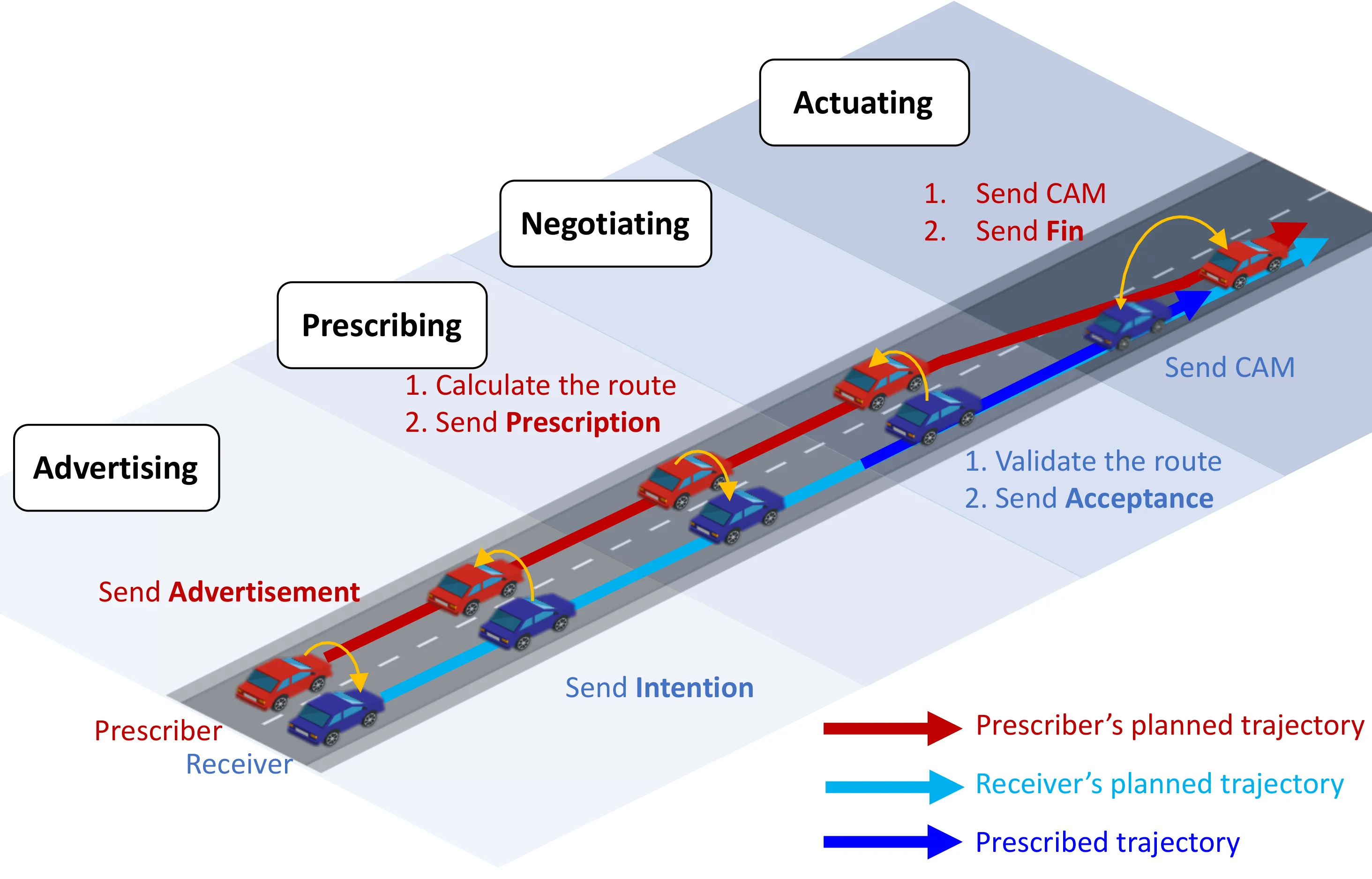
- AutoMCM uses a seven-message protocol and a service interface for coordinating driving maneuvers.
- The implementation extends Autoware and OpenC2X and exchanges messages when coordination events occur.
- Experiments reported reduced bandwidth use, faster travel in the evaluated scenarios and tolerance of packet loss with appropriate timeouts.
Figures from the paper
Abstract
A cooperative intelligent transport system (C-ITS) uses vehicle-to-everything (V2X) technology to make self-driving vehicles safer and more efficient. Current C-ITS applications have mainly focused on real-time information sharing, such as for cooperative perception. In addition to better real-time perception, self-driving vehicles need to achieve higher safety and efficiency by coordinating action plans. This study designs a maneuver coordination (MC) protocol that uses seven messages to cover various scenarios and an abstracted MC support service. We implement our proposal as AutoMCM by extending two open-source software tools: Autoware for autonomous driving and OpenC2X for C-ITS. The results show that our system effectively reduces the communication bandwidth by limiting message exchange in an event-driven manner. Furthermore, it shows that the vehicles run 15% faster when the vehicle speed is 30 km/h and 28% faster when the vehicle speed is 50 km/h using our scheme. Our system shows robustness against packet loss in experiments when the message timeout parameters are appropriately set.
Video
Related research and software
How to cite
M. Mizutani, M. Tsukada, and H. Esaki, “AutoMCM: Maneuver Coordination Service with Abstracted Functions for Autonomous Driving,” in 24th IEEE International Conference on Intelligent Transportation Systems (ITSC 2021), Indianapolis, IN, USA, 2021, doi: 10.1109/ITSC48978.2021.9564556.
BibTeX
@inproceedings{Mizutani2021b,
  title         = {AutoMCM: Maneuver Coordination Service with Abstracted Functions for Autonomous Driving},
  author        = {Masaya Mizutani and Manabu Tsukada and Hiroshi Esaki},
  url           = {https://arxiv.org/abs/2107.06627 https://youtu.be/eC7L0R_1Ybo https://youtu.be/s3l5zypizxQ https://youtu.be/XBpZeT-apGE},
  doi           = {10.1109/ITSC48978.2021.9564556},
  year          = {2021},
  date          = {2021-09-19},
  urldate       = {2021-09-19},
  booktitle     = {24th IEEE International Conference on Intelligent Transportation Systems (ITSC 2021)},
  address       = {Indianapolis, IN, USA},
  abstract      = {A cooperative intelligent transport system (C-ITS) uses vehicle-to-everything (V2X) technology to make self-driving vehicles safer and more efficient. Current C-ITS applications have mainly focused on real-time information sharing, such as for cooperative perception. In addition to better real-time perception, self-driving vehicles need to achieve higher safety and efficiency by coordinating action plans. This study designs a maneuver coordination (MC) protocol that uses seven messages to cover various scenarios and an abstracted MC support service. We implement our proposal as AutoMCM by extending two open-source software tools: Autoware for autonomous driving and OpenC2X for C-ITS. The results show that our system effectively reduces the communication bandwidth by limiting message exchange in an event-driven manner. Furthermore, it shows that the vehicles run 15% faster when the vehicle speed is 30 km/h and 28% faster when the vehicle speed is 50 km/h using our scheme. Our system shows robustness against packet loss in experiments when the message timeout parameters are appropriately set.},
  keywords      = {ITS},
  pubstate      = {published},
  tppubtype     = {inproceedings}
}