
Cooperative awareness using roadside unit networks in mixed traffic
IEEE Vehicular Networking Conference (VNC 2019), pp. 9–16, Dec 4, 2019
PDFDOI: 10.1109/VNC48660.2019.9062773
Summary in three lines
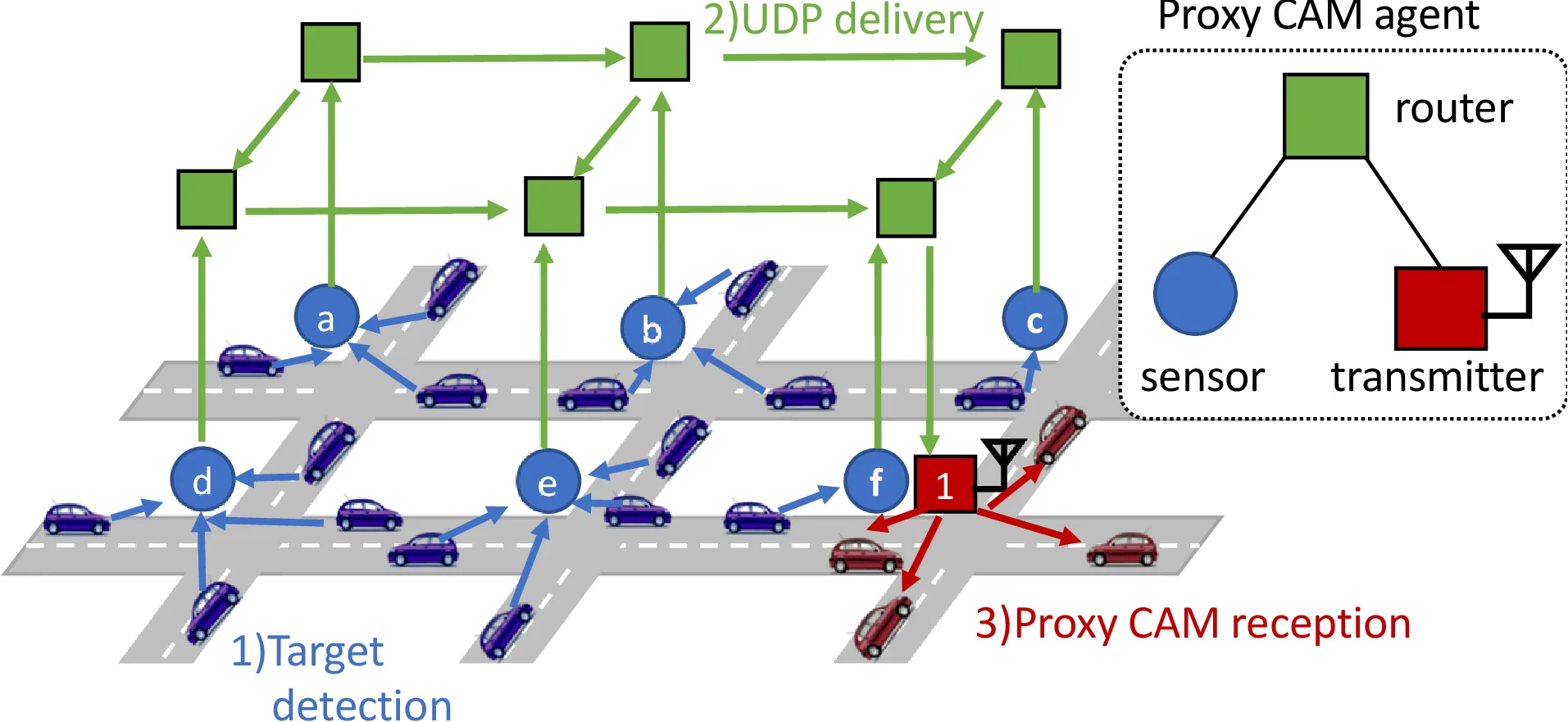
- Grid Proxy CAM extends roadside awareness messages to areas where detected vehicles cannot broadcast their own status.
- It links roadside units over a high-speed edge network and prioritizes packets by their contribution to safety.
- Simulations on maps of Tokyo and Paris found that the scheme could extend delivery range while maintaining high delivery ratios and low delay.
Figures from the paper
Abstract
Vehicle-to-vehicle (V2V) messaging is an indispensable component of connected autonomous vehicle systems. Although V2V standards have been specified by the European Union, United States, and Japan, the deployment phase represents mixed traffic in which connected and legacy vehicles co-exist. To enhance cooperative awareness in this mixed traffic, we assessed the special roadside unit that we developed in our previous work that generates required V2V messages on behalf of sensed target vehicles. In this paper, we extend our earlier work to propose a system called “Grid Proxy Cooperative Awareness Message to broaden the cooperative awareness message dissemination area by connecting infrastructure using high-speed roadside networks. To minimize delay in message delivery, we designed the proposed system to use edge computing. The proposed scheme delivers cooperative messages to a wider area with a low delay and a high packet delivery ratio by prioritizing packets by their respective safety contributions. Our simulation results indicate that the proposed scheme efficiently delivers messages in heavy road traffic conditions modeled on real maps of Tokyo and Paris.
Video
Related research and software
How to cite
M. Tsukada, M. Kitazawa, T. Oi, H. Ochiai, and H. Esaki, “Cooperative awareness using roadside unit networks in mixed traffic,” in IEEE Vehicular Networking Conference (VNC 2019), 2019, doi: 10.1109/VNC48660.2019.9062773.
BibTeX
@inproceedings{Tsukada2019b,
  title         = {Cooperative awareness using roadside unit networks in mixed traffic},
  author        = {Manabu Tsukada and Masahiro Kitazawa and Takaharu Oi and Hideya Ochiai and Hiroshi Esaki},
  url           = {https://hal.archives-ouvertes.fr/hal-02335068/?.pdf},
  doi           = {10.1109/VNC48660.2019.9062773},
  year          = {2019},
  date          = {2019-12-04},
  booktitle     = {IEEE Vehicular Networking Conference (VNC 2019)},
  pages         = {9--16},
  abstract      = {Vehicle-to-vehicle (V2V) messaging is an indispensable component of connected autonomous vehicle systems. Although V2V standards have been specified by the European Union, United States, and Japan, the deployment phase represents mixed traffic in which connected and legacy vehicles co-exist. To enhance cooperative awareness in this mixed traffic, we assessed the special roadside unit that we developed in our previous work that generates required V2V messages on behalf of sensed target vehicles. In this paper, we extend our earlier work to propose a system called “Grid Proxy Cooperative Awareness Message to broaden the cooperative awareness message dissemination area by connecting infrastructure using high-speed roadside networks. To minimize delay in message delivery, we designed the proposed system to use edge computing.  The proposed scheme delivers cooperative messages to a wider area with a low delay and a high packet delivery ratio by prioritizing packets by their respective safety contributions. Our simulation results indicate that the proposed scheme efficiently delivers messages in heavy road traffic conditions modeled on real maps of Tokyo and Paris.},
  keywords      = {ITS},
  pubstate      = {published},
  tppubtype     = {inproceedings}
}