
Networked Roadside Perception Units for Autonomous Driving
Sensors, vol. 20, no. 18, Sep 17, 2020
Summary in three lines
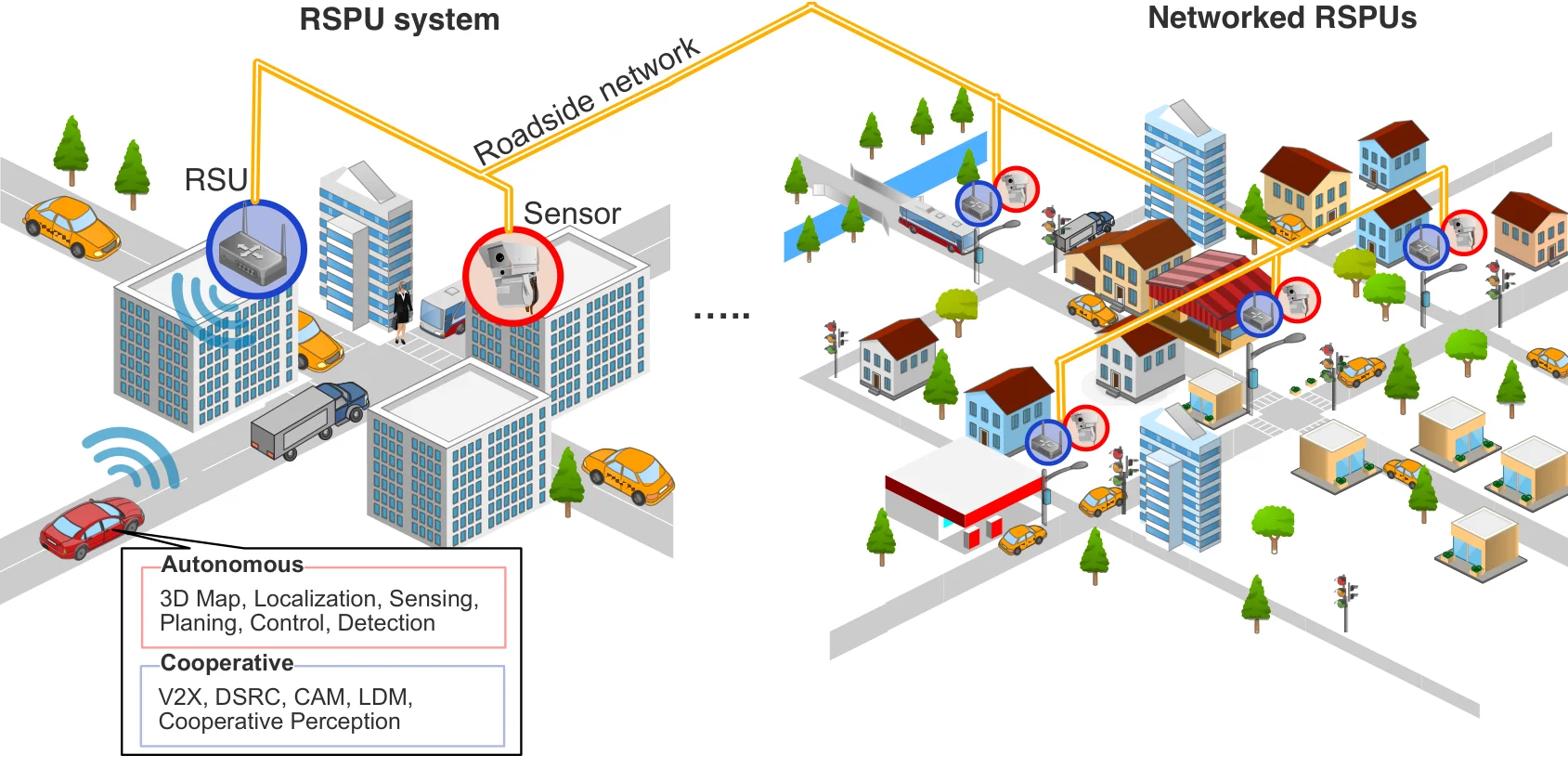
- The roadside perception unit combines roadside sensors and V2X equipment, with AutoC2X sharing detections with vehicles.
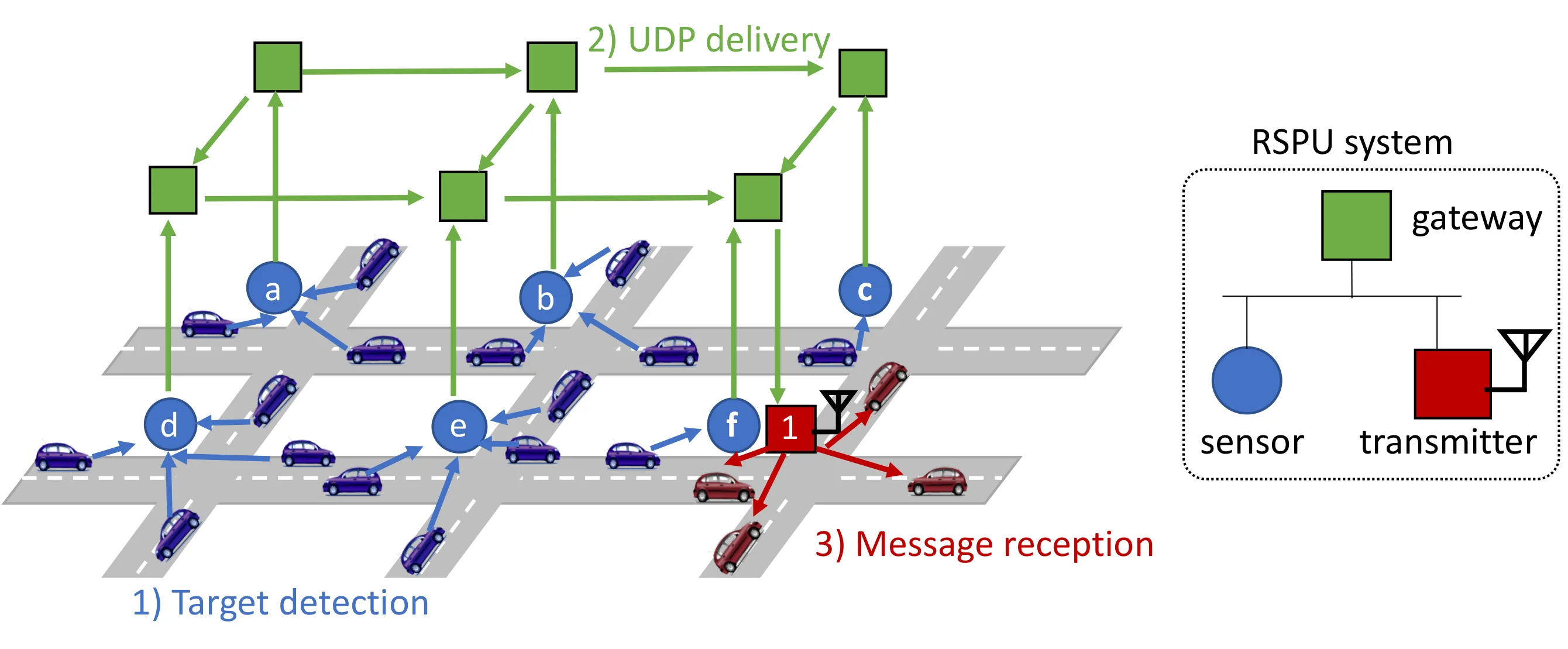
- The paper connects units over a wired network and prioritizes messages to extend the area covered by cooperative perception.
- Field tests delivered messages within 100 ms, and simulations showed that prioritization maintained high delivery ratios and low latency under heavy traffic.
Figures from the paper
Abstract
Vehicle-to-Everything (V2X) communication enhances the capability of autonomous driving through better safety, efficiency, and comfort. In particular, sensor data sharing, known as cooperative perception, is a crucial technique to accommodate vulnerable road users in a cooperative intelligent transport system (ITS). In this paper, we describe a roadside perception unit (RSPU) that combines sensors and roadside units (RSUs) for infrastructure-based cooperative perception. We propose a software called AutoC2X that we designed to realize cooperative perception for RSPUs and vehicles. We also propose the concept of networked RSPUs, which is the inter-connection of RSPUs along a road over a wired network, and helps realize broader cooperative perception. We evaluated the RSPU system and the networked RSPUs through a field test, numerical analysis, and simulation experiments. Field evaluation showed that, even in the worst case, our RSPU system can deliver messages to an autonomous vehicle within 100 ms. The simulation result shows that the proposed priority algorithm achieves a wide perception range with a high delivery ratio and low latency, especially under heavy road traffic conditions.
Video
Related research and software
How to cite
M. Tsukada, T. Oi, M. Kitazawa, and H. Esaki, “Networked Roadside Perception Units for Autonomous Driving,” Sensors, vol. 20, no. 18, 2020, doi: 10.3390/s20185320.
BibTeX
@article{Tsukada2020b,
  title         = {Networked Roadside Perception Units for Autonomous Driving},
  author        = {Manabu Tsukada and Takaharu Oi and Masahiro Kitazawa and Hiroshi Esaki},
  url           = {https://www.mdpi.com/1424-8220/20/18/5320/pdf?.pdf https://youtu.be/n7gD0L7NDEM},
  doi           = {10.3390/s20185320},
  issn          = {1424-8220},
  year          = {2020},
  date          = {2020-09-17},
  urldate       = {2020-09-17},
  journal       = {Sensors},
  volume        = {20},
  number        = {18},
  abstract      = {Vehicle-to-Everything (V2X) communication enhances the capability of autonomous driving through better safety, efficiency, and comfort. In particular, sensor data sharing, known as cooperative perception, is a crucial technique to accommodate vulnerable road users in a cooperative intelligent transport system (ITS). In this paper, we describe a roadside perception unit (RSPU) that combines sensors and roadside units (RSUs) for infrastructure-based cooperative perception. We propose a software called AutoC2X that we designed to realize cooperative perception for RSPUs and vehicles. We also propose the concept of networked RSPUs, which is the inter-connection of RSPUs along a road over a wired network, and helps realize broader cooperative perception. We evaluated the RSPU system and the networked RSPUs through a field test, numerical analysis, and simulation experiments. Field evaluation showed that, even in the worst case, our RSPU system can deliver messages to an autonomous vehicle within 100 ms. The simulation result shows that the proposed priority algorithm achieves a wide perception range with a high delivery ratio and low latency, especially under heavy road traffic conditions.},
  keywords      = {ITS},
  pubstate      = {published},
  tppubtype     = {article}
}