
HERO: Heterogeneous Evidential Robust Object-Level Collaborative Perception
19th European Conference on Computer Vision (ECCV 2026), Malmö, Sweden, Sep 8, 2026
Summary in three lines
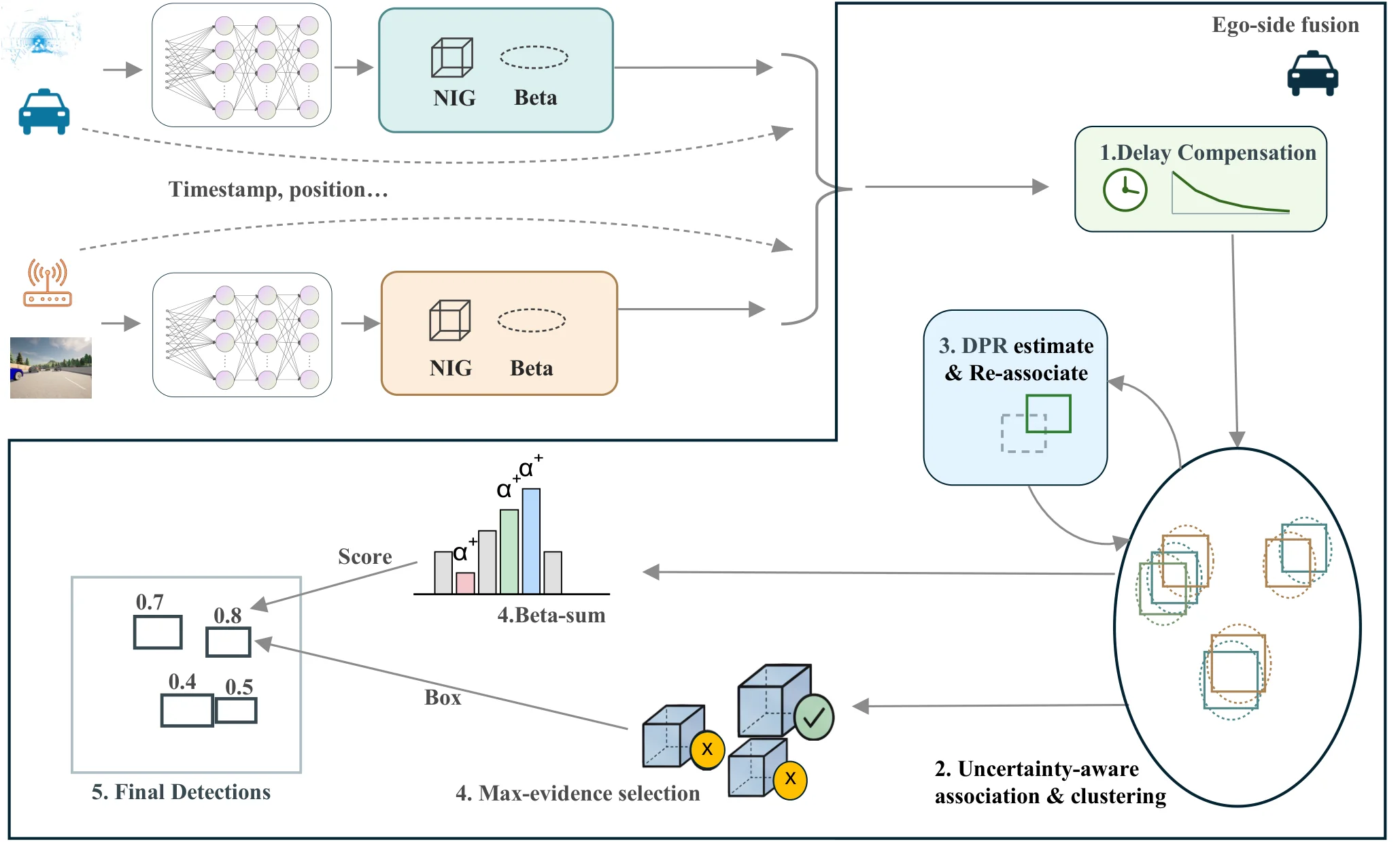
- HERO shares compact 3D object proposals and associated uncertainty across heterogeneous perception agents.
- The receiver compensates for delay, repairs pose alignment and fuses proposals according to their uncertainty.
- Experiments show that HERO retains competitive detection under pose errors and transmission delays.
Figures from the paper
Abstract
Real-world collaborative perception agents typically deploy diverse sensor configurations and network architectures. While feature-level fusion methods address this heterogeneity by aligning feature spaces, they require collaborative training and large communication overhead. In contrast, object-level fusion sidesteps these constraints, as transmitted bounding boxes are directly usable across varying architectures. However, standard late fusion relies only on box coordinates and confidence scores, which provide insufficient information for robust association and leave the system vulnerable to localization noise and asynchronous delays. To address this, we propose HERO, an uncertainty-guided object-level collaborative perception method that equips proposals with evidential statistics and uses the uncertainty signals to perform robust association and fusion under pose noise and asynchrony. Experiments on OPV2V-H and DAIR-V2X show that HERO matches the SOTA feature-level fusion methods while reducing bandwidth by over 1000 times. Under localization error and latency scenarios, HERO further outperforms feature-level SOTA models.
How to cite
H. Si, E. Javanmardi, H. Wu, and M. Tsukada, “HERO: Heterogeneous Evidential Robust Object-Level Collaborative Perception,” in 19th European Conference on Computer Vision (ECCV 2026), Malmö, Sweden, 2026.
BibTeX
@inproceedings{nokey,
  title         = {HERO: Heterogeneous Evidential Robust Object-Level Collaborative Perception},
  author        = {Hao Si and Ehsan Javanmardi and Hanlin Wu and Manabu Tsukada},
  year          = {2026},
  date          = {2026-09-08},
  booktitle     = {19th European Conference on Computer Vision (ECCV 2026)},
  address       = {Malmö, Sweden},
  abstract      = {Real-world collaborative perception agents typically deploy diverse sensor configurations and network architectures. While feature-level fusion methods address this heterogeneity by aligning feature spaces, they require collaborative training and large communication overhead. In contrast, object-level fusion sidesteps these constraints, as transmitted bounding boxes are directly usable across varying architectures. However, standard late fusion relies only on box coordinates and confidence scores, which provide insufficient information for robust association and leave the system vulnerable to localization noise and asynchronous delays. To address this, we propose HERO, an uncertainty-guided object-level collaborative perception method that equips proposals with evidential statistics and uses the uncertainty signals to perform robust association and fusion under pose noise and asynchrony. Experiments on OPV2V-H and DAIR-V2X show that HERO matches the SOTA feature-level fusion methods while reducing bandwidth by over 1000 times. Under localization error and latency scenarios, HERO further outperforms feature-level SOTA models.},
  keywords      = {CRONOS, ITS},
  pubstate      = {published},
  tppubtype     = {inproceedings}
}