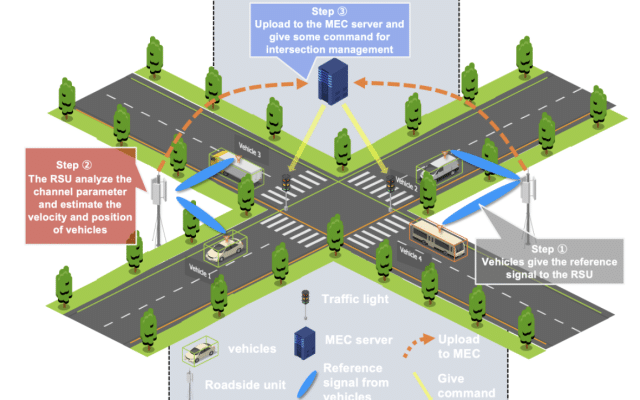
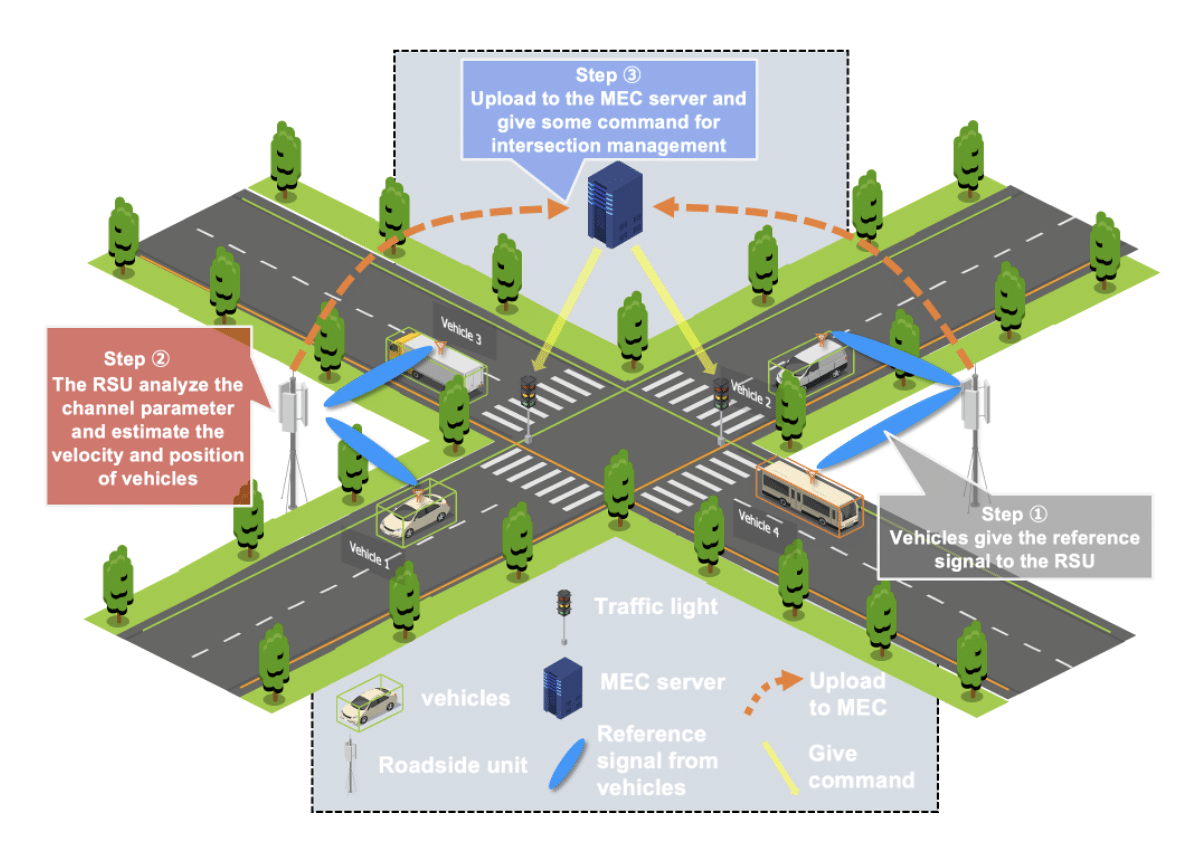
自動運転や高度道路交通システム(ITS)の急速な発展に伴い、協調的なモビリティやV2X(Vehicle-to-Everything)通信において、極めて正確な車両測位が不可欠な基盤となっています。従来のGPSは開けた場所では機能しますが、都市部のビル群やトンネルなどの見通し外(NLoS)環境ではその信頼性が著しく低下します。この課題を解決するため、本研究プロジェクトでは、Beyond 5G/6Gの無線通信チャネルが持つ物理層の情報を活用した、GPSに依存しない統合的な車両測位フレームワークを提案しています。通信とセンシングを融合させることで、遮蔽、高速移動、多ユーザといった厳しい条件下でも高精度を維持できる、インフラ協調型のスケーラブルなソリューションを実現します。
見通し内(LoS)環境に対しては、ミリ波マルチアンテナシステムを基盤とした連続的なトラッキング・アーキテクチャを構築しました。適応型かつ低演算量の2D-MUSICアルゴリズムを開発し、高精度な到来角(DoA)および到達時間(ToA)情報を効率的に抽出します。さらに、これらの空間パラメータをアンセンテッド・カルマンフィルタ(UKF)を用いて車両の運動力学と有機的に融合させます。このMUSICとUKFを密接に結合したアプローチにより、測定ノイズや誤差の蓄積を効果的に抑制し、カーブや交差点などの複雑な道路形状にも適応可能な、安定したリアルタイムの軌跡および速度の推定が可能となります。
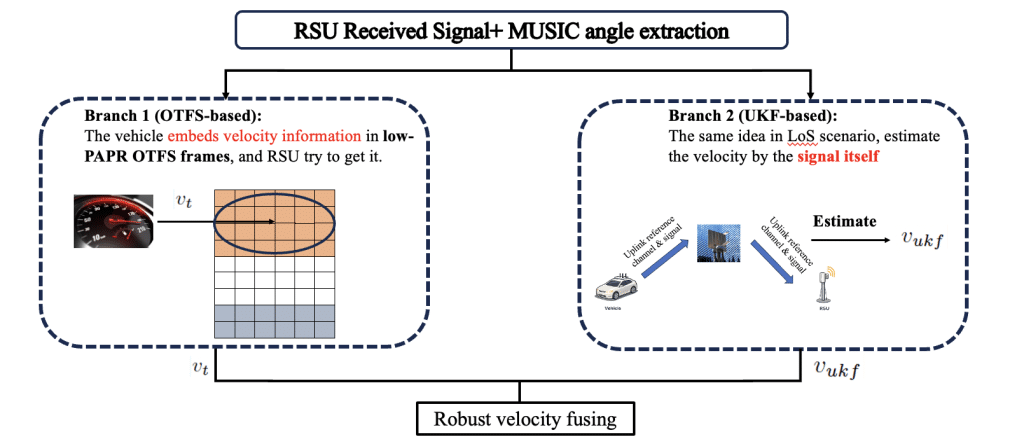
直接的な見通し(LoS)経路が遮断された場合、従来の角度ベースの測位は困難になります。この課題を克服するため、本フレームワークは再構成可能インテリジェントサーフェス(RIS)とOTFS(Orthogonal Time Frequency Space)変調を統合した高度なセンシング戦略へと移行します。適切に配置されたRISが障害物を迂回する制御可能な仮想伝搬経路を再構築し、チャネルの観測性を回復させます。同時に、新規の低PAPR(ピーク対平均電力比)パイロット設計によって強化されたOTFS変調が、高速移動に伴う激しいドップラーシフトとマルチパスフェージングを解消します。UKFを活用した2系統の速度推定手法を組み合わせることで、過酷なNLoS環境下でも強靭な追跡性能を保証します。
最後に、現実の大規模かつ高密度な交通シナリオでの実用性を担保するため、フレームワークを多ユーザの共存環境へと拡張しました。ページスタイルのフレーム構造に基づく干渉考慮型の反復的逐次干渉除去(SIC)スキームを導入し、重複する複数ユーザの信号を効率的に分離します。さらに、干渉レベルに応じてRoot-MUSIC(低ノイズ条件)とFBSS-MUSIC(強干渉条件)を動的に切り替える適応型DoA推定メカニズムを採用しています。本研究は、古典的なアレイ信号処理と最先端の波形設計を橋渡しするものであり、将来の自動運転モビリティ・ネットワークに求められる協調認知のための、堅牢で信頼性の高い基盤を提供します。
@phdthesis{Hu2025,
title = {Reliable GPS-Free Vehicle Localization for V2X Systems: A Study across Blockage, High-Mobility, and Multi-User Conditions},
author = {Dou Hu},
year = {2026},
date = {2026-03-31},
urldate = {2026-03-31},
school = {Ph.D Thesis, The University of Tokyo},
abstract = {Accurate vehicle localization and velocity estimation is a fundamental requirement for intelligent transportation systems, autonomous mobility, and safety-critical V2X communication. However, achieving reliable positioning in realistic vehicular environments remains challenging, as signal propagation continuously transitions between line-of-sight (LoS) and non-line-of-sight (NLOS) conditions, while Doppler dynamics, fast mobility, and multipath fading disrupt classical localization strategies. To address these challenges, this dissertation presents a unified and channel-adaptive localization framework that maintains reliable positioning performance across heterogeneous V2X scenarios. For LoS environments, a low-complexity 2D MUSIC-based direction-of-arrival estimator is developed to extract azimuth and elevation information from mmWave antenna arrays. The estimated angles are fused with kinematic motion states using an Unscented Kalman Filter (UKF), enabling continuous trajectory estimation with high temporal stability and robustness against measurement noise. This module demonstrates centimeter-level accuracy while significantly reducing computational overhead compared with exhaustive spectral search-based approaches. When LoS paths disappear and angle-based localization becomes unreliable, the framework transitions to a sensing strategy built on Orthogonal Time-Frequency Space (OTFS) modulation. A reconfigurable intelligent surface (RIS) is incorporated to reconstruct controllable propagation paths and enhance channel observability in NLoS conditions. A structured delay-Doppler processing and velocity estimation method are further designed to ensure delay, Doppler, and channel coefficient resolvability under high mobility and sparse multipath conditions. The final stage extends the methodology to multi-user environments. An interference-aware iterative SIC-based page-style method is introduced to separate overlapping user signals. Furthermore, we also give the idea for adopting different MUSIC algorithms under different SNR between an adaptive FBSS and Root-MUSIC-enhanced estimator, the method dynamically selects processing modes based on interference level and snapshot quality. This enables scalable localization without sacrificing precision under dense vehicular access. Comprehensive simulations confirm the effectiveness of the proposed system under different mobility levels, SNR conditions, antenna geometries, waveform configurations, and user densities. Results demonstrate that the framework achieves sub-degree DoA estimation accuracy in LoS conditions, maintains reliable localization performance under severe NLoS environments with RIS assistance, and supports multi-user coexistence with predictable computational complexity. Overall, this dissertation presents a scalable, robust, and environment-adaptive localization framework that bridges classical array-signal processing, OTFS waveform design, and RIS-assisted channel engineering. The proposed methodology serves as a promising foundation for next-generation autonomous mobility, cooperative perception, and future V2X communication systems.},
keywords = {},
pubstate = {published},
tppubtype = {phdthesis}
}
@misc{Hu2026,
title = {Robust Vehicle Localization Based on Adaptive DOA Estimation and UKF under Varying Interference Conditions},
author = {Dou Hu and Pengfei Lin and Manabu Tsukada
},
doi = {10.1109/CCNC65079.2026.11366311},
year = {2026},
date = {2026-01-09},
urldate = {2026-01-09},
abstract = {Only the chairs can edit Accurate vehicle localization in GPS-denied environments is essential for enabling future intelligent transportation systems (ITS) and vehicular networks. Direction-of-arrival (DOA) estimation techniques such as MUSIC and Root-MUSIC provide high-resolution localization but their performance depends heavily on the interference environment. In particular, Root-MUSIC achieves superior accuracy under clean line-of-sight (LoS) conditions, whereas forward-backward spatial smoothing (FBSS) enhances robustness against multipath and interference. To address the limitations of fixed estimators, this paper proposes an adaptive DOA-based localization framework for GPS-denied scenarios. The framework dynamically selects the optimal estimator according to interference levels: Root-MUSIC with an Unscented Kalman Filter (UKF) is employed under low-interference conditions, while FBSS-Root-MUSIC with UKF is adopted in the presence of strong interference. Simulation results show that the proposed method consistently outperforms static approaches, reducing positioning error across varying SNR and interference regimes. This adaptability makes it a reliable solution for vehicle localization in non-stationary wireless environments without GPS support.},
howpublished = {IEEE Consumer Communications & Networking Conference (CCNC2026), Poster},
keywords = {},
pubstate = {published},
tppubtype = {misc}
}
@article{Hu2025c,
title = {DoA Estimation and Kalman Filter based Multi-Antenna System for Vehicle Position in mmWave Network},
author = {Dou Hu and Jin Nakazato and Javanmardi Ehsan and Kazuki Maruta and Rui Dinis and Manabu Tsukada},
doi = {10.1109/OJVT.2025.3608747},
issn = {2644-1330},
year = {2025},
date = {2025-09-14},
urldate = {2025-09-14},
journal = {IEEE Open Journal of Vehicular Technology},
volume = {6},
pages = {2761-2775},
abstract = {With the advancement of Beyond 5G/6G technologies, accurate positioning and velocity estimation in Internet of Vehicles (IoV) systems has become increasingly critical. Although GPS can provide real-time location information, its performance degrades significantly in environments with heavy obstructions, such as urban areas surrounded by skyscrapers. To address this limitation, this study proposes a positioning framework that relies on channel parameter estimation derived from multi-antenna signal processing. Specifically, we adopt an adaptive low-complexity 2D MUSIC (ALC2D-MUSIC) algorithm to estimate signal directions, and further apply an unscented Kalman filter (UKF) using extracted Direction of Arrival (DoA) and Time of Arrival (ToA) information to estimate vehicle positions and velocities. The proposed system is robust to variations in road geometry, making it suitable for deployment in diverse traffic environments. Simulation results demonstrate that our method achieves high estimation accuracy and outperforms a compressive sensing-based approach across different SNR levels, angular search resolutions, and antenna array sizes. Furthermore, the UKF-based tracking algorithm shows superior performance in curved road scenarios, validating its effectiveness under realistic mobility conditions.},
keywords = {},
pubstate = {published},
tppubtype = {article}
}
@article{Hu2025b,
title = {OTFS Based RIS-assisted vehicle positioning and tracking in V2X scenario},
author = {Dou Hu and Jin Nakazato and Kazuki Maruta and Rui Dinis and Omid Abbassi Aghda and and Manabu Tsukada},
doi = {10.1109/TCOMM.2025.3588559},
issn = {0090-6778},
year = {2025},
date = {2025-07-08},
urldate = {2025-07-08},
journal = {IEEE Transactions on Communications},
volume = {73},
issue = {11},
pages = {10676-10691},
abstract = {This paper proposes a novel and robust framework for velocity and position estimation in vehicle-to-everything (V2X) communication networks, targeting challenges that arise when traditional GPS systems and line-of-sight (LoS) channels fail due to signal blockages between vehicles, base stations (BSs), and satellites. The proposed solution integrates multiple complementary methods to enhance robustness and accuracy. Specifically, the framework first applies the MUSIC algorithm for angle-of-arrival (AoA) estimation to obtain reliable initial positioning. In parallel, a newly designed low peak-to-average power ratio (PAPR) frame structure is introduced under reconfigurable intelligent surface (RIS)-assisted Orthogonal Time Frequency Space (OTFS) modulation, enabling resilient velocity embedding against noise and interference. These methods jointly support an unscented Kalman Filter (UKF), which refines the velocity and position estimation with high reliability. Extensive numerical evaluations confirm the effectiveness of the proposed multi-method integrated framework. Various modulation techniques, including zero padding (ZP), cyclic prefix (CP), and their recursive variants (e.g., RZP, RCP), demonstrate improved bit error rate (BER) performance over traditional OFDM. The proposed low-PAPR signal design achieves a 21.5% PAPR reduction compared to conventional embedded pilot schemes, significantly improving BER in 4-QAM scenarios. Velocity estimation results also show that the UKF outperforms the extended Kalman Filter (EKF) in both straight and curved road conditions. By combining MUSIC-based AoA estimation with RIS assistance under NLoS conditions, the proposed framework remains effective even in high-Doppler and low-SNR environments.},
keywords = {},
pubstate = {published},
tppubtype = {article}
}
@workshop{Hu2025,
title = {A Low PAPR Layered Multi-User OTFS Modulation},
author = {Dou Hu and Jin Nakazato and Kazuki Maruta and Omid Abbassi Aghda and Rui Dinis and Manabu Tsukada},
year = {2025},
date = {2025-06-17},
urldate = {2025-06-17},
booktitle = {AI-Driven Connectivity for Vehicular and Wireless Networks in VTC2025-Spring},
address = {Oslo, Norway},
abstract = {In modern communication systems, meeting the growing demand for high-capacity transmission requires developing efficient and robust modulation techniques. To address this, we propose a low-PAPR page-style Orthogonal Time Frequency Space (OTFS) modulation framework that enhances communication capacity while maintaining a low peak-to-average power ratio (PAPR). The proposed design introduces a novel pilot signal placement and analysis method, improving channel estimation accuracy and system performance in high-mobility multi-user scenarios. This paper provides an overview of recent advancements in OTFS-based multi-user communication systems, emphasizing their contributions to enhancing spectral efficiency, reliability, and robustness. Through extensive simulations, we demonstrate the effectiveness of the proposed framework in achieving superior BER performance, improved interference mitigation, and robust transmission capabilities compared to traditional methods, validating its suitability for next-generation communication networks.},
howpublished = {Workshop on AI-Driven Connectivity for Vehicular and Wireless Networks in VTC2025-Spring},
note = {IEEE VTS Tokyo/Japan Chapter 2025 Young Researcher's Encouragement Award},
keywords = {},
pubstate = {published},
tppubtype = {workshop}
}
@workshop{Hu2024,
title = {A Research of Kalman Filter enabled Beam Tracking for Multiple Vehicles},
author = {Dou Hu and Jin Nakazato and Ehsan Javanmardi and Muhammad Asad and Maruta Kazuki and Manabu Tsukada},
url = {https://www.ieice.org/publications/proceedings/bin/pdf_link.php?fname=15.pdf&iconf=ASPIRE_WS&year=2024&vol=80&number=P-15&lang=E?.pdf},
doi = {10.34385/proc.80.P-15},
isbn = {2188-5079},
year = {2024},
date = {2024-03-05},
urldate = {2024-03-05},
booktitle = {ASPIRE Workshop 2024 in conjunction with the IEICE General Conference},
address = {Hiroshima, Japan},
abstract = {In the era of Beyond 5G, the significance of interdisciplinary research has become increasingly important. Within this context, the Kalman filter, a technology integral to self-positioning estimation in autonomous driving, is already being adopted in various societal applications. This study proposes a method wherein beam tracking, in conjunction with the Kalman filter, is an alternative to GPS in specific scenarios. This research is particularly relevant in environments such as intersections flanked by high-rise buildings, where GPS signals are prone to interference.
},
keywords = {},
pubstate = {published},
tppubtype = {workshop}
}
@conference{Dou2023,
title = {Extended Kalman filter based beam tracking for vehicle position and velocity estimation under intersection scenario},
author = {Dou Hu and Jin Nakazato and Ehsan Javanmardi and Muhammad Asad and Manabu Tsukada and Kazuki Maruta
},
year = {2023},
date = {2023-10-10},
urldate = {2023-10-10},
booktitle = {革新的無線通信技術に関する横断型研究会(MIKA)},
address = {沖縄県},
abstract = {As typified by the IoT, mobile traffic continues to increase with the spread of devices equipped with wireless communication functions. Deploying small cell base stations (BSs) is known to straight forward way to efficiently support such traffic. Meanwhile, the facility cost increases when large numbers of BSs are deployed in a fixed manner. It is possible to construct an efficient wireless network by installing BS functions in moving objects such as vehicles and UAVs, and allowing them to move autonomously or activate wireless functions to follow the traffic demand. This paper proposes a method for estimating propagation channels and vehicle position/velocity information at intersections based on vehicle-oriented beam control using a Kalman filter.},
keywords = {},
pubstate = {published},
tppubtype = {conference}
}
@misc{Hu2023,
title = {An Extended Kalman Filter Enabled Beam Tracking Framework in Intersection Management},
author = {Dou Hu and Jin Nakazato and Ehsan Javanmardi and Muhammad Asad and Manabu Tsukada
},
url = {https://www.researchgate.net/profile/Jin-Nakazato/publication/371358188_An_Extended_Kalman_Filter_Enabled_Beam_Tracking_Framework_in_Intersection_Management/links/64807e24b3dfd73b776baeed/An-Extended-Kalman-Filter-Enabled-Beam-Tracking-Framework-in-Intersection-Management.pdf},
year = {2023},
date = {2023-06-06},
urldate = {2023-06-06},
address = {Gothenburg, Sweden},
abstract = {Recently, vehicle-to-everything (V2X) has been at- tracting attention for its potential to improve traffic safety and increase traffic volume worldwide, improving the accuracy of data and parameters collected from moving vehicles is widely discussed in the V2X. The most common technique of GPS may not be efficient during some specific scenarios, like some intersections full of skyscrapers, or some special terrains with obstacles. In such cases, GPS technology has a longer detection period and lower tracking accuracy, so beam tracking can be a fast and efficient solution in these circumstances. Therefore we propose an anti-diverge extend Kalman filter-enabled beam tracking method in V2X to help the intersection management. The numerical results show that our method has the ability to resist the Kalman filter’s divergence and can detect data in an accurate manner.},
howpublished = {European Conference on Networks and Communications (EuCNC) & 6G Summit Poster},
keywords = {},
pubstate = {published},
tppubtype = {misc}
}
digital twins extended reality
digital twins
autonomous driving machine learning
machine learning v2x
autonomous driving v2x
extended reality