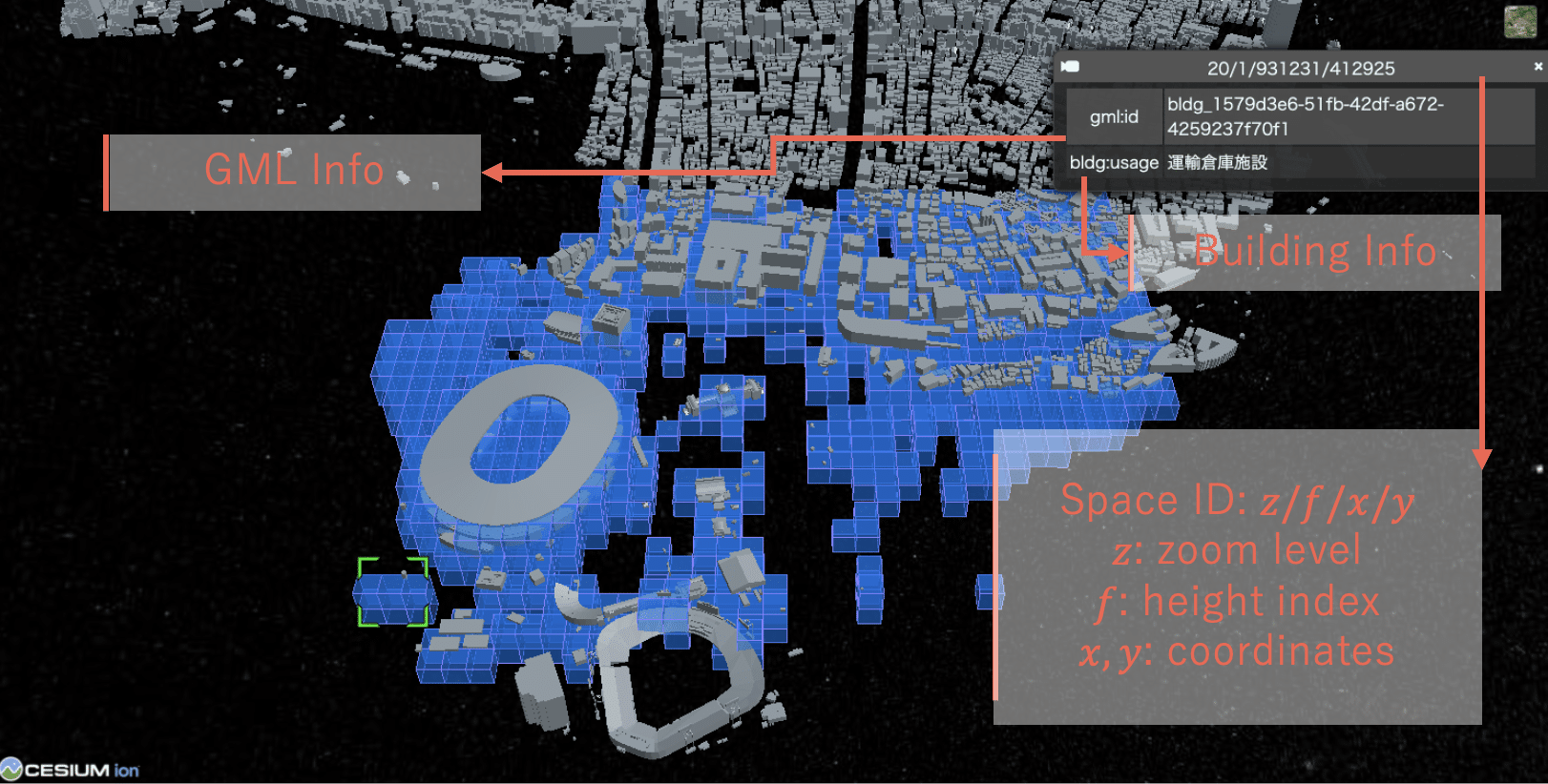
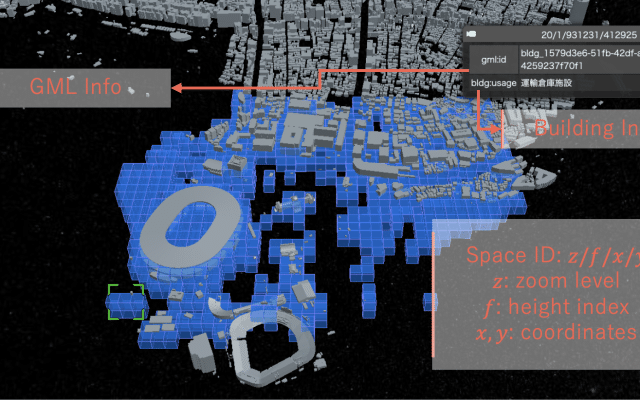
空間ID(Spatial ID)は、日本政府によって策定された標準仕様であり、物理空間を階層的な三次元ボクセルとして表現し、必要に応じて時間軸を拡張可能な枠組みです。各ボクセルには {z}/{f}/{x}/{y}(ズームレベル/高度/経度/緯度)の形式で計算可能な識別子が割り当てられ、地球規模(プラネタリースケール)から、サブメートル解像度(例:ZL28における約15cm)まで、一貫した空間アドレッシングを可能にします。空間IDは、静的・動的、空間・時間を問わない異種データを、アプリケーション固有のGIS処理ではなく、一般的なデータベース機構によってインデックス化・検索・統合することを可能にします。この点において、空間IDは単なる空間表現ではなく、大規模空間コンピューティングのための「アドレス可能でクエリ可能な基盤」として機能します。
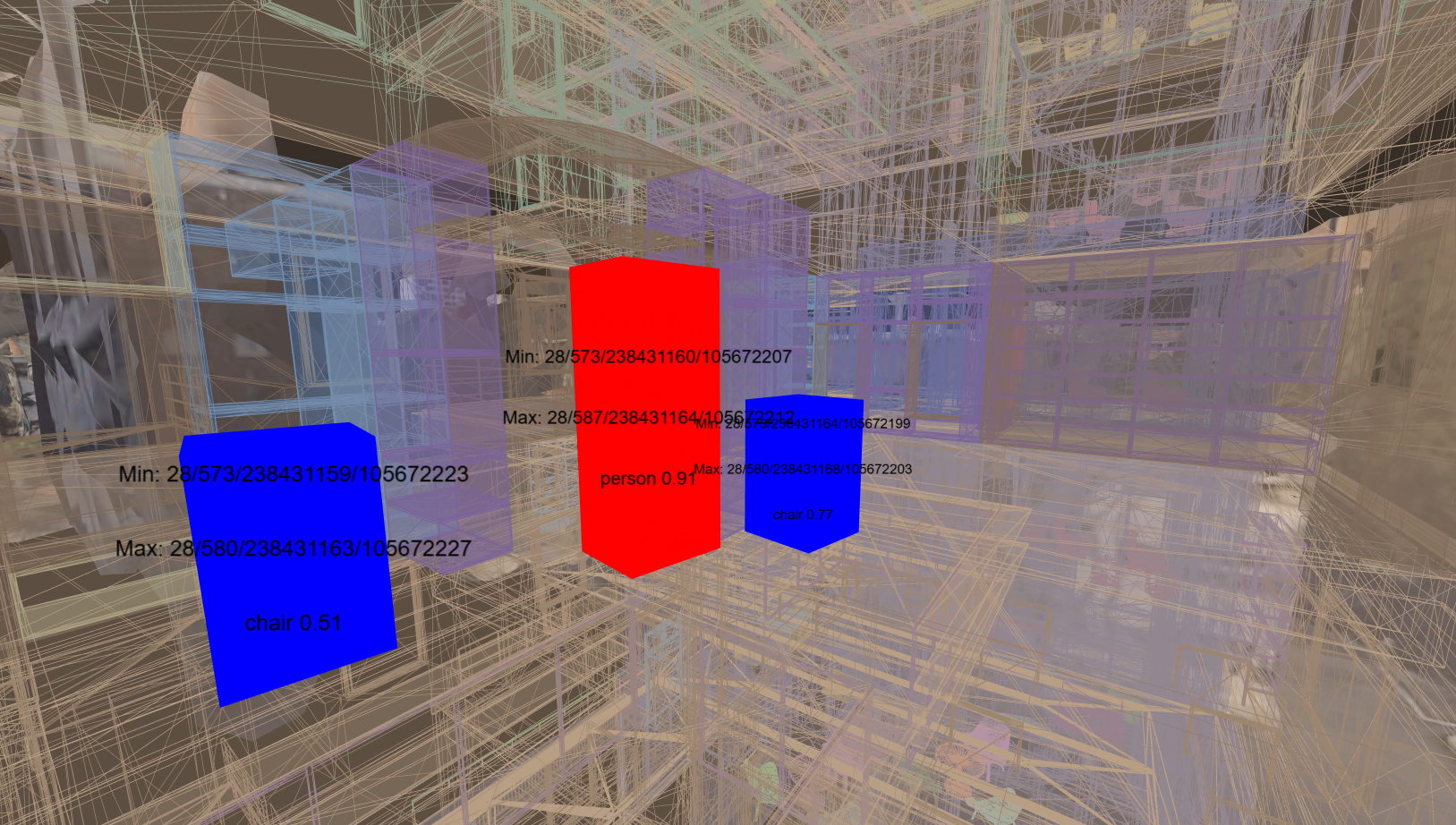
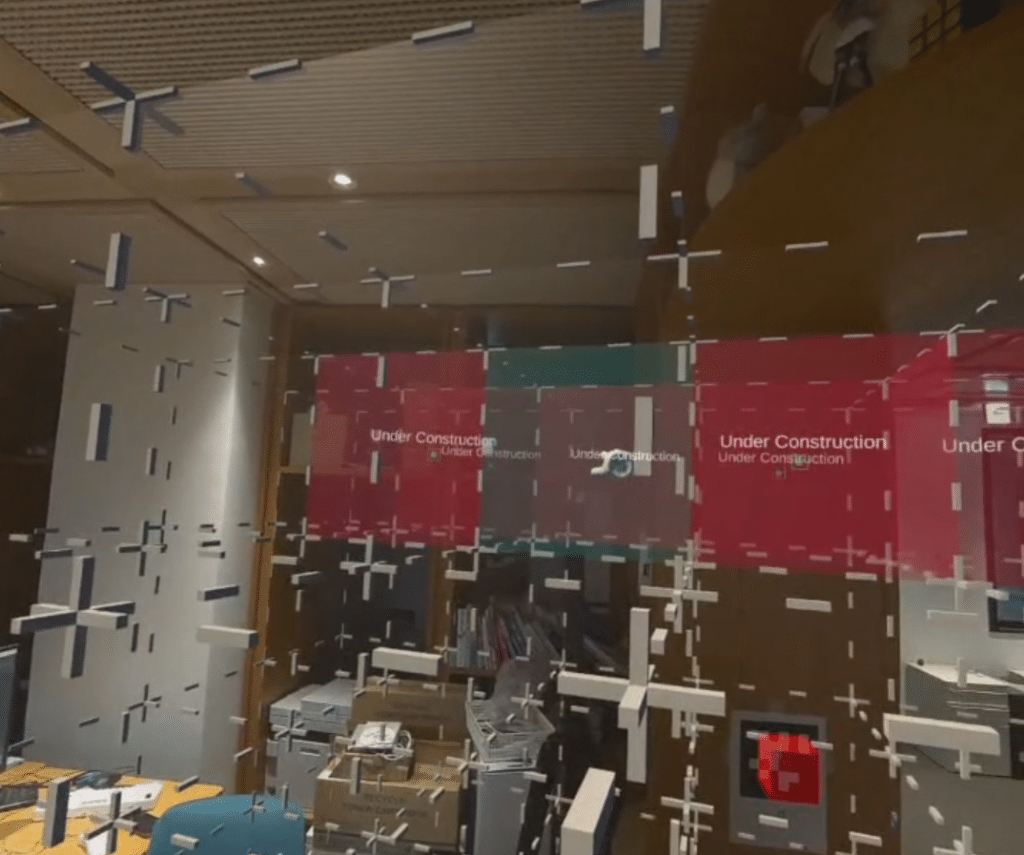
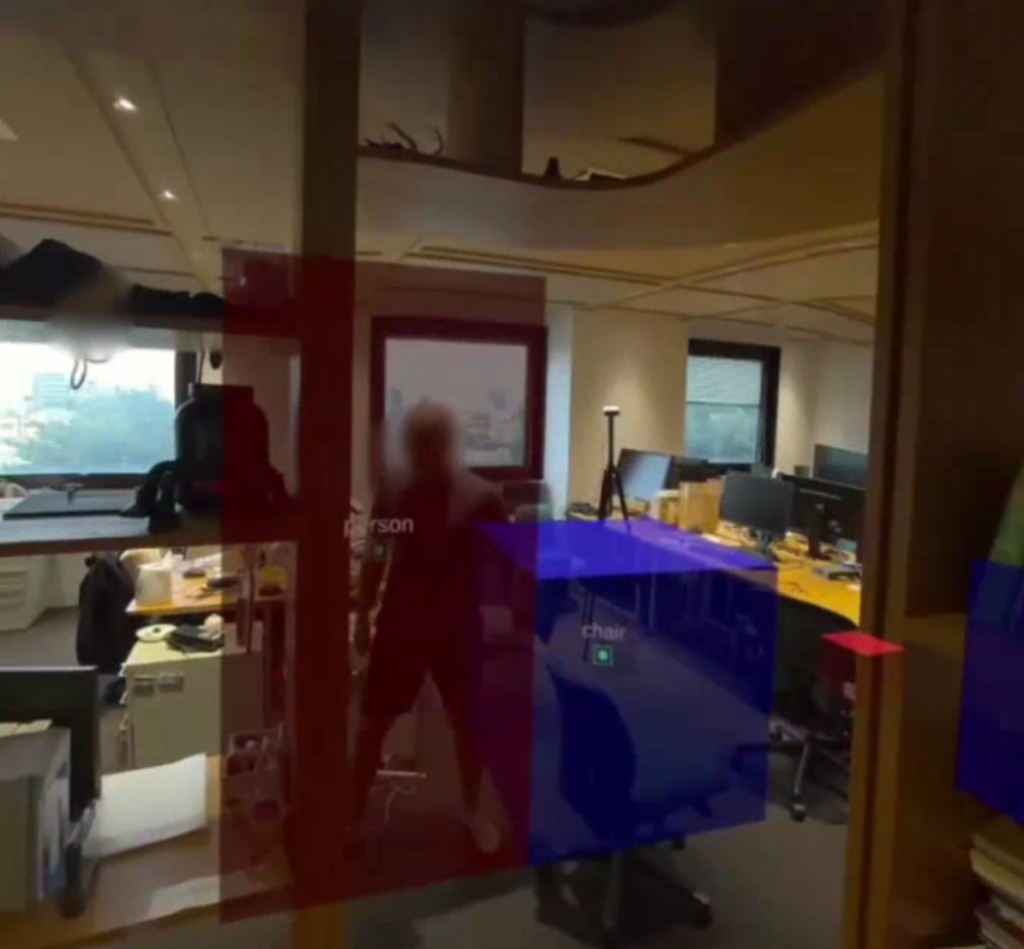
本研究の一つの方向性として、空間IDを空間オーサリングおよび参照のための仕組みとして活用し、Mixed Reality(MR)システムを物理空間とのインタフェースとして用いる研究を行っています。この研究では、空間IDが永続的なアンカーとして機能し、注釈、属性情報、センサ由来データといったデジタルコンテンツを実空間上の位置に結び付けます。これらの関連付けは分離型のデータベース構成によって管理され、柔軟な取得やクロスプラットフォームでの相互運用を可能にします。さらに、クラウドベースの認識パイプラインを統合し、その出力を対応する物理位置にMR上で可視化することで、空間IDが正確な空間整合、永続的なオーサリング、リアルタイムな検証・観察を支えることを示しています。この研究において、MRは空間IDに基づくデータを生成・検証・探索するためのインタフェース層として用いられています。
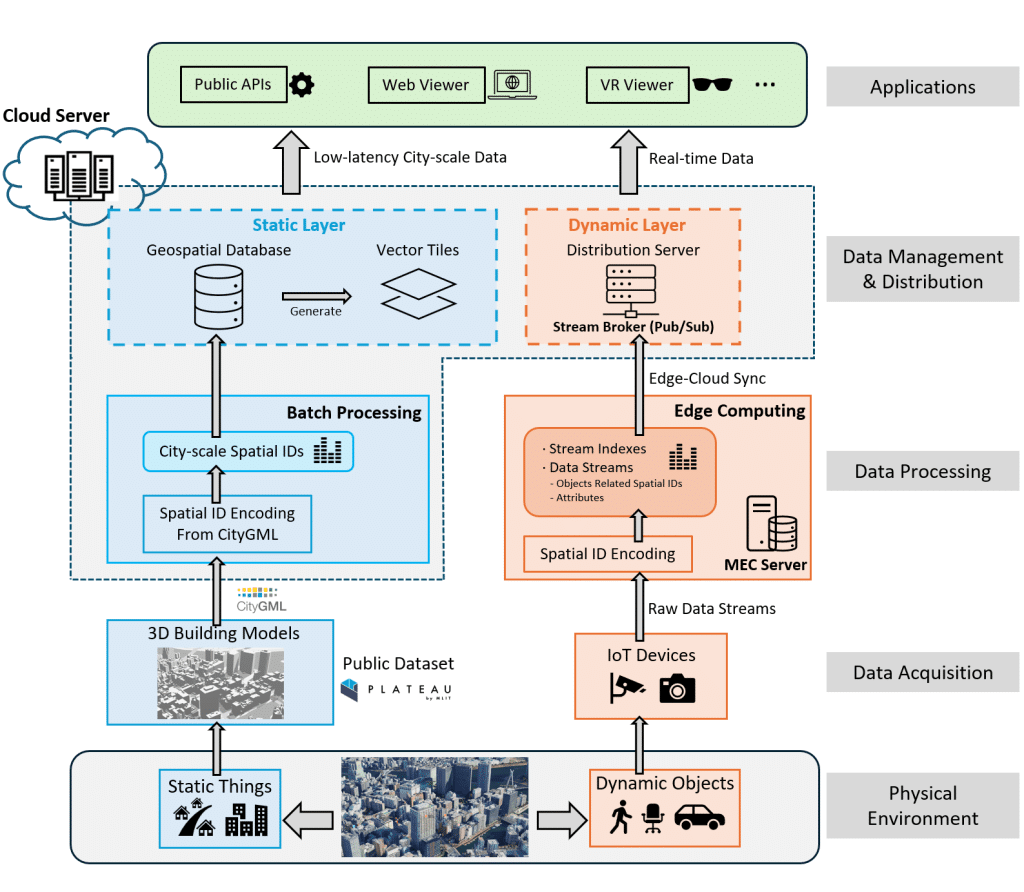
より大きなスケールでは、空間IDをリアルタイム都市データ基盤の中核となるインデックス層として運用する研究に取り組んでいます。プロジェクト PLATEAU に由来する静的な3D都市モデルは空間IDへと変換され、地理空間データベースおよびベクタータイルとして配信されます。一方、動的なIoTストリームはエッジ側でリアルタイムに空間IDへとエンコードされ、Publish/Subscribe方式を用いてクラウドサービスと同期されます。このエッジ・クラウド統合アーキテクチャにより、空間+時間からなる4次元データに対して、データベース的なクエリおよび購読型アクセスを実現し、Webベースおよび没入型クライアントからの低遅延な利用を可能にします。東京における都市規模の実運用を通じて、空間IDが静的・動的な都市データを、アプリケーションごとに分断されたパイプラインではなく、単一の運用基盤として統合できることを示しています。
今後の主な焦点は、都市規模においてほぼ瞬時のクエリ応答を可能とする高性能な空間IDデータベース基盤を構築し、公開インフラとして運用することです。この規模では、いくつかの課題が支配的になります。第一に、高ズームレベルではクエリ対象領域が拡大するにつれて空間IDの数が急激に増加し、比較的小さな領域拡張であっても、クエリ時間やI/Oが指数的に増大し得ます。そのため、高解像度かつ広域を対象とするクエリは、面積制約やクエリ方針を厳密に設けない限り現実的ではありません。第二に、データセット規模そのものが制約となります。東京23区のZL25における空間IDデータは生データで150GBを超えており、単一サーバでの運用は事実上不可能です。これに対応するためには、分散計算、適切なインデックス設計、インフラレベルでの設計が不可欠となります。最も難しい問題は、どのズームレベルでどのデータをクエリ可能にするかという設計です。建物や街区スケールでは有用な個別センサ位置や詳細メタデータも、都市・広域スケールのクエリにそのまま露出させると、膨大な件数の集約が必要となり、スケールしません。そのため、データ投入(インジェスト)の段階から、ズームレベルに応じたデータ可視性、集約、圧縮方針を組み込む必要があります。これらの課題に取り組むことは、空間IDを既存の計算基盤と親和性の高い、実用的かつ信頼できる空間インデックス基盤として確立する上で不可欠です。
@inproceedings{Djelloul2026,
title = {Spatial ID Authoring in Mixed Reality: A Unified Platform Integrating Anchoring and Visualization},
author = {Sami Brahim Djelloul and Yanru Chen and Alex Orsholits and Manabu Tsukada},
year = {2026},
date = {2026-01-26},
booktitle = {IEEE International Conference on Artificial Intelligence and Virtual Reality (AIxVR), Work in Progress (WiP)},
address = {Osaka, Japan},
abstract = {We present a Mixed Reality (MR) authoring platform that leverages Spatial IDs as a standardized reference to align digital content with the physical environment. The platform enables users to tag and annotate space through Spatial IDs, with annotations managed through a decoupled architecture where a queryable Spatial ID index links spatial entities to external databases containing attributes and application-specific content. To support this, we integrate two enabling components. First, anchoring: Spatial IDs provide a hierarchical four-dimensional indexing system that ensures consistent alignment across datasets and localization methods. Second, visualization: anchored Spatial IDs allow both real-world data streams and authored datasets to be rendered in MR. As a proof of concept, we integrate cloud-based object detection from an external depth camera, streaming recognized objects into MR and visualizing them at their true physical locations. Together, these components demonstrate how Spatial IDs enable accurate visualization and persistent authoring, offering a unified pipeline for next-generation spatial computing.},
keywords = {},
pubstate = {published},
tppubtype = {inproceedings}
}
@inproceedings{Chen2026,
title = {Spatial ID-Driven Edge-Cloud Architecture for Real-Time Urban Digital Twins},
author = {Yanru Chen and Sami Brahim Djelloul and Alex Orsholits and Manabu Tsukada and Hiroshi Esaki},
doi = {10.1109/CCNC65079.2026.11366402},
year = {2026},
date = {2026-01-08},
urldate = {2026-01-08},
booktitle = {IEEE Consumer Communications & Networking Conference (CCNC2026)},
address = {Las Vegas, USA},
abstract = {Only the chairs can edit The integration of static geospatial datasets and real-time IoT streams is essential for responsive and scalable urban Digital Twins (DTs). However, current infrastructures remain fragmented across domains, formats, and reference systems, limiting interoperability and city-scale deployment. This paper presents the first city-scale implementation of a Spatial ID-driven edge-cloud architecture that unifies heterogeneous static and dynamic urban data under a hierarchical four-dimensional identifier. Unlike prior DT systems that rely on ad hoc tiling or local schemas, our design operationalizes Spatial ID as a universal indexing layer across batch and streaming pipelines, enabling multi-resolution queries, real-time synchronization, and cross-domain interoperability. A prototype deployment in Tokyo's Chiyoda and Bunkyo wards demonstrates the approach, integrating 3D city models with live IoT streams. Static data are encoded into Spatial IDs and distributed via a geospatial database and vector tiles, while dynamic streams are processed at the edge and synchronized with a cloud backend using a publish/subscribe model. The system supports real-time encoding, querying, distribution, and web/Mixed Reality (MR)-based visualization. Evaluation shows millisecond-to-second query performance over 148 million records, sub-100 ms vector tile delivery, and real-time IoT stream processing at 30 fps. These results establish Spatial ID not only as a conceptual framework but as a practical, deployable foundation for interoperable, low-latency, and scalable Digital Twin infrastructures aligned with the vision of Society 5.0.},
keywords = {},
pubstate = {published},
tppubtype = {inproceedings}
}
autonomous driving v2x
digital twins extended reality
digital twins
autonomous driving machine learning
machine learning v2x
autonomous driving v2x
extended reality