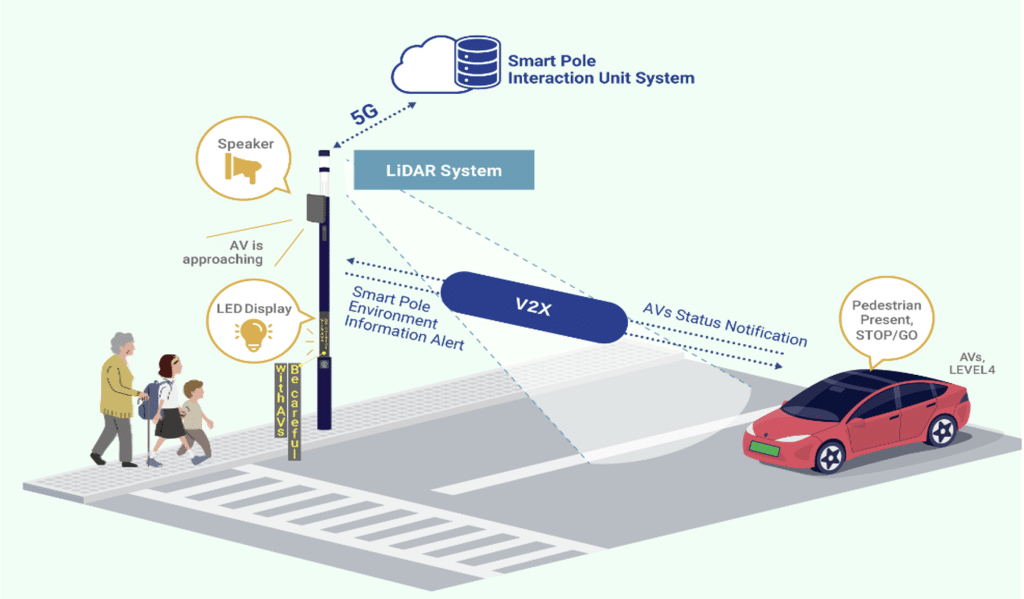
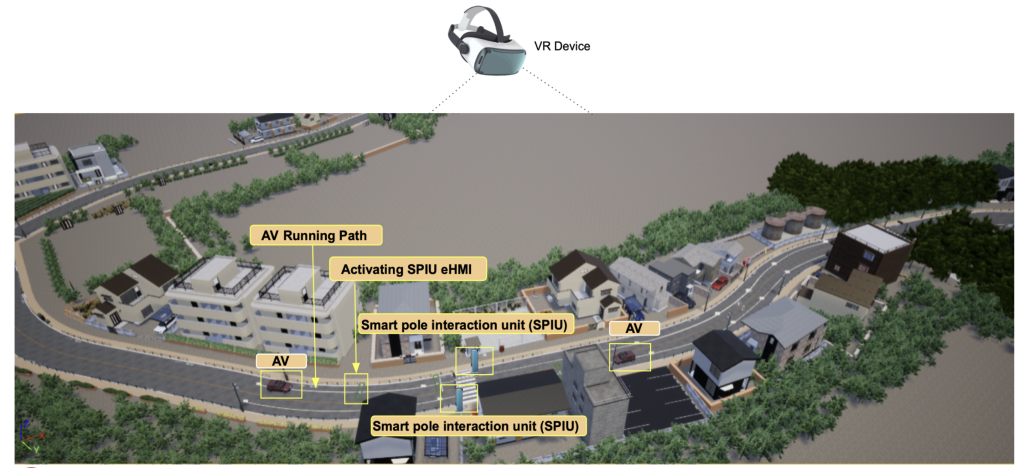
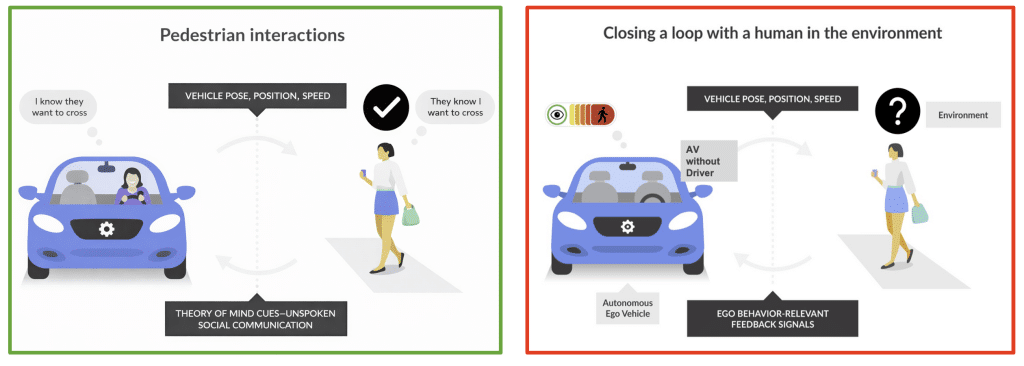
自動運転車が歩行者中心の都市空間へ入り込むにつれ、課題は認識や制御だけでなく、歩行者とのコミュニケーションへと広がっている。共有空間では、歩行者、自転車、車両が明確な車線分離や従来型の信号に強く依存せず、その場で相互に動きを調整する。そこから人間の運転者がいなくなると、歩行者は視線、身振り、譲り合いといった社会的手がかりを失い、車両の意図を不確実なまま推測しなければならない。本プロジェクトは、このコミュニケーション上のギャップに対し、交差点や横断地点の近くから歩行者向けに同期した情報を提示するインフラ側インタフェース、Smart Pole Interaction Unit(SPIU)を提案する。
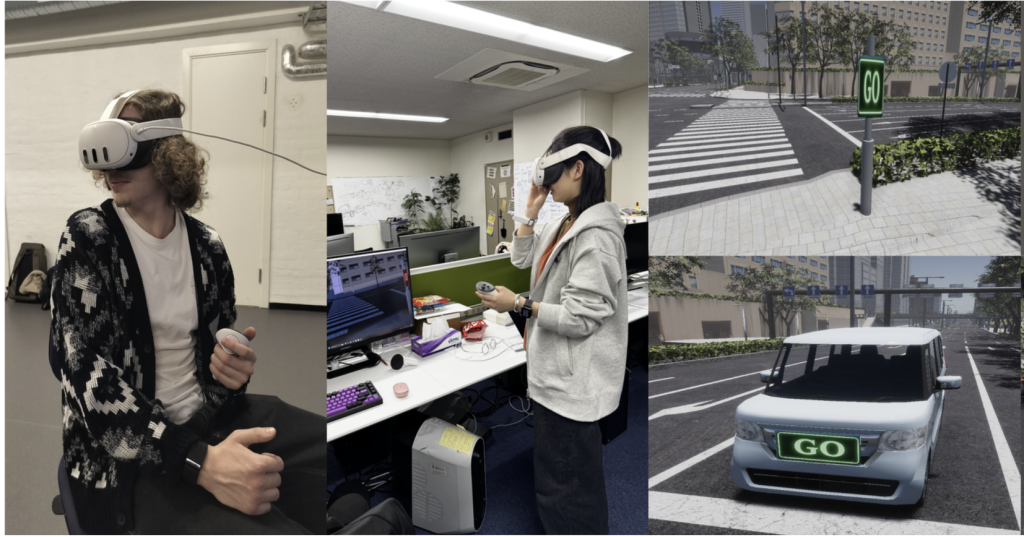
研究は、概念提案と初期検証から始まった。2023年のIEEE WFIoT論文では、共有空間における歩行者の認知負荷を軽減するためのSPIUの着想を提示し、続くElectronics論文では、没入型VR実験を通してその概念を検証した。これらの初期研究は、移動する車両上の表示だけに依存するのではなく、歩行者から見やすい道路側の媒介を用いることで、自動運転車の意図をより早く、より少ない不確実性で理解できることを示した。すなわち、共有空間のコミュニケーションは車両単体ではなく、交渉が生じる領域全体を対象に設計すべきだという考え方が、この段階で明確になった。
次の段階では、SPIUが何を伝えるべきか、そしてどのように設計されるべきかを掘り下げた。専門家によるディスカッション、シナリオスケッチ、さらにマルチモーダルLLMによる提案との比較を通して、人間とAIが安全な歩行者―自動運転車インタラクションに対してどこで一致し、どこで異なるのかを整理した。この過程により、SPIUは単純な表示装置から、明確な視覚メッセージに加えて、音声、センシング、LiDAR、V2X連携などを組み合わせうるマルチモーダル設計フレームワークへと発展した。同時に、SPIUは車載eHMIを置き換えるのではなく、それを補完して理解を強める存在として最も効果を発揮することも明らかになった。
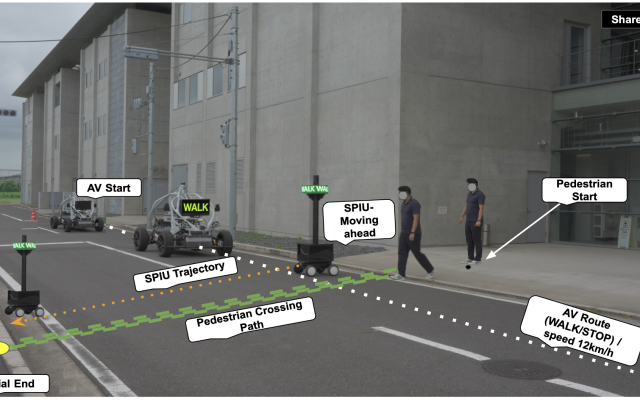
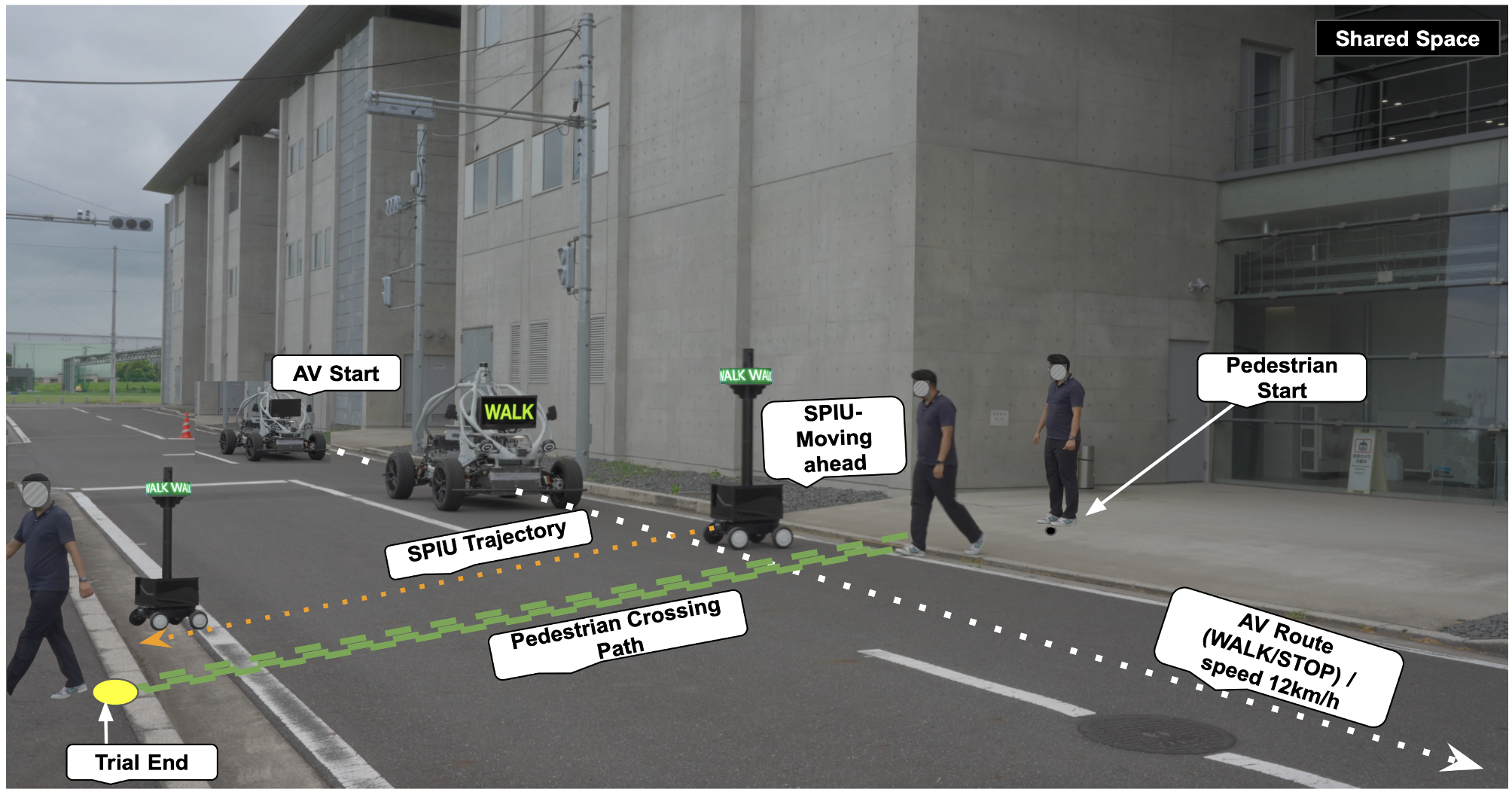
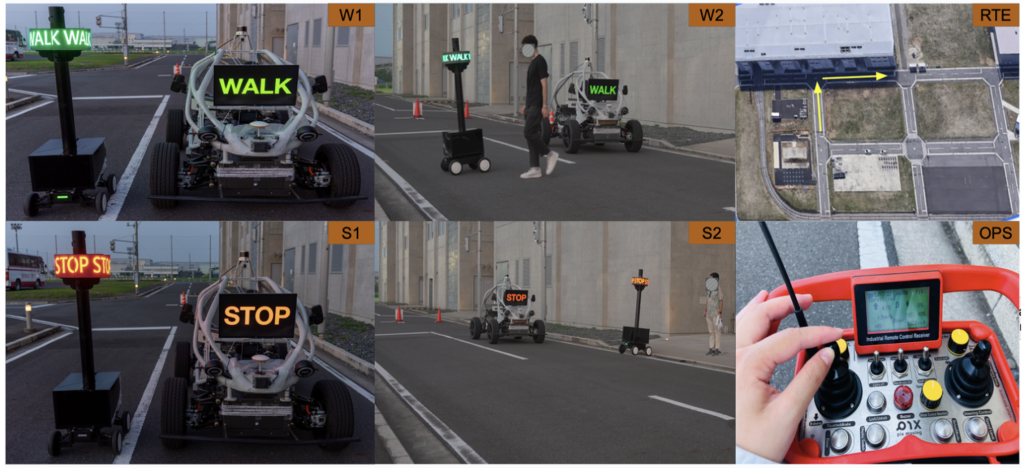
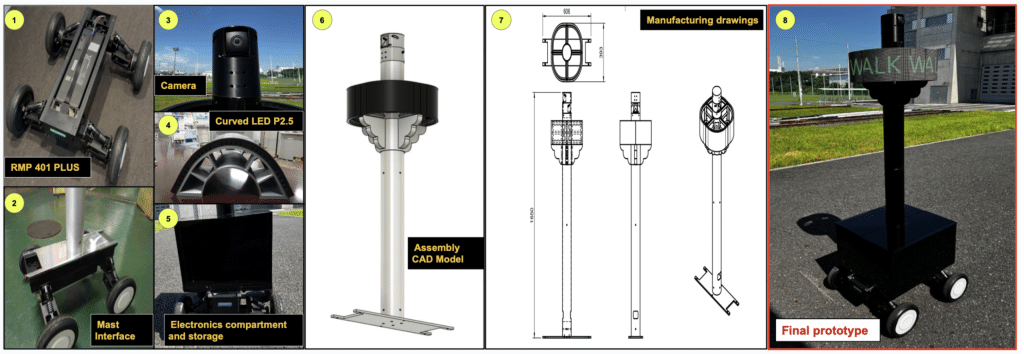
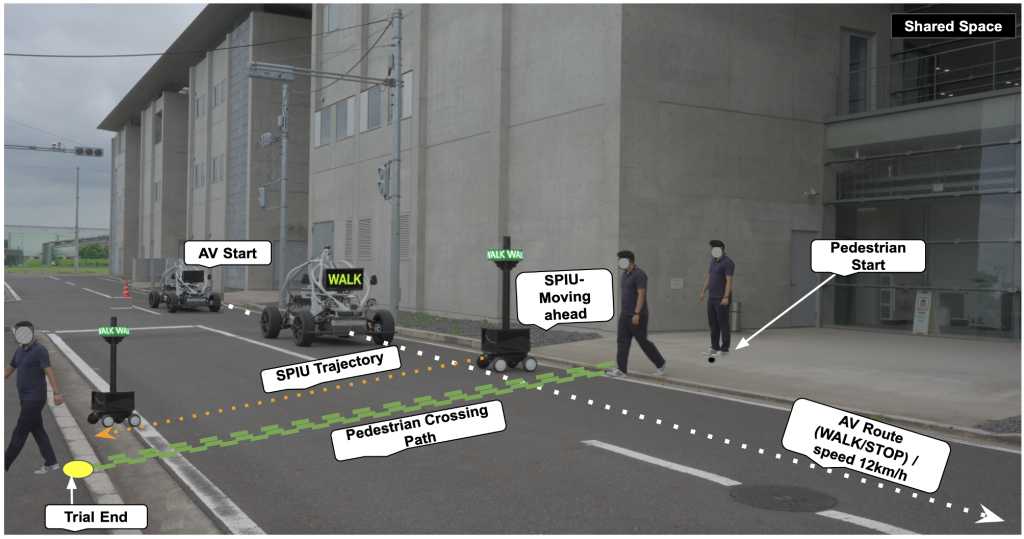
近年の進捗では、研究は実験室内の検証から、異文化間評価と実世界での展開へと進んでいる。日本で構築しノルウェーで再現したVR-AWSIM環境では、四差路、死角、配送ロボットを含む混合交通、夜間横断といった高リスクな状況において、SPIUが歩行者の意思決定を改善することを示した。さらに最近では、移動型SPIUプロトタイプを製作し、屋外の共有空間で評価を実施した結果、SPIUは理解しやすさ、信頼感、安全感を向上させ、とくに車載eHMIと併用した条件で最も高い効果を示した。共有空間の視覚デザインに関する関連研究も含め、これらの成果はSPIUを将来の歩行者―自動運転車エコシステムに向けた実装可能なインフラ側インタフェースとして位置づけるとともに、今後はより多様なモダリティ、アクセシビリティ、都市導入に向けた発展を示している。
@inproceedings{Chauhan2026,
title = {Colored Shared Spaces (CSS): How Visual Design Transforms Pedestrian Experiences},
author = {Vishal Chauhan and Anubhav Anubhav and Chia Ming Chang and Ehsan Javanmardi and Takeo Igarashi and Alex Orsholits and Kantaro Fujiwara and Manabu Tsukada},
year = {2026},
date = {2026-07-26},
urldate = {2026-07-16},
booktitle = {28th International Conference on Human-Computer Interaction (HCII2026)},
address = {Montreal, Canada},
keywords = {},
pubstate = {published},
tppubtype = {inproceedings}
}
@inproceedings{Chauhan2026b,
title = {Don't Worry, Just Follow Me: Prototyping and In-the-Wild Evaluation of Smart Pole Interaction Unit with Mobility},
author = {Vishal Chauhan and Anubhav Anubhav and Mark Colley and Chia-Ming Chang and Xinyue Gui and Ding Xia and Ehsan Javanmardi and Takeo Igarashi and Kantaro Fujiwara and Manabu Tsukada},
url = {https://www.researchgate.net/profile/Vishal-Chauhan-17/publication/401082338_Don\\\\\\\'t_Worry_Just_Follow_Me_Prototyping_and_In-the-Wild_Evaluation_of_Smart_Pole_Interaction_Unit_with_Mobility/links/699c56575d60ab483570b3d5/Dont-Worry-Just-Follow-Me-Prototyping-and-In-the-Wild-Evaluation-of-Smart-Pole-Interaction-Unit-with-Mobility.pdf},
doi = {10.1145/3772318.3790882},
year = {2026},
date = {2026-04-13},
urldate = {2026-04-13},
booktitle = {ACM CHI conference on Human Factors in Computing Systems 2026},
address = {Barcelona, Spain},
abstract = {Pedestrian–automated vehicle(AV) encounters in shared spaces often involve hesitation and ambiguity. Vehicle-mounted external human–machine interfaces(eHMIs) can help, but obscured or poorly timed communications create significant challenges. To address this, we present a mobile smart pole interaction unit(SPIU) with integrated cameras and LED displays, designed as a pedestrian-side system to deliver explicit cues(``WALK,'' ``STOP''). An in-the-wild evaluation of the SPIU(N=21) using a four-factor analysis (CarBehavior, Mobility, eHMI, SPIU) showed that the SPIU improved understandability, trust, and perceived safety, and reduced workload compared with the baseline, with a combination(eHMI+SPIU) yielding the strongest results. Beyond these quantitative benefits, participants appreciated the mobility of the SPIU for its ``clear'' and ``easy to decide'' mediation. This work contributes to(1) a design and deployment framework for a mobile SPIU and(2) an in-the-wild evaluation protocol for pedestrian–AV interactions in nonsignalized spaces. Our work sparks discussions on real world evaluations involving detailed vehicle kinematics and accessible multimodality(e.g., audio), focusing on the role of personal robots as user-side eHMIs.},
note = {Honourable Mention Award},
keywords = {},
pubstate = {published},
tppubtype = {inproceedings}
}
@inproceedings{Chauhan2025b,
title = {A Silent Negotiator? Cross-cultural VR Evaluation of Smart Pole Interaction Units in Dynamic Shared Spaces},
author = {Vishal Chauhan and Anubhav Anubhav and Robin Sidhu and Yu Asabe and Kanta Tanaka and Chia-Ming Chang and Xiang Su and Dr. Ehsan Javanmardi and Takeo Igarashi and Alex Orsholits and Kantaro Fujiwara and Manabu Tsukada},
url = {https://github.com/tlab-wide/Smartpole-VR-AWSIM.git},
doi = {10.1145/3756884.3765991},
year = {2025},
date = {2025-11-12},
urldate = {2025-11-12},
booktitle = {The ACM Symposium on Virtual Reality Software and Technology (VRST2025) },
address = {Montreal, Canada},
abstract = {As autonomous vehicles (AVs) enter pedestrian-centric environments, existing vehicle-mounted external human–machine interfaces (eHMIs) often fall short in shared spaces due to line-of-sight limitations, inconsistent signaling, and increased cognitive burden on pedestrians. To address these challenges, we introduce the Smart Pole Interaction Unit (SPIU), an infrastructure-based eHMI that decouples intent signaling from vehicles and provides context-aware, elevated visual cues. We evaluate SPIU using immersive VR-AWSIM simulations in four high-risk urban scenarios: four-way intersections, autonomous mixed traffic, blindspots, and nighttime crosswalks. The experiment was developed in Japan and replicated in Norway, where forty participants engaged in 32 trials each under both SPIU-present and SPIU-absent conditions. Behavioral (response time) and subjective (acceptance scale) data were collected. Results show that SPIU significantly improves pedestrian decision-making, with reductions ranging from 40% to over 80% depending on scenario and cultural context, particularly in complex or low-visibility scenarios. Cross-cultural analyses highlight SPIU's adaptability across differing urban and social contexts. We release our open-source Smartpole-VR-AWSIM framework to support reproducibility and global advancement of infrastructure-based eHMI research through reproducible and immersive behavioral studies.},
keywords = {},
pubstate = {published},
tppubtype = {inproceedings}
}
@article{Chauhan2025,
title = {Towards the Future of Pedestrian-AV Interaction: Human Perception vs. LLM Insights on Smart Pole Interaction Unit in Shared Spaces},
author = {Vishal Chauhan and Anubhav Anubhav and Chia-Ming Chang and Xiang Su and Jin Nakazato and Ehsan Javanmardi and Alex Orsholits and Takeo Igarashi and Kantaro Fujiwara and Manabu Tsukada},
doi = {10.1016/j.ijhcs.2025.103628},
isbn = {1071-5819},
year = {2025},
date = {2025-09-13},
urldate = {2025-09-13},
journal = {International Journal of Human–Computer Studies (IJHCS)},
volume = {205},
pages = {103628},
abstract = {As autonomous vehicles (AVs) reshape urban mobility, establishing effective communication between pedestrians and self-driving vehicles has become a critical safety imperative. This work investigates the integration of Smart Pole Interaction Units (SPIUs) as external human–machine interfaces (eHMIs) in shared spaces and introduces an innovative approach to enhance pedestrian–AV interactions. To provide subjective evidence on SPIU usability, we conduct a group design study (“Humans”) involving 25 participants (aged 18–40). We evaluate user preferences and interaction patterns using group discussion materials, revealing that 90% of the participants strongly prefer real-time multi-AV interactions facilitated by SPIU over conventional eHMI systems, where a pedestrian must look at multiple AVs individually. Furthermore, they emphasize inclusive design through multi-sensory communication channels—visual, auditory, and tactile signals—specifically addressing the needs of vulnerable road users (VRUs), including those with impairments. To complement these non-expert, real-world insights, we employ three leading Large Language Models (LLMs) (ChatGPT-4, Gemini-Pro, and Claude 3.5 Sonnet) as “experts” due to their extensive training data. Using the advantages of the multimodal vision-language processing capabilities of these LLMs, identical questions (text and images) used in human discussions are posed to generate text responses for pedestrian–AV interaction scenarios. Responses generated from LLMs and recorded conversations from human group discussions are used to extract the most frequent words. A keyword frequency analysis from both humans and LLMs is performed with three categories, Context, Safety, and Important. Our findings indicate that LLMs employ safety-related keywords 30% more frequently than human participants, suggesting a more structured, safety-centric approach. Among LLMs, ChatGPT-4 demonstrates superior response latency, Claude shows a closer alignment with human responses, and Gemini-Pro provides structured and contextually relevant insights. Our results from “Humans” and “LLMs” establish SPIU as a promising system for facilitating trust-building and safety-ensuring interactions among pedestrians, AVs, and delivery robots. Integrating diverse stakeholder feedback, we propose a prototype SPIU design to advance pedestrian–AV interactions in shared urban spaces, positioning SPIU as crucial infrastructure hubs for safe and trustworthy navigation.},
keywords = {},
pubstate = {published},
tppubtype = {article}
}
@inproceedings{Chauhan2024b,
title = {Connected Shared Spaces: Expert Insights into the Impact of eHMI and SPIU for Next-Generation Pedestrian-AV Communication},
author = {Vishal Chauhan and Anubhav Anubhav and Chia-Ming Chang and Jin Nakazato and Ehsan Javanmardi and Alex Orsholits and Takeo Igarashi and Kantaro Fujiwara and Manabu Tsukada},
doi = {10.1145/3732437.3732752},
year = {2024},
date = {2024-11-28},
urldate = {2024-11-28},
booktitle = {International Conference on Intelligent Computing and its Emerging Applications (ICEA2024)},
pages = {16 - 20},
address = {Tokyo, Japan},
abstract = {Increasing prevalence of Autonomous Vehicles (AVs) necessitates efficient communication with susceptible road users, especially pedestrians, in communal urban areas. To improve pedestrians’ trust and safety, Smart Pole Interaction Units (SPIU) and external Human-Machine Interfaces (eHMI) have become crucial interfaces. In this study, we ask 12 automotive UI design experts to evaluate eHMI, SPIU, and eHMI+SPIU through an online survey. They evaluated the interfaces’ effects on five key parameters: Safety, Seamless, Adaptability, Accessibility, and Trust. Our findings show that eHMI stands out for its smooth integration (Seamless), whereas SPIU is favoured for fostering Safety, Adaptability, Accessibility, and Trust. Furthermore, an integrated eHMI+SPIU solution is rated higher than individual eHMI and SPIU. In particular, when several AVs interact, the best way to promote pedestrian trust is to employ eHMI in conjunction with SPIU. This study highlights the benefits of SPIU as a centralised information hub for reliable pedestrian communication and presents innovative design considerations for eHMI on AVs in shared spaces. The results provide a framework for more practical testing of these systems to create safe, inclusive, and human-centric pedestrian-AV interactions in various urban environments beyond shared spaces.},
keywords = {},
pubstate = {published},
tppubtype = {inproceedings}
}
@inproceedings{Chauhan2024,
title = {Transforming Pedestrian and Autonomous Vehicles Interactions in Shared Spaces: A Think-Tank Study on Exploring Human-Centric Designs},
author = {Vishal Chauhan and Anubhav Anubhav and Chia-Ming Chang and Jin Nakazato and Ehsan Javanmardi and Alex Orsholits and Takeo Igarashi and Kantaro Fujiwara and Manabu Tsukada
},
doi = {10.1145/3641308.3685037},
year = {2024},
date = {2024-09-22},
urldate = {2024-09-22},
booktitle = {16th International ACM Conference on Automotive User Interfaces and Interactive Vehicular Applications (AutoUI 2024), Work in Progress (WiP)},
pages = {1-8},
address = {California, USA},
abstract = {Our research focuses on the smart pole interaction unit (SPIU) as an infrastructure external human-machine interface (HMI) to enhance pedestrian interaction with autonomous vehicles (AVs) in shared spaces. We extensively study SPIU with external human-machine interfaces (eHMI) on AVs as an integrated solution. To discuss interaction barriers and enhance pedestrian safety, we engaged 25 participants aged 18-40 to brainstorm design solutions for pedestrian-AV interactions, emphasising effectiveness, simplicity, visibility, and clarity. Findings indicate a preference for real-time SPIU interaction over eHMI on AVs in multiple AV scenarios. However, the combined use of SPIU and eHMI on AVs is crucial for building trust in decision-making. Consequently, we propose innovative design solutions for both SPIU and eHMI on AVs, discussing their pros and cons. This study lays the groundwork for future autonomous mobility solutions by developing human-centric eHMI and SPIU prototypes as ieHMI.},
keywords = {},
pubstate = {published},
tppubtype = {inproceedings}
}
@inproceedings{Chauhan2023,
title = {Keep Calm and Cross: Smart Pole Interaction Unit for Easing Pedestrian Cognitive Load},
author = {Vishal Chauhan and Chia-Ming Chang and Ehsan Javanmardi and Jin Nakazato and Koki Toda and Pengfei Lin and Takeo Igarashi and Manabu Tsukada},
url = {https://www.researchgate.net/profile/Jin-Nakazato/publication/374582122_Keep_Calm_and_Cross_Smart_Pole_Interaction_Unit_for_Easing_Pedestrian_Cognitive_Load/links/6525681eb32c91681fb2e1b5/Keep-Calm-and-Cross-Smart-Pole-Interaction-Unit-for-Easing-Pedestrian-Cognitive-Load.pdf},
doi = {10.1109/WF-IoT58464.2023.10539511},
year = {2023},
date = {2023-10-12},
urldate = {2023-10-12},
booktitle = {The 9th IEEE World Forum on Internet of Things (IEEE WFIoT2023)},
address = {Aveiro, Portugal},
abstract = {Recently, there has been a growing emphasis on autonomous vehicles (AVs), and as they coexist with pedestrians, ensuring pedestrian safety at crosswalks has become paramount. While AVs exhibit commendable performance on traditional roads with established traffic infrastructure, their interaction in different environments, such as shared spaces lacking traffic lights or sign rules (also known as naked streets), can present significant challenges, including right-of-way and accessibility concerns. To address these challenges, this study proposes a novel approach to enhance pedestrian safety in shared spaces, focusing on the proposed smart pole interaction unit (SPIU) combined with an external human-machine interface (eHMI). By evaluating the proposal of SPIU developed by a virtual reality system, we explore its usability and effectiveness in facilitating vehicle-to-pedestrian (V2P) interactions at crosswalks. Our findings from this study showed that SPIU facilitates safe, quicker decision-making to stop and pass at crosswalks in shared space and reduces cognitive load compared to scenarios where an SPIU is absent for pedestrians and reduce the need for eHMI to see on multiple AVs. The SPIU addition with the eHMI in vehicles yields a noteworthy 21 % improvement in response time, enhancing efficiency during pedestrian stops. In both scenarios, whether with a single AV (1-way) or multiple AVs (2-way), SPIU has a positive impact on interaction dynamics and statistically demonstrates a significant improvement (p = 0.001). },
keywords = {},
pubstate = {published},
tppubtype = {inproceedings}
}
@article{Chauhan2023c,
title = {Fostering Fuzzy Logic in Enhancing Pedestrian Safety: Harnessing Smart Pole Interaction Unit for Autonomous Vehicle-to-Pedestrian Communication and Decision Optimization},
author = {Vishal Chauhan and Chia-Ming Chang and Ehsan Javanmardi and Jin Nakazato and Pengfei Lin and Takeo Igarashi and Manabu Tsukada},
url = {https://www.mdpi.com/2079-9292/12/20/4207},
doi = {10.3390/electronics12204207},
issn = {2079-9292},
year = {2023},
date = {2023-10-11},
urldate = {2023-10-11},
journal = {Electronics},
volume = {12},
number = {20},
abstract = {In autonomous vehicles (AVs), ensuring pedestrian safety within intricate and dynamic settings, particularly at crosswalks, has gained substantial attention. While AVs perform admirably in standard road conditions, their integration into unique environments like shared spaces devoid of traditional traffic infrastructure control presents complex challenges. These challenges involve issues of right-of-way negotiation and accessibility, particularly in “naked streets”. This research delves into an innovative smart pole interaction unit (SPIU) with an external human–machine interface (eHMI). Utilizing virtual reality (VR) technology to evaluate the SPIU efficacy, this study investigates its capacity to enhance interactions between vehicles and pedestrians at crosswalks. The SPIU is designed to communicate the vehicles’ real-time intentions well before arriving at the crosswalk. The study findings demonstrate that the SPIU significantly improves secure decision making for pedestrian passing and stops in shared spaces. Integrating an SPIU with an eHMI in vehicles leads to a substantial 21% reduction in response time, greatly enhancing the efficiency of pedestrian stops. Notable enhancements are observed in unidirectional (one-way) and bidirectional (two-way) scenarios, highlighting the positive impact of the SPIU on interaction dynamics. This work contributes to AV–pedestrian interaction and underscores the potential of fuzzy-logic-driven solutions in addressing complex and ambiguous pedestrian behaviors.},
keywords = {},
pubstate = {published},
tppubtype = {article}
}
autonomous driving v2x
digital twins extended reality
digital twins
autonomous driving machine learning
machine learning v2x
autonomous driving v2x
extended reality