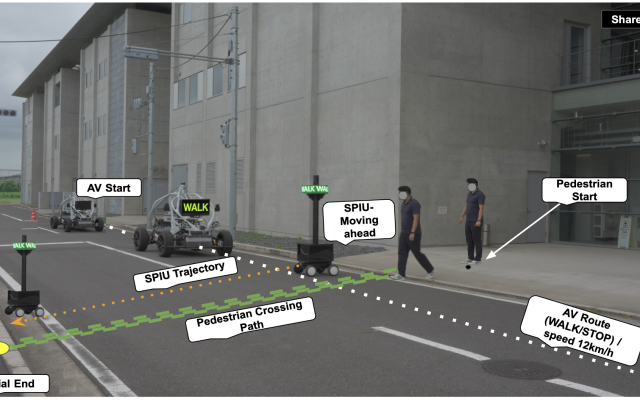
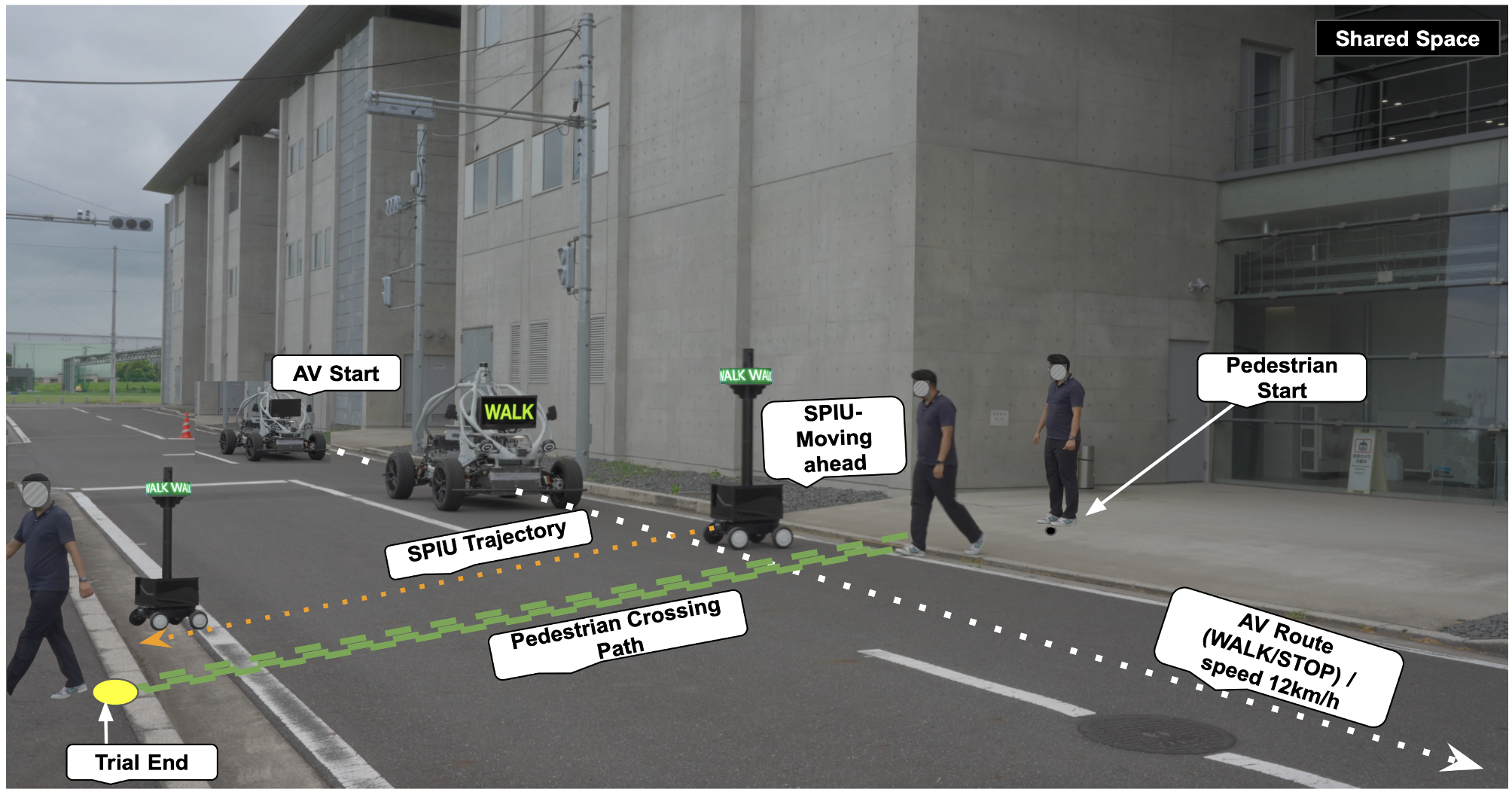
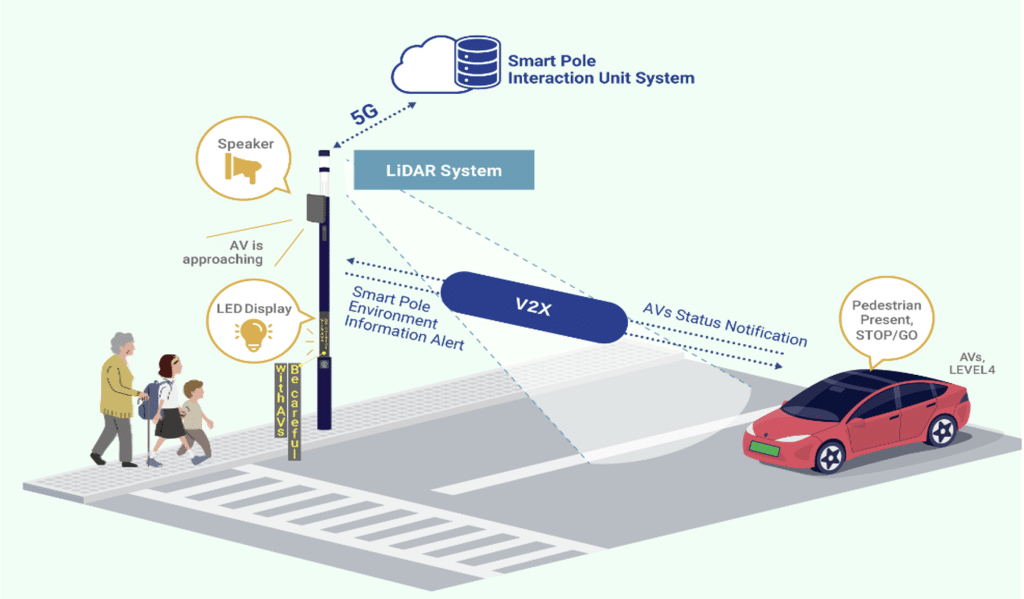
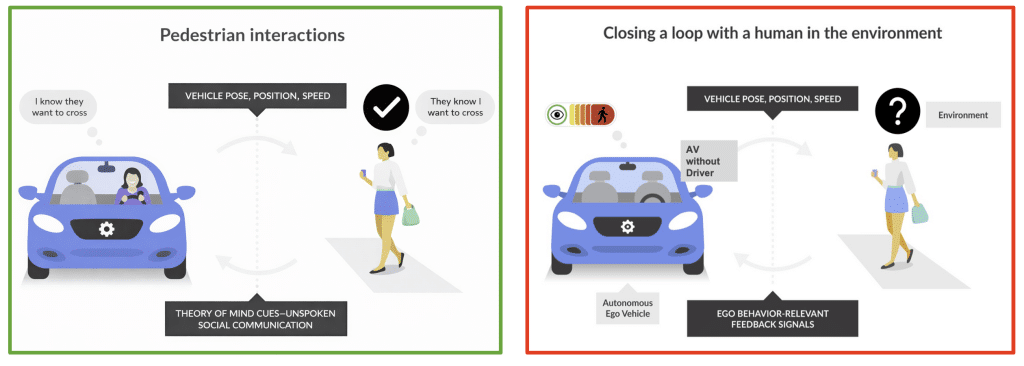
As autonomous vehicles move into pedestrian-centered urban spaces, communication becomes as important as perception and control. In shared spaces, pedestrians, cyclists, and vehicles negotiate movement informally, often without strong lane separation or conventional traffic signals. Once the human driver disappears, pedestrians lose the social cues they normally rely on, such as eye contact, gestures, and informal yielding behavior. This project addresses that communication gap through the Smart Pole Interaction Unit (SPIU), an infrastructure-side interface that works alongside vehicle-mounted eHMIs to provide synchronized pedestrian-facing signals near the point of interaction.
The project began with early concept development and validation. The 2023 IEEE WFIoT paper introduced the idea of using SPIU to ease pedestrian cognitive load in shared spaces, and the 2023 Electronics paper provided formal concept validation through immersive VR experiments. These early studies showed that when intent communication is shifted from a moving vehicle alone to a clear roadside mediator, pedestrians can interpret AV behavior more quickly and with less uncertainty. This established the central idea that shared-space communication should be organized around the negotiation region, not only around the vehicle.
The next stage focused on what SPIU should actually communicate and how it should be designed. Through expert discussions, scenario sketches, and comparisons with multimodal LLM-generated proposals, the research mapped where human expectations and AI suggestions converged and diverged for safe pedestrian-AV interaction. This phase transformed SPIU from a simple signaling concept into a richer multimodal framework that can combine clear visual messages with complementary elements such as audio feedback, sensing, LiDAR, and V2X-based coordination. It also clarified an important design principle: SPIU is most valuable when it complements vehicle eHMI rather than replaces it.
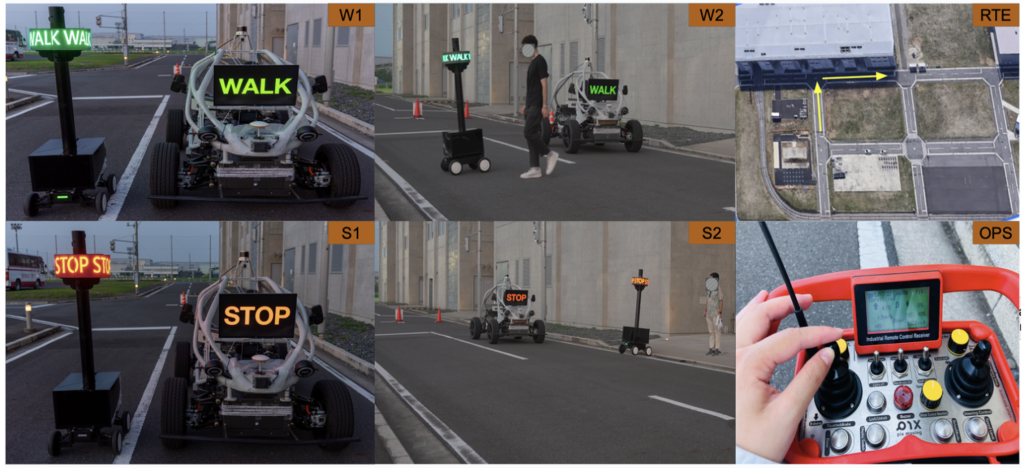
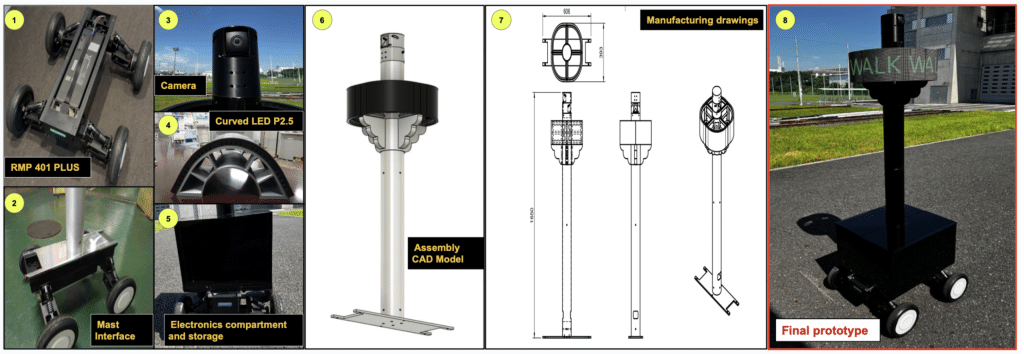
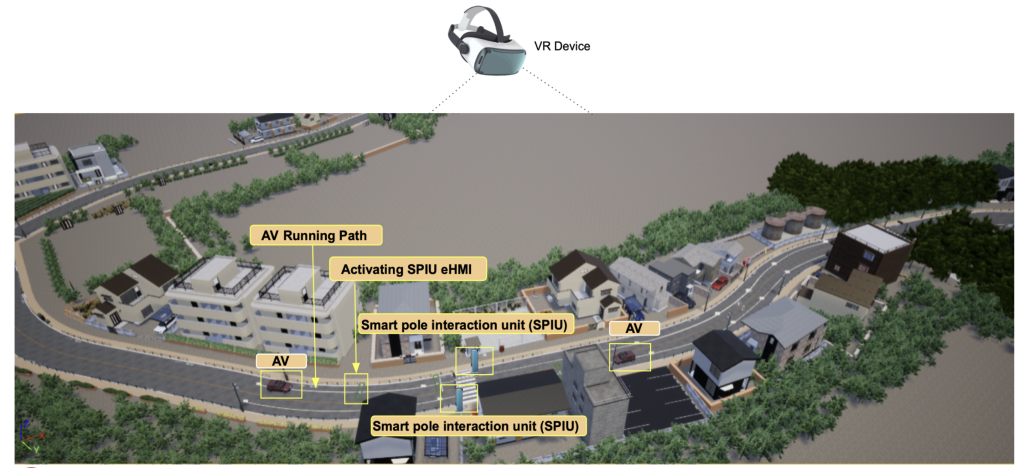
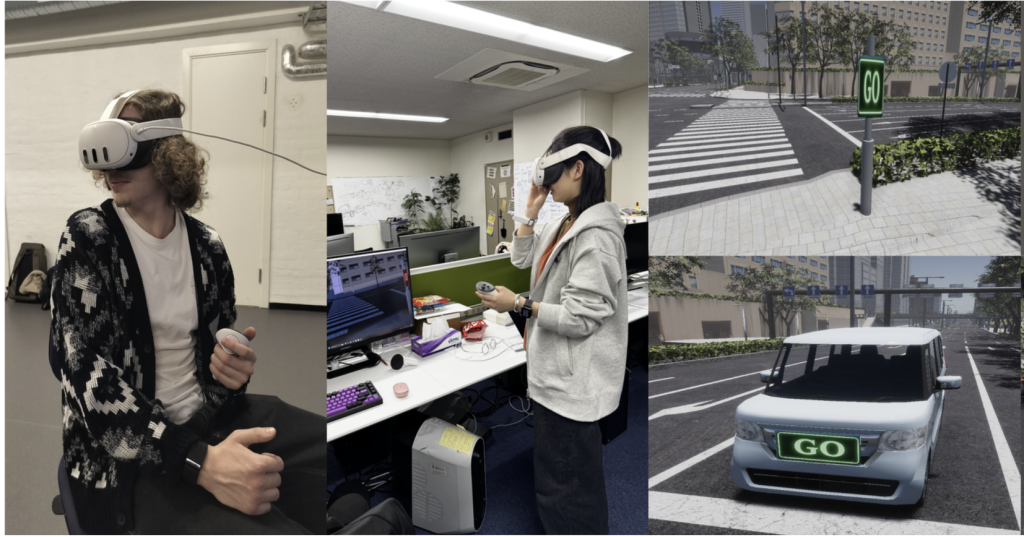
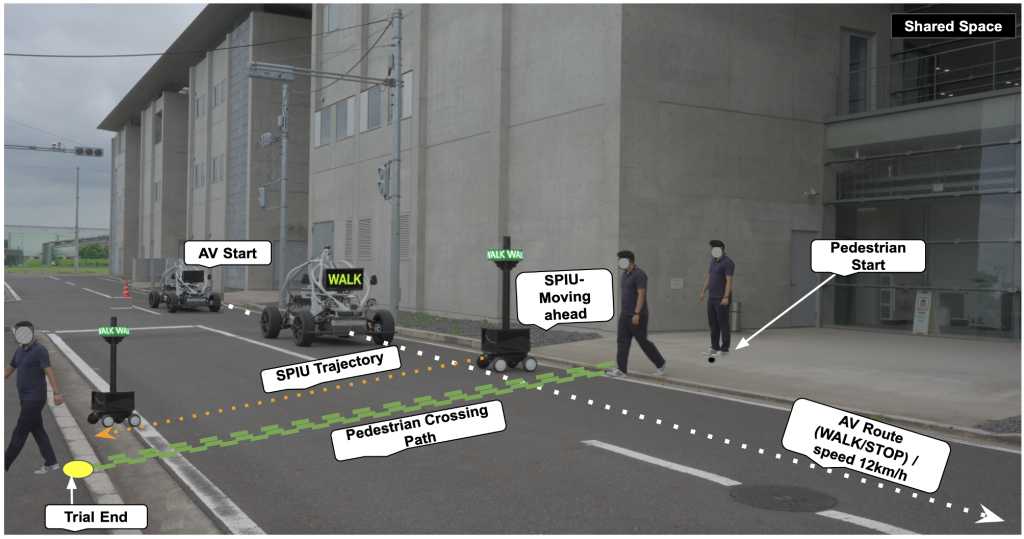
Recent progress has extended the project beyond conceptual and lab-based studies into cross-cultural and real-world evaluation. In a VR-AWSIM framework developed in Japan and replicated in Norway, SPIU improved pedestrian decision-making across high-risk situations such as four-way intersections, blindspots, mixed traffic with delivery robots, and nighttime crossings. Most recently, a mobile SPIU prototype was built and evaluated in an outdoor shared-space study, where SPIU improved understandability, trust, and perceived safety, with the strongest results observed when SPIU and vehicle eHMI were used together. Together with related work on shared-space visual design, these studies position SPIU as a practical infrastructure-side interface for future pedestrian-AV ecosystems and point toward richer multimodal, accessible, and deployable communication in real cities.
@inproceedings{Chauhan2026,
title = {Colored Shared Spaces (CSS): How Visual Design Transforms Pedestrian Experiences},
author = {Vishal Chauhan and Anubhav Anubhav and Chia Ming Chang and Ehsan Javanmardi and Takeo Igarashi and Alex Orsholits and Kantaro Fujiwara and Manabu Tsukada},
year = {2026},
date = {2026-07-26},
urldate = {2026-07-16},
booktitle = {28th International Conference on Human-Computer Interaction (HCII2026)},
address = {Montreal, Canada},
keywords = {},
pubstate = {published},
tppubtype = {inproceedings}
}
@inproceedings{Chauhan2026b,
title = {Don't Worry, Just Follow Me: Prototyping and In-the-Wild Evaluation of Smart Pole Interaction Unit with Mobility},
author = {Vishal Chauhan and Anubhav Anubhav and Mark Colley and Chia-Ming Chang and Xinyue Gui and Ding Xia and Ehsan Javanmardi and Takeo Igarashi and Kantaro Fujiwara and Manabu Tsukada},
url = {https://www.researchgate.net/profile/Vishal-Chauhan-17/publication/401082338_Don\\\\\\\'t_Worry_Just_Follow_Me_Prototyping_and_In-the-Wild_Evaluation_of_Smart_Pole_Interaction_Unit_with_Mobility/links/699c56575d60ab483570b3d5/Dont-Worry-Just-Follow-Me-Prototyping-and-In-the-Wild-Evaluation-of-Smart-Pole-Interaction-Unit-with-Mobility.pdf},
doi = {10.1145/3772318.3790882},
year = {2026},
date = {2026-04-13},
urldate = {2026-04-13},
booktitle = {ACM CHI conference on Human Factors in Computing Systems 2026},
address = {Barcelona, Spain},
abstract = {Pedestrian–automated vehicle(AV) encounters in shared spaces often involve hesitation and ambiguity. Vehicle-mounted external human–machine interfaces(eHMIs) can help, but obscured or poorly timed communications create significant challenges. To address this, we present a mobile smart pole interaction unit(SPIU) with integrated cameras and LED displays, designed as a pedestrian-side system to deliver explicit cues(``WALK,'' ``STOP''). An in-the-wild evaluation of the SPIU(N=21) using a four-factor analysis (CarBehavior, Mobility, eHMI, SPIU) showed that the SPIU improved understandability, trust, and perceived safety, and reduced workload compared with the baseline, with a combination(eHMI+SPIU) yielding the strongest results. Beyond these quantitative benefits, participants appreciated the mobility of the SPIU for its ``clear'' and ``easy to decide'' mediation. This work contributes to(1) a design and deployment framework for a mobile SPIU and(2) an in-the-wild evaluation protocol for pedestrian–AV interactions in nonsignalized spaces. Our work sparks discussions on real world evaluations involving detailed vehicle kinematics and accessible multimodality(e.g., audio), focusing on the role of personal robots as user-side eHMIs.},
note = {Honourable Mention Award},
keywords = {},
pubstate = {published},
tppubtype = {inproceedings}
}
@inproceedings{Chauhan2025b,
title = {A Silent Negotiator? Cross-cultural VR Evaluation of Smart Pole Interaction Units in Dynamic Shared Spaces},
author = {Vishal Chauhan and Anubhav Anubhav and Robin Sidhu and Yu Asabe and Kanta Tanaka and Chia-Ming Chang and Xiang Su and Dr. Ehsan Javanmardi and Takeo Igarashi and Alex Orsholits and Kantaro Fujiwara and Manabu Tsukada},
url = {https://github.com/tlab-wide/Smartpole-VR-AWSIM.git},
doi = {10.1145/3756884.3765991},
year = {2025},
date = {2025-11-12},
urldate = {2025-11-12},
booktitle = {The ACM Symposium on Virtual Reality Software and Technology (VRST2025) },
address = {Montreal, Canada},
abstract = {As autonomous vehicles (AVs) enter pedestrian-centric environments, existing vehicle-mounted external human–machine interfaces (eHMIs) often fall short in shared spaces due to line-of-sight limitations, inconsistent signaling, and increased cognitive burden on pedestrians. To address these challenges, we introduce the Smart Pole Interaction Unit (SPIU), an infrastructure-based eHMI that decouples intent signaling from vehicles and provides context-aware, elevated visual cues. We evaluate SPIU using immersive VR-AWSIM simulations in four high-risk urban scenarios: four-way intersections, autonomous mixed traffic, blindspots, and nighttime crosswalks. The experiment was developed in Japan and replicated in Norway, where forty participants engaged in 32 trials each under both SPIU-present and SPIU-absent conditions. Behavioral (response time) and subjective (acceptance scale) data were collected. Results show that SPIU significantly improves pedestrian decision-making, with reductions ranging from 40% to over 80% depending on scenario and cultural context, particularly in complex or low-visibility scenarios. Cross-cultural analyses highlight SPIU's adaptability across differing urban and social contexts. We release our open-source Smartpole-VR-AWSIM framework to support reproducibility and global advancement of infrastructure-based eHMI research through reproducible and immersive behavioral studies.},
keywords = {},
pubstate = {published},
tppubtype = {inproceedings}
}
@article{Chauhan2025,
title = {Towards the Future of Pedestrian-AV Interaction: Human Perception vs. LLM Insights on Smart Pole Interaction Unit in Shared Spaces},
author = {Vishal Chauhan and Anubhav Anubhav and Chia-Ming Chang and Xiang Su and Jin Nakazato and Ehsan Javanmardi and Alex Orsholits and Takeo Igarashi and Kantaro Fujiwara and Manabu Tsukada},
doi = {10.1016/j.ijhcs.2025.103628},
isbn = {1071-5819},
year = {2025},
date = {2025-09-13},
urldate = {2025-09-13},
journal = {International Journal of Human–Computer Studies (IJHCS)},
volume = {205},
pages = {103628},
abstract = {As autonomous vehicles (AVs) reshape urban mobility, establishing effective communication between pedestrians and self-driving vehicles has become a critical safety imperative. This work investigates the integration of Smart Pole Interaction Units (SPIUs) as external human–machine interfaces (eHMIs) in shared spaces and introduces an innovative approach to enhance pedestrian–AV interactions. To provide subjective evidence on SPIU usability, we conduct a group design study (“Humans”) involving 25 participants (aged 18–40). We evaluate user preferences and interaction patterns using group discussion materials, revealing that 90% of the participants strongly prefer real-time multi-AV interactions facilitated by SPIU over conventional eHMI systems, where a pedestrian must look at multiple AVs individually. Furthermore, they emphasize inclusive design through multi-sensory communication channels—visual, auditory, and tactile signals—specifically addressing the needs of vulnerable road users (VRUs), including those with impairments. To complement these non-expert, real-world insights, we employ three leading Large Language Models (LLMs) (ChatGPT-4, Gemini-Pro, and Claude 3.5 Sonnet) as “experts” due to their extensive training data. Using the advantages of the multimodal vision-language processing capabilities of these LLMs, identical questions (text and images) used in human discussions are posed to generate text responses for pedestrian–AV interaction scenarios. Responses generated from LLMs and recorded conversations from human group discussions are used to extract the most frequent words. A keyword frequency analysis from both humans and LLMs is performed with three categories, Context, Safety, and Important. Our findings indicate that LLMs employ safety-related keywords 30% more frequently than human participants, suggesting a more structured, safety-centric approach. Among LLMs, ChatGPT-4 demonstrates superior response latency, Claude shows a closer alignment with human responses, and Gemini-Pro provides structured and contextually relevant insights. Our results from “Humans” and “LLMs” establish SPIU as a promising system for facilitating trust-building and safety-ensuring interactions among pedestrians, AVs, and delivery robots. Integrating diverse stakeholder feedback, we propose a prototype SPIU design to advance pedestrian–AV interactions in shared urban spaces, positioning SPIU as crucial infrastructure hubs for safe and trustworthy navigation.},
keywords = {},
pubstate = {published},
tppubtype = {article}
}
@inproceedings{Chauhan2024b,
title = {Connected Shared Spaces: Expert Insights into the Impact of eHMI and SPIU for Next-Generation Pedestrian-AV Communication},
author = {Vishal Chauhan and Anubhav Anubhav and Chia-Ming Chang and Jin Nakazato and Ehsan Javanmardi and Alex Orsholits and Takeo Igarashi and Kantaro Fujiwara and Manabu Tsukada},
doi = {10.1145/3732437.3732752},
year = {2024},
date = {2024-11-28},
urldate = {2024-11-28},
booktitle = {International Conference on Intelligent Computing and its Emerging Applications (ICEA2024)},
pages = {16 - 20},
address = {Tokyo, Japan},
abstract = {Increasing prevalence of Autonomous Vehicles (AVs) necessitates efficient communication with susceptible road users, especially pedestrians, in communal urban areas. To improve pedestrians’ trust and safety, Smart Pole Interaction Units (SPIU) and external Human-Machine Interfaces (eHMI) have become crucial interfaces. In this study, we ask 12 automotive UI design experts to evaluate eHMI, SPIU, and eHMI+SPIU through an online survey. They evaluated the interfaces’ effects on five key parameters: Safety, Seamless, Adaptability, Accessibility, and Trust. Our findings show that eHMI stands out for its smooth integration (Seamless), whereas SPIU is favoured for fostering Safety, Adaptability, Accessibility, and Trust. Furthermore, an integrated eHMI+SPIU solution is rated higher than individual eHMI and SPIU. In particular, when several AVs interact, the best way to promote pedestrian trust is to employ eHMI in conjunction with SPIU. This study highlights the benefits of SPIU as a centralised information hub for reliable pedestrian communication and presents innovative design considerations for eHMI on AVs in shared spaces. The results provide a framework for more practical testing of these systems to create safe, inclusive, and human-centric pedestrian-AV interactions in various urban environments beyond shared spaces.},
keywords = {},
pubstate = {published},
tppubtype = {inproceedings}
}
@inproceedings{Chauhan2024,
title = {Transforming Pedestrian and Autonomous Vehicles Interactions in Shared Spaces: A Think-Tank Study on Exploring Human-Centric Designs},
author = {Vishal Chauhan and Anubhav Anubhav and Chia-Ming Chang and Jin Nakazato and Ehsan Javanmardi and Alex Orsholits and Takeo Igarashi and Kantaro Fujiwara and Manabu Tsukada
},
doi = {10.1145/3641308.3685037},
year = {2024},
date = {2024-09-22},
urldate = {2024-09-22},
booktitle = {16th International ACM Conference on Automotive User Interfaces and Interactive Vehicular Applications (AutoUI 2024), Work in Progress (WiP)},
pages = {1-8},
address = {California, USA},
abstract = {Our research focuses on the smart pole interaction unit (SPIU) as an infrastructure external human-machine interface (HMI) to enhance pedestrian interaction with autonomous vehicles (AVs) in shared spaces. We extensively study SPIU with external human-machine interfaces (eHMI) on AVs as an integrated solution. To discuss interaction barriers and enhance pedestrian safety, we engaged 25 participants aged 18-40 to brainstorm design solutions for pedestrian-AV interactions, emphasising effectiveness, simplicity, visibility, and clarity. Findings indicate a preference for real-time SPIU interaction over eHMI on AVs in multiple AV scenarios. However, the combined use of SPIU and eHMI on AVs is crucial for building trust in decision-making. Consequently, we propose innovative design solutions for both SPIU and eHMI on AVs, discussing their pros and cons. This study lays the groundwork for future autonomous mobility solutions by developing human-centric eHMI and SPIU prototypes as ieHMI.},
keywords = {},
pubstate = {published},
tppubtype = {inproceedings}
}
@inproceedings{Chauhan2023,
title = {Keep Calm and Cross: Smart Pole Interaction Unit for Easing Pedestrian Cognitive Load},
author = {Vishal Chauhan and Chia-Ming Chang and Ehsan Javanmardi and Jin Nakazato and Koki Toda and Pengfei Lin and Takeo Igarashi and Manabu Tsukada},
url = {https://www.researchgate.net/profile/Jin-Nakazato/publication/374582122_Keep_Calm_and_Cross_Smart_Pole_Interaction_Unit_for_Easing_Pedestrian_Cognitive_Load/links/6525681eb32c91681fb2e1b5/Keep-Calm-and-Cross-Smart-Pole-Interaction-Unit-for-Easing-Pedestrian-Cognitive-Load.pdf},
doi = {10.1109/WF-IoT58464.2023.10539511},
year = {2023},
date = {2023-10-12},
urldate = {2023-10-12},
booktitle = {The 9th IEEE World Forum on Internet of Things (IEEE WFIoT2023)},
address = {Aveiro, Portugal},
abstract = {Recently, there has been a growing emphasis on autonomous vehicles (AVs), and as they coexist with pedestrians, ensuring pedestrian safety at crosswalks has become paramount. While AVs exhibit commendable performance on traditional roads with established traffic infrastructure, their interaction in different environments, such as shared spaces lacking traffic lights or sign rules (also known as naked streets), can present significant challenges, including right-of-way and accessibility concerns. To address these challenges, this study proposes a novel approach to enhance pedestrian safety in shared spaces, focusing on the proposed smart pole interaction unit (SPIU) combined with an external human-machine interface (eHMI). By evaluating the proposal of SPIU developed by a virtual reality system, we explore its usability and effectiveness in facilitating vehicle-to-pedestrian (V2P) interactions at crosswalks. Our findings from this study showed that SPIU facilitates safe, quicker decision-making to stop and pass at crosswalks in shared space and reduces cognitive load compared to scenarios where an SPIU is absent for pedestrians and reduce the need for eHMI to see on multiple AVs. The SPIU addition with the eHMI in vehicles yields a noteworthy 21 % improvement in response time, enhancing efficiency during pedestrian stops. In both scenarios, whether with a single AV (1-way) or multiple AVs (2-way), SPIU has a positive impact on interaction dynamics and statistically demonstrates a significant improvement (p = 0.001). },
keywords = {},
pubstate = {published},
tppubtype = {inproceedings}
}
@article{Chauhan2023c,
title = {Fostering Fuzzy Logic in Enhancing Pedestrian Safety: Harnessing Smart Pole Interaction Unit for Autonomous Vehicle-to-Pedestrian Communication and Decision Optimization},
author = {Vishal Chauhan and Chia-Ming Chang and Ehsan Javanmardi and Jin Nakazato and Pengfei Lin and Takeo Igarashi and Manabu Tsukada},
url = {https://www.mdpi.com/2079-9292/12/20/4207},
doi = {10.3390/electronics12204207},
issn = {2079-9292},
year = {2023},
date = {2023-10-11},
urldate = {2023-10-11},
journal = {Electronics},
volume = {12},
number = {20},
abstract = {In autonomous vehicles (AVs), ensuring pedestrian safety within intricate and dynamic settings, particularly at crosswalks, has gained substantial attention. While AVs perform admirably in standard road conditions, their integration into unique environments like shared spaces devoid of traditional traffic infrastructure control presents complex challenges. These challenges involve issues of right-of-way negotiation and accessibility, particularly in “naked streets”. This research delves into an innovative smart pole interaction unit (SPIU) with an external human–machine interface (eHMI). Utilizing virtual reality (VR) technology to evaluate the SPIU efficacy, this study investigates its capacity to enhance interactions between vehicles and pedestrians at crosswalks. The SPIU is designed to communicate the vehicles’ real-time intentions well before arriving at the crosswalk. The study findings demonstrate that the SPIU significantly improves secure decision making for pedestrian passing and stops in shared spaces. Integrating an SPIU with an eHMI in vehicles leads to a substantial 21% reduction in response time, greatly enhancing the efficiency of pedestrian stops. Notable enhancements are observed in unidirectional (one-way) and bidirectional (two-way) scenarios, highlighting the positive impact of the SPIU on interaction dynamics. This work contributes to AV–pedestrian interaction and underscores the potential of fuzzy-logic-driven solutions in addressing complex and ambiguous pedestrian behaviors.},
keywords = {},
pubstate = {published},
tppubtype = {article}
}
autonomous driving v2x
v2x
digital twins extended reality
digital twins
autonomous driving machine learning
machine learning v2x
autonomous driving v2x
extended reality
We are part of the University of Tokyo’s Graduate School of Information Science and Technology, Department of Creative Informatics and focuses on computer networks and cyber-physical systems
Address
4F, I-REF building, Graduate School of Information Science and Technology, The University of Tokyo, 1-1-1, Yayoi, Bunkyo-ku, Tokyo, 113-8657 Japan
Room 91B1, Bld 2 of Engineering Department, The University of Tokyo, 7-3-1 Hongo, Bunkyo-ku, Tokyo 113-8656, Japan
Mail: